- Downloads
- Sounds
- projects.esu.eu
- LokSound 5 North American and Australian Sound files
#90 SCR BLW 2-10-0  H0 N XL L M4
- Article numbers:S0799
- Last change: 9/29/2026
- Manufacturer: ESU

Strasburg Rail Road (Great Western) No. 90 is a 2-10-0 "Decapod" type steam locomotive owned and operated by the Strasburg Rail Road outside of Strasburg, Pennsylvania. Built by the Baldwin Locomotive Works in 1924, No. 90 originally pulled sugar beet trains for the Great Western Railway of Colorado. In 1967, No. 90 was sold to the Strasburg Rail Road where it now resides and operates today for use on excursion trains. As of today, No. 90 is one of only two operational Decapod type steam locomotives in America, the other being Frisco No. 1630 at the Illinois Railway Museum in Union, Illinois.
The locomotive was built by the Baldwin Locomotive Works in June 1924, in Philadelphia. it originally pulled sugar beet trains of about 40 to 50 cars length for the Great Western Railway of Colorado to the company's towering mill in Loveland, Colorado. It was the Great Western's largest and most powerful road locomotive, and saw extensive use on trains too large for the company's fleet of 2-8-0s. On November 7, 1944, the engine was hit by a truck at a grade crossing east of Loveland and knocked onto its fireman's side, killing both the fireman and the truck driver. The Great Western sent 90 to the Chicago, Burlington and Quincy Railroad's shops in Denver for repairs. Following WWII, the locomotive was used primarily in the Autumn during the harvest season.
By the late 1950s, the engine was occasionally used in excursion service on the Great Western. In 1963, No. 90 pulled a few special excursions for that year's National Railway Historical Society Convention, were it was held in Denver at the time. On one such excursion, Strasburg Rail Road's Chief Mechanical Officer, Huber Leath, met the Great Western's superintendent, a man who grew up in the vicinity of the Strasburg Rail Road and struck a deal in which the Great Western would contact the Strasburg Rail Road as soon as the engine was available for purchase. The Strasburg Rail Road purchased No. 90 on April 5, 1967, for a price of $23,000.00(~$175,000 in 2019) and the locomotive arrived on Strasburg's property a month later on May 5, 1967.
In the winter of 1968, Ross Rowland's High Iron Company planned to operate a series of mainline steam excursions between Jersey City, New Jersey and Wilkes-Barre, Pennsylvania on the Central Railroad of New Jersey. Rowland had originally planned to lease two ex Canadian Pacific G5-class 4-6-2s, numbers 1238 and 1286, both owned by George M. Hart. However, those two locomotives were on emergency leases to the city of Reading, Pennsylvania to provide steam for the city after the boiler at the Reading Steam Heat and Power Co. became disabled. Since tickets for the excursion had already been sold, and Rowland was unwilling to pull the trip with a diesel, he leased Steamtown's ex Canadian Pacific 127 (formerly 1278), a sister to the two locomotives he intended to use to pull the train. However, the 127 did not have enough power to pull the train over the grades on the CNJ near Jim Thorpe, Pennsylvania on her own and Rowland leased the 90 to act as a helper engine for the trips, double-heading with the 127 between Bethlehem and Jim Thorpe, Pennsylvania. After the trips concluded, No. 90 was returned to Strasburg.
As it was on the Great Western, the engine is also the most powerful of the four steam locomotives in operation at the Strasburg Rail Road in Lancaster County, Pennsylvania, rated for 1,211 tons on the line. It is currently one of the only two 2-10-0 Decapods operating in the United States, the other one is former Frisco No. 1630, which operates at the Illinois Railway Museum.
No. 90 has had numerous modifications during its time at Strasburg, the most recent being in 2013, in which it was repainted in a new paint scheme similar to what it originally wore back in the 1990s. Differences include the yellow pin striping and lettering, which is currently painted / stenciled in white. Its smokebox was painted silver, and its number plate was black. In 2015, No. 90 went through another modification, where its smokebox color changed from silver to brown. After this modification, 90 was to return to service in February 2016. As of January 2023, No. 90 is still operational, but in early 2024, it is currently undergo its Federal Railroad Administration (FRA) federally mandated 1,472-day boiler inspection and overhaul.
Whistles:
CV163=0 SCR #90
CV163=1 SP&S 3-Chime
CV163=2 PRR 3-Chime
CV163=3 NKP #765
CV163=4 MILW #261
CV163=5 Hooter
CV163=6 Hancock Long Bell 3-Chime
CV163=7 DRGW #346
Bells:
CV164=0 #90 SCR Bell 1
CV164=1 Pnuematic Bell 2
CV164=2 Rope Pull Bell
CV164=3 SOO Line 1003 Bell
Brake Squeal:
CV165=0 Brake Squeal #1 Long
CV165=1 Brake Squeal #1 Short
CV165=2 Brake Squeal #2 Long
CV165=3 Brake Squeal #2 Short
CV165=4 Brake Squeal #3 Long
CV165=5 Brake Squeal #4Short
Dynamos:
CV166=0 SCR #90 Dynamo
CV166=1 K27 463 Dynamo
Air Pumps
CV167=0 Cross Compound #1 Soo Line 1003
CV167=1 Cross Compound #2 K27 463
CV167=2 Single Stage #1 Z27
CV167=3 SCR #90
Reversers
CV168=0 Johnson Bar
CV168=1 Power Reverse
The ESU Full Throttle Steam files now include a few new logic features for added operational realism while still leaving you in control of HOW YOU wish to run your locomotive.
Heavy Load: F9 by default.
Similar to the “Drive Hold” button on the Full Throttle Diesel files “Heavy Load” allows you to adjust the “Steam Cut Off Valve” at any speed allowing for a fierce full chuff or drifting with snifters and rod clanks. Heavy load can also act as an offset allowing speed adjustments when engaged if desired.
Coast: F4 by default.
Opposite of “Heavy Load” Coast allows for a negative offset allow drifting sounds of Rods and snifter valves at any speed. You again have the option to hold the speed to adjust the speed with this offset active. Even allowing for an increase of speed with no chuffs as if drifting downhill.
Independent brake: F10 by default
Identical to the Full Throttle Diesel files. This allows for the locomotive to stop more quickly than its regular momentum would normally carry it. This one is pretty self-explanatory – just press the brake and come to a stop! For additional options there are 3 Braking rates that can be set up for user preference.
Articulation: Sound Slot 2
By adding Sound Slot 2 to the F8 Function Mapping and enabling the "Secondary Trigger" (CV250) you can add a second set of drivers making any ESU Steam File articulated.
Function Mappable Air Horn: F21 by default
Sound Slot 21.
Many Steam locomotives had a single chime airhorn equipped. Those modelling SP, MILW, and others can now have this feature and put it where they would like in the function mapping in addition to the whistle.
S0799 - Release Notes
===================================================
V-1 R-1:
===================================================
- new project
V-2 R-2:
===================================================
-remastered the SCR #90 whistle Hide description more…
H0 N XL L M4
- Article numbers
- S0799
- Last change
- 9/29/2026
- Manufacturer
- ESU
EMD 16-645E 2EXH NT Ed3 H0 N XL L M4
- Article numbers:S0777
- Last change: 9/24/2026
- Manufacturer: ESU

The EMD 645 family of diesel engines were designed and manufactured by the Electro-Motive Division of General Motors. The 645 series was an evolution of the earlier 567 series and a precursor to the later 710 series. The 645 series engines entered production in 1965. All 645 engines utilize forced induction, with either a Roots blower or a turbocharger. The 645 series has a maximum engine speed of between 900 and 950 revolutions per minute (rpm), an increase over the 800 to 900 rpm maximum speed for the 567 series.
Locomotives:
GP38, GP38AC, GP38-2, GP38-2L, GP38-2W, SD38, SD38-2, NSWGR 422 Class, Victorian Railways X Class, EMD G26
Recorded from a EMD SD38
This project is a normal idle version. It has 2 exhaust stacks.
File also contains an "Isolation Switch" Mode on F15 when Standing Still.
Pressing F15 while not moving will lower the prime mover and lock the motor. F15 must be turned off to begin moving.
Another Mode is "Reverser In Center Position". When pressing F24 while stopped, the motor will lock so you can throttle through the notches like the prototype in neutral. F24 must be turned off to begin moving.
This project has "Run 8" mode. When turning on F26 with F28 off, the prime mover goes to run 8. Turning off F26 returns the prime mover sounds back to normal mode.
This project has "Coast" mode. When turning on F27 with F28 off, the prime mover goes to idle for coasting purposes. Turning off F27 returns the prime mover sounds back to normal mode.
You can still use F26 and F27 for manual notching. You have to keep both F26 and F27 off before pressing F28 to turn on manual notching. Once F28 is on, you can use F26 to notch up and F27 to notch down. F26, F27, and F28 must be turned off to return to normal mode.
This project has "Load" mode. When turning on F29 with F15, F24, F26, F27, F28 off, the prime mover goes into load mode. While you are using load mode, the prime mover will notch up 1 or more notches based on primary load settings(CV104). The throttle notches up using speed instead of requested speed while using the load feature. F29 must be turned off to return to normal mode.
Prime mover volume selection mode. By default the prime mover has volume dynamics. Meaning idle is soft while notch 8 is loud. This is very prototypical. The next option is volume maxed out. Meaning idle and notch 8 are the same volume. This is more suitable for people who like it loud.
Change the sound configuration of the prime mover sound slot 1
CV31 = 16, CV32 = 1
----------------------
CV263 = 0 Prime Mover Dynamic Volume Control
CV263 = 1 Prime Mover Max Volume
2nd Generation Horn Pack 1
Horns (SoundCV9):
CV163=0 Leslie S-3K-R
CV163=1 Leslie RS-3L-R
CV163=2 Leslie S-5T-F
CV163=3 Leslie S-5T-R
CV163=4 Nathan K-3H
CV163=5 Nathan K-3L
CV163=6 Nathan K-3LA
CV163=7 Nathan K-5H
CV163=8 Nathan K-5LA
CV163=9 Nathan K-5LA-R24
CV163=10 Nathan M-3
CV163=11 Nathan M-3H
CV163=12 Nathan P-3
CV163=13 Nathan P-5-R24
EMD 2nd Generation Bell Template Pack 3
Bells (SoundCV10):
CV164=0 EMD 8004156 Steel Bell 057
CV164=1 EMD 8475495 Bronze Bell 005
CV164=2 EMD 8475495 Bronze Bell 039
CV164=3 EMD 8004156 Steel Bell 059
CV164=4 EMD 8475495 Bronze Bell 045
CV164=5 UKM B443 Steel Bell 004
Auto Bell:
Many Second and Third Generation locomotives have been fitted with an Automatic Bell that is triggered when the horn is blown. In MANY cases this cannot even be bypassed on modern locos. Before the FRA mandated this feature on new locomotives the bell was of course turned on and off separately. Some locomotives were delivered with a manual bell and have been converted to an automatic bell. This creates a challenge in sound file creation.
We realize that not every loco with a particular prime mover had this feature. As such we have built in an option to turn the feature on and off. We will set the default in the file to be what is most appropriate for the particular file.
To turn the feature OFF - Auto Bell OFF:
1. Remove the Auto bell sound slot from the function mapping chart
CV31 = 16, CV32 = 8
----------------------
CV311 = 4
2. Change the sound configuration of the Auto bell sound slot
CV31 = 16, CV32 = 1
----------------------
CV287 = 0
To turn the feature ON - Auto Bell ON:
1. ADD the Auto bell sound slot from the function mapping chart
CV31 = 16, CV32 = 8
----------------------
CV311 = 12
2. Change the sound configuration of the Auto bell sound slot
CV31 = 16, CV32 = 1
----------------------
CV287 = 1
Auto Bell Timer:
The Bell timer is amount of time the bell will play after the horn if the auto timer is active. The timer is broken down into 1/4 of a second increments.
CV169=4 - 1 Second
CV169=8 - 2 Seconds
CV169=12 - 3 Seconds
CV169=16 - 4 Seconds
CV169=20 - 5 Seconds - Default
Etc...
2nd Generation Brake Squeal Template Pack 1
Brake Squeal (SoundCV11)
CV165=0 Composition Shoe
CV165=1 Cast Iron Shoe
EMD 2nd Generation Air Dryer Template Pack 3
Air Dryer (SoundCV12)
CV166=0 GP39 Air Dryer 1
CV166=1 GP39-2 Air Dryer 1
CV166=2 SD38 Air Dryer 1
CV166=3 SD38-2 Air Dryer 1
S0777 - Release Notes
===================================================
V-3 R-3:
===================================================- remastered prime mover
- prime mover volume selection mode
- brake 1 and 2 settings change
- brake set/release change
- traction motor update
- starting delay timer from CV13 = 13 to CV13 = 8 Hide description more…
H0 N XL L M4
- Article numbers
- S0777
- Last change
- 9/24/2026
- Manufacturer
- ESU
EMD 16-645E 2EXH NT Ed2 H0 N XL L M4
- Article numbers:S0721
- Last change: 9/24/2026
- Manufacturer: ESU

The EMD 645 family of diesel engines were designed and manufactured by the Electro-Motive Division of General Motors. The 645 series was an evolution of the earlier 567 series and a precursor to the later 710 series. The 645 series engines entered production in 1965. All 645 engines utilize forced induction, with either a Roots blower or a turbocharger. The 645 series has a maximum engine speed of between 900 and 950 revolutions per minute (rpm), an increase over the 800 to 900 rpm maximum speed for the 567 series.
Locomotives:
GP38, GP38AC, GP38-2, GP38-2L, GP38-2W, SD38, SD38-2, NSWGR 422 Class, Victorian Railways X Class, EMD G26
Recorded from a EMD GP38-2
This project is a normal idle version. It has 2 exhaust stacks.
File also contains an "Isolation Switch" Mode on F15 when Standing Still.
Pressing F15 while not moving will lower the prime mover and lock the motor. F15 must be turned off to begin moving.
Another Mode is "Reverser In Center Position". When pressing F24 while stopped, the motor will lock so you can throttle through the notches like the prototype in neutral. F24 must be turned off to begin moving.
This project has "Run 8" mode. When turning on F26 with F28 off, the prime mover goes to run 8. Turning off F26 returns the prime mover sounds back to normal mode.
This project has "Coast" mode. When turning on F27 with F28 off, the prime mover goes to idle for coasting purposes. Turning off F27 returns the prime mover sounds back to normal mode.
You can still use F26 and F27 for manual notching. You have to keep both F26 and F27 off before pressing F28 to turn on manual notching. Once F28 is on, you can use F26 to notch up and F27 to notch down. F26, F27, and F28 must be turned off to return to normal mode.
This project has "Load" mode. When turning on F29 with F15, F24, F26, F27, F28 off, the prime mover goes into load mode. While you are using load mode, the prime mover will notch up 1 or more notches based on primary load settings(CV104). The throttle notches up using speed instead of requested speed while using the load feature. F29 must be turned off to return to normal mode.
Prime mover volume selection mode. By default the prime mover has volume dynamics. Meaning idle is soft while notch 8 is loud. This is very prototypical. The next option is volume maxed out. Meaning idle and notch 8 are the same volume. This is more suitable for people who like it loud.
Change the sound configuration of the prime mover sound slot 1
CV31 = 16, CV32 = 1
----------------------
CV263 = 0 Prime Mover Dynamic Volume Control
CV263 = 1 Prime Mover Max Volume
This file is also equipped with a Smart Start feature that cycles the prime mover on and off at intervals of your choice if the throttle is left at Idle and the loco is stopped.
Smart Start (Sound CV14):
CV168=0 No Smart Start Cycle - Default
CV168=1 - 1 Minute Cycle Engine On & 1 Minute Cycle Engine Off
CV168=2 - 2 Minute Cylcle Engine On & 2 Minute Cycle Engine Off
CV168=3 - 3 Minute Cylcle Engine On & 3 Minute Cycle Engine Off
CV168=4 - 4 Minute Cylcle Engine On & 4 Minute Cycle Engine Off
Etc.....
CV168=255 - 255 Minute Cycle
2nd Generation Horn Pack 1
Horns (SoundCV9):
CV163=0 Leslie S-3K-R
CV163=1 Leslie RS-3L-R
CV163=2 Leslie S-5T-F
CV163=3 Leslie S-5T-R
CV163=4 Nathan K-3H
CV163=5 Nathan K-3L
CV163=6 Nathan K-3LA
CV163=7 Nathan K-5H
CV163=8 Nathan K-5LA
CV163=9 Nathan K-5LA-R24
CV163=10 Nathan M-3
CV163=11 Nathan M-3H
CV163=12 Nathan P-3
CV163=13 Nathan P-5-R24
EMD 2nd Generation Bell Template Pack 2
Bells (SoundCV10):
CV164=0 EMD 8475495 Steel Bell 004
CV164=1 EMD 8004156 Bronze Bell 004
CV164=2 EMD 8475495 Steel Bell 005
CV164=3 EMD 8004156 Bronze Bell 010
CV164=4 EMD 8475495 Steel Bell 015
CV164=5 UKM B443 Steel Bell 002
Auto Bell:
Many Second and Third Generation locomotives have been fitted with an Automatic Bell that is triggered when the horn is blown. In MANY cases this cannot even be bypassed on modern locos. Before the FRA mandated this feature on new locomotives the bell was of course turned on and off separately. Some locomotives were delivered with a manual bell and have been converted to an automatic bell. This creates a challenge in sound file creation.
We realize that not every loco with a particular prime mover had this feature. As such we have built in an option to turn the feature on and off. We will set the default in the file to be what is most appropriate for the particular file.
To turn the feature OFF - Auto Bell OFF:
1. Remove the Auto bell sound slot from the function mapping chart
CV31 = 16, CV32 = 8
----------------------
CV311 = 4
2. Change the sound configuration of the Auto bell sound slot
CV31 = 16, CV32 = 1
----------------------
CV287 = 0
To turn the feature ON - Auto Bell ON:
1. ADD the Auto bell sound slot from the function mapping chart
CV31 = 16, CV32 = 8
----------------------
CV311 = 12
2. Change the sound configuration of the Auto bell sound slot
CV31 = 16, CV32 = 1
----------------------
CV287 = 1
Auto Bell Timer:
The Bell timer is amount of time the bell will play after the horn if the auto timer is active. The timer is broken down into 1/4 of a second increments.
CV169=4 - 1 Second
CV169=8 - 2 Seconds
CV169=12 - 3 Seconds
CV169=16 - 4 Seconds
CV169=20 - 5 Seconds - Default
Etc...
2nd Generation Brake Squeal Template Pack 1
Brake Squeal (SoundCV11)
CV165=0 Composition Shoe
CV165=1 Cast Iron Shoe
EMD 2nd Generation Air Dryer Template Pack 4
Air Dryer (SoundCV12)
CV166=0 GP38-2 Air Dryer 1
CV166=1 GP38-2 Air Dryer 2
CV166=2 GP38-2 Air Dryer 3
CV166=3 GP38-2 Air Dryer 4
S0721 - Release Notes
===================================================
V-4 R-4:
===================================================- remastered prime mover
- prime mover volume selection mode
- brake 1 and 2 settings change
- brake set/release change
- traction motor update
- starting delay timer from CV13 = 13 to CV13 = 8
- smart start update Hide description more…
H0 N XL L M4
- Article numbers
- S0721
- Last change
- 9/24/2026
- Manufacturer
- ESU
GMD 16-645E3 T H0 N XL L M4
- Article numbers:S0730
- Last change: 9/14/2026
- Manufacturer: ESU

The EMD 645 series was an evolution of the earlier 567 series and a precursor to the later 710 series. When the 645 prime mover entered production in 1965, a large series of new locomotive models was introduced. The turbocharged version was used in EMD's 40 Series (GP40, SD40 and SD45) in 3,000 horsepower (2,200 kW), sixteen-cylinder form and in 3,600 horsepower (2,700 kW), twenty-cylinder form. EMD also introduced the Roots-blown 38 Series (GP38, SD38) and turbocharged, twelve-cylinder 39 Series (GP39, SD39). All of these locomotive models extensively share common components and subsystems, thereby significantly reducing cost and increasing interchangeability. The GP38-2 and SD40-2 became the most popular models of the series and among the most popular locomotive models ever built.
This 16cyl 645E3 with Turbo sound file would be appropriate for the following locomotives:
GP40, GP40P, GP40P-2, GP40-2, GP40X, SD40X, SD40A, SD45T-2, SD40-2, SD40-2W, SD40-2S, F40C, F40PH, F40PH-2, F40PH-2M, SDP40F, SD40-2F
Export locomotives:
GT26MC, GT26CW, GT26CW-1, GT26CW-2, GT26CU-2
Recorded from a GMD SD40-2
This project is a normal idle version. It has a single turbo early exhaust stack.
File also contains an "Isolation Switch" Mode on F15 when Standing Still.
Pressing F15 while not moving will lower the prime mover and lock the motor. F15 must be turned off to begin moving.
Another Mode is "Reverser In Center Position". When pressing F24 while stopped, the motor will lock so you can throttle through the notches like the prototype in neutral. F24 must be turned off to begin moving.
This project has "Run 8" mode. When turning on F26 with F28 off, the prime mover goes to run 8. Turning off F26 returns the prime mover sounds back to normal mode.
This project has "Coast" mode. When turning on F27 with F28 off, the prime mover goes to idle for coasting purposes. Turning off F27 returns the prime mover sounds back to normal mode.
You can still use F26 and F27 for manual notching. You have to keep both F26 and F27 off before pressing F28 to turn on manual notching. Once F28 is on, you can use F26 to notch up and F27 to notch down. F26, F27, and F28 must be turned off to return to normal mode.
This project has "Load" mode. When turning on F29 with F15, F24, F26, F27, F28 off, the prime mover goes into load mode. While you are using load mode, the prime mover will notch up 1 or more notches based on primary load settings(CV104). The throttle notches up using speed instead of requested speed while using the load feature. F29 must be turned off to return to normal mode.
Prime mover volume selection mode. By default the prime mover has volume dynamics. Meaning idle is soft while notch 8 is loud. This is very prototypical. The next option is volume maxed out. Meaning idle and notch 8 are the same volume. This is more suitable for people who like it loud.
Change the sound configuration of the prime mover sound slot 1
CV31 = 16, CV32 = 1
----------------------
CV263 = 0 Prime Mover Dynamic Volume Control
CV263 = 1 Prime Mover Max Volume
This file is also equipped with a Smart Start feature that cycles the prime mover on and off at intervals of your choice if the throttle is left at Idle and the loco is stopped.
Smart Start (Sound CV14):
CV168=0 No Smart Start Cycle - Default
CV168=1 - 1 Minute Cycle Engine On & 1 Minute Cycle Engine Off
CV168=2 - 2 Minute Cylcle Engine On & 2 Minute Cycle Engine Off
CV168=3 - 3 Minute Cylcle Engine On & 3 Minute Cycle Engine Off
CV168=4 - 4 Minute Cylcle Engine On & 4 Minute Cycle Engine Off
Etc.....
CV168=255 - 255 Minute Cycle
2nd Generation Horn Pack 4
Horns (SoundCV9):
CV163=0 Leslie RS-3L
CV163=1 Leslie RS-5T-RRO
CV163=2 Leslie S-3K-R
CV163=3 Nathan K-3L
CV163=4 Nathan K-3L-R2
CV163=5 Nathan K-5H-R24
CV163=6 Nathan K-5L
CV163=7 Nathan K-5L-R24
CV163=8 Nathan M-3H
CV163=9 Nathan M-3H-R2
CV163=10 Nathan M-3-RT1
CV163=11 Nathan M-5
CV163=12 Nathan P-3-R2
CV163=13 Nathan P-5-R24
CV163=14 Prime PM-990
GMD 2nd Generation Bell Template Pack 2
Bells (SoundCV10):
CV164=0 EMD 8004156 Bronze Bell 018
CV164=1 EMD 8004156 Bronze Bell 019
CV164=2 EMD 8475495 Steel Bell 020
CV164=3 EMD 8475495 Steel Bell 021
CV164=4 EMD 8475495 Steel Bell 023
CV164=5 EMD 8475495 Steel Bell 069
Auto Bell:
Many Second and Third Generation locomotives have been fitted with an Automatic Bell that is triggered when the horn is blown. In MANY cases this cannot even be bypassed on modern locos. Before the FRA mandated this feature on new locomotives the bell was of course turned on and off separately. Some locomotives were delivered with a manual bell and have been converted to an automatic bell. This creates a challenge in sound file creation.
We realize that not every loco with a particular prime mover had this feature. As such we have built in an option to turn the feature on and off. We will set the default in the file to be what is most appropriate for the particular file.
To turn the feature OFF - Auto Bell OFF:
1. Remove the Auto bell sound slot from the function mapping chart
CV31 = 16, CV32 = 8
----------------------
CV311 = 4
2. Change the sound configuration of the Auto bell sound slot
CV31 = 16, CV32 = 1
----------------------
CV287 = 0
To turn the feature ON - Auto Bell ON:
1. ADD the Auto bell sound slot from the function mapping chart
CV31 = 16, CV32 = 8
----------------------
CV311 = 12
2. Change the sound configuration of the Auto bell sound slot
CV31 = 16, CV32 = 1
----------------------
CV287 = 1
Auto Bell Timer:
The Bell timer is amount of time the bell will play after the horn if the auto timer is active. The timer is broken down into 1/4 of a second increments.
CV169=4 - 1 Second
CV169=8 - 2 Seconds
CV169=12 - 3 Seconds
CV169=16 - 4 Seconds
CV169=20 - 5 Seconds - Default
Etc...
2nd Generation Brake Squeal Template Pack 1
Brake Squeal (SoundCV11)
CV165=0 Composition Shoe
CV165=1 Cast Iron Shoe
EMD 2nd Generation Air Dryer Template Pack 2
Air Dryer (SoundCV12)
CV166=0 SD40-2 Air Dryer 5
CV166=1 SD40-2 Air Dryer 6
CV166=2 SD40-2 Air Dryer 7
CV166=3 SD40-2 Air Dryer 8
S0730 - Release Notes
===================================================
V-4 R-4:
===================================================
- description mispelling fix
- description brake squeal error fix
- soundslot brake squeal spelling mistake
- remastered prime mover
- prime mover volume selection mode
- smart start update
- brake 1 and 2 settings change
- brake set/release change
- traction motor update Hide description more…
H0 N XL L M4
- Article numbers
- S0730
- Last change
- 9/14/2026
- Manufacturer
- ESU
EMD 16-645E 4EXH NT H0 N XL L M4
- Article numbers:S0526
- Last change: 9/11/2026
- Manufacturer: ESU

The EMD 645 family of diesel engines were designed and manufactured by the Electro-Motive Division of General Motors. The 645 series was an evolution of the earlier 567 series and a precursor to the later 710 series. The 645 series engines entered production in 1965. All 645 engines utilize forced induction, with either a Roots blower or a turbocharger. The 645 series has a maximum engine speed of between 900 and 950 revolutions per minute (rpm), an increase over the 800 to 900 rpm maximum speed for the 567 series.
Locomotives:
GP38, GP38AC, GP38-2, GP38-2L, GP38-2W, SD38, SD38-2, NSWGR 422 Class, Victorian Railways X Class, EMD G26
Recorded from a EMD SD20
This project is a normal idle version. It has 4 exhaust stacks.
File also contains an "Isolation Switch" Mode on F15 when Standing Still.
Pressing F15 while not moving will lower the prime mover and lock the motor. F15 must be turned off to begin moving.
Another Mode is "Reverser In Center Position". When pressing F24 while stopped, the motor will lock so you can throttle through the notches like the prototype in neutral. F24 must be turned off to begin moving.
This project has "Run 8" mode. When turning on F26 with F28 off, the prime mover goes to run 8. Turning off F26 returns the prime mover sounds back to normal mode.
This project has "Coast" mode. When turning on F27 with F28 off, the prime mover goes to idle for coasting purposes. Turning off F27 returns the prime mover sounds back to normal mode.
You can still use F26 and F27 for manual notching. You have to keep both F26 and F27 off before pressing F28 to turn on manual notching. Once F28 is on, you can use F26 to notch up and F27 to notch down. F26, F27, and F28 must be turned off to return to normal mode.
This project has "Load" mode. When turning on F29 with F15, F24, F26, F27, F28 off, the prime mover goes into load mode. While you are using load mode, the prime mover will notch up 1 or more notches based on primary load settings(CV104). The throttle notches up using speed instead of requested speed while using the load feature. F29 must be turned off to return to normal mode.
Prime mover volume selection mode. By default the prime mover has volume dynamics. Meaning idle is soft while notch 8 is loud. This is very prototypical. The next option is volume maxed out. Meaning idle and notch 8 are the same volume. This is more suitable for people who like it loud.
Change the sound configuration of the prime mover sound slot 1
CV31 = 16, CV32 = 1
----------------------
CV263 = 0 Prime Mover Dynamic Volume Control
CV263 = 1 Prime Mover Max Volume
1st Generation Horn Pack 2
Horns (SoundCV9):
CV163=0 Leslie S-3J
CV163=1 Leslie S-3K-R
CV163=2 Leslie RS-3L
CV163=3 Leslie S-5T-F
CV163=4 Leslie S-5T-R
CV163=5 Leslie S-5T-RRO
CV163=6 Leslie SL-4T
CV163=7 Nathan K-5LA
CV163=8 Nathan M-3H-R2
CV163=9 Nathan M-3-R1
CV163=10 Nathan M-3-RT1
CV163=11 Nathan M-5-R24
CV163=12 Wabco A-2
EMD 2nd Generation Bell Template Pack 3
Bells (SoundCV10):
CV164=0 EMD 8475495 Bronze Bell 014
CV164=1 EMD 8004156 Steel Bell 013
CV164=2 EMD 8475495 Bronze Bell 015
CV164=3 EMD 8004156 Steel Bell 024
CV164=4 EMD 8475495 Steel Bell 028
CV164=5 Graham-White E-Bell 005
Auto Bell:
Many Second and Third Generation locomotives have been fitted with an Automatic Bell that is triggered when the horn is blown. In MANY cases this cannot even be bypassed on modern locos. Before the FRA mandated this feature on new locomotives the bell was of course turned on and off separately. Some locomotives were delivered with a manual bell and have been converted to an automatic bell. This creates a challenge in sound file creation.
We realize that not every loco with a particular prime mover had this feature. As such we have built in an option to turn the feature on and off. We will set the default in the file to be what is most appropriate for the particular file.
To turn the feature OFF - Auto Bell OFF:
1. Remove the Auto bell sound slot from the function mapping chart
CV31 = 16, CV32 = 8
----------------------
CV311 = 4
2. Change the sound configuration of the Auto bell sound slot
CV31 = 16, CV32 = 1
----------------------
CV287 = 0
To turn the feature ON - Auto Bell ON:
1. ADD the Auto bell sound slot from the function mapping chart
CV31 = 16, CV32 = 8
----------------------
CV311 = 12
2. Change the sound configuration of the Auto bell sound slot
CV31 = 16, CV32 = 1
----------------------
CV287 = 1
Auto Bell Timer:
The Bell timer is amount of time the bell will play after the horn if the auto timer is active. The timer is broken down into 1/4 of a second increments.
CV169=4 - 1 Second
CV169=8 - 2 Seconds
CV169=12 - 3 Seconds
CV169=16 - 4 Seconds
CV169=20 - 5 Seconds - Default
Etc...
1st Generation Brake Squeal Template Pack 1
Brake Squeal (SoundCV11)
CV165=0 Composition Shoe
CV165=1 Cast Iron Shoe
EMD 1st Generation Air Dryer Template Pack 4
Air Dryer (SoundCV12)
CV166=0 GP10 Air Dryer 1
CV166=1 GP10 Air Dryer 2
CV166=2 SD20 Air Dryer 1
CV166=3 SD20 Air Dryer 2
S0526 - Release Notes
===================================================
V-4 R-3:
===================================================
- description mispelling fix
- description brake squeal error fix
- soundslot brake squeal spelling mistake
- remastered prime mover
- prime mover volume selection mode
- brake 1 and 2 settings change
- brake set/release change
- traction motor update
- smart start removed
- new icon Hide description more…
H0 N XL L M4
- Article numbers
- S0526
- Last change
- 9/11/2026
- Manufacturer
- ESU
EMD 12-645E 2EXH NT ED2 H0 N XL L M4
- Article numbers:S0543
- Last change: 9/11/2026
- Manufacturer: ESU

The EMD 645 family of diesel engines were designed and manufactured by the Electro-Motive Division of General Motors. The 645 series was an evolution of the earlier 567 series and a precursor to the later 710 series. The 645 series engines entered production in 1965. All 645 engines utilize forced induction, with either a Roots blower or a turbocharger. The 645 series has a maximum engine speed of between 900 and 950 revolutions per minute (rpm), an increase over the 800 to 900 rpm maximum speed for the 567 series.
Our 12cyl 645E variation is appropriate for the following locomotives:
GP15-1, GP15AC, SW-1500, SW-1504, MP15AC, MP15DC
Recorded from a EMD GP15-1
This project is a normal idle version. It has 2 exhaust stacks.
File also contains an "Isolation Switch" Mode on F15 when Standing Still.
Pressing F15 while not moving will lower the prime mover and lock the motor. F15 must be turned off to begin moving.
Another Mode is "Reverser In Center Position". When pressing F24 while stopped, the motor will lock so you can throttle through the notches like the prototype in neutral. F24 must be turned off to begin moving.
This project has "Run 8" mode. When turning on F26 with F28 off, the prime mover goes to run 8. Turning off F26 returns the prime mover sounds back to normal mode.
This project has "Coast" mode. When turning on F27 with F28 off, the prime mover goes to idle for coasting purposes. Turning off F27 returns the prime mover sounds back to normal mode.
You can still use F26 and F27 for manual notching. You have to keep both F26 and F27 off before pressing F28 to turn on manual notching. Once F28 is on, you can use F26 to notch up and F27 to notch down. F26, F27, and F28 must be turned off to return to normal mode.
This project has "Load" mode. When turning on F29 with F15, F24, F26, F27, F28 off, the prime mover goes into load mode. While you are using load mode, the prime mover will notch up 1 or more notches based on primary load settings(CV104). The throttle notches up using speed instead of requested speed while using the load feature. F29 must be turned off to return to normal mode.
Prime mover volume selection mode. By default the prime mover has volume dynamics. Meaning idle is soft while notch 8 is loud. This is very prototypical. The next option is volume maxed out. Meaning idle and notch 8 are the same volume. This is more suitable for people who like it loud.
Change the sound configuration of the prime mover sound slot 1
CV31 = 16, CV32 = 1
----------------------
CV263 = 0 Prime Mover Dynamic Volume Control
CV263 = 1 Prime Mover Max Volume
This file is also equipped with a Smart Start feature that cycles the prime mover on and off at intervals of your choice if the throttle is left at Idle and the loco is stopped.
Smart Start (Sound CV14):
CV168=0 No Smart Start Cycle - Default
CV168=1 - 1 Minute Cycle Engine On & 1 Minute Cycle Engine Off
CV168=2 - 2 Minute Cylcle Engine On & 2 Minute Cycle Engine Off
CV168=3 - 3 Minute Cylcle Engine On & 3 Minute Cycle Engine Off
CV168=4 - 4 Minute Cylcle Engine On & 4 Minute Cycle Engine Off
Etc.....
CV168=255 - 255 Minute Cycle
2nd Generation Horn Pack 1
Horns (SoundCV9):
CV163=0 Leslie S-3K-R
CV163=1 Leslie RS-3L-R
CV163=2 Leslie S-5T-F
CV163=3 Leslie S-5T-R
CV163=4 Nathan K-3H
CV163=5 Nathan K-3L
CV163=6 Nathan K-3LA
CV163=7 Nathan K-5H
CV163=8 Nathan K-5LA
CV163=9 Nathan K-5LA-R24
CV163=10 Nathan M-3
CV163=11 Nathan M-3H
CV163=12 Nathan P-3
CV163=13 Nathan P-5-R24
EMD 2nd Generation Bell Template Pack 3
Bells (SoundCV10):
CV164=0 EMD 8475495 Steel Bell 057
CV164=1 EMD 8004156 Bronze Bell 005
CV164=2 EMD 8004156 Bronze Bell 039
CV164=3 EMD 8475495 Steel Bell 059
CV164=4 EMD 8004156 Bronze Bell 045
CV164=5 UKM B443 Steel Bell 004
Auto Bell:
Many Second and Third Generation locomotives have been fitted with an Automatic Bell that is triggered when the horn is blown. In MANY cases this cannot even be bypassed on modern locos. Before the FRA mandated this feature on new locomotives the bell was of course turned on and off separately. Some locomotives were delivered with a manual bell and have been converted to an automatic bell. This creates a challenge in sound file creation.
We realize that not every loco with a particular prime mover had this feature. As such we have built in an option to turn the feature on and off. We will set the default in the file to be what is most appropriate for the particular file.
To turn the feature OFF - Auto Bell OFF:
1. Remove the Auto bell sound slot from the function mapping chart
CV31 = 16, CV32 = 8
----------------------
CV311 = 4
2. Change the sound configuration of the Auto bell sound slot
CV31 = 16, CV32 = 1
----------------------
CV287 = 0
To turn the feature ON - Auto Bell ON:
1. ADD the Auto bell sound slot from the function mapping chart
CV31 = 16, CV32 = 8
----------------------
CV311 = 12
2. Change the sound configuration of the Auto bell sound slot
CV31 = 16, CV32 = 1
----------------------
CV287 = 1
Auto Bell Timer:
The Bell timer is amount of time the bell will play after the horn if the auto timer is active. The timer is broken down into 1/4 of a second increments.
CV169=4 - 1 Second
CV169=8 - 2 Seconds
CV169=12 - 3 Seconds
CV169=16 - 4 Seconds
CV169=20 - 5 Seconds - Default
Etc...
2nd Generation Brake Squeal Template Pack 1
Brake Squeal (SoundCV11)
CV165=0 Composition Shoe
CV165=1 Cast Iron Shoe
EMD 2nd Generation Air Dryer Template Pack 7
Air Dryer (SoundCV12)
CV166=0 GP15-1 Air Dryer 1
CV166=1 GP15-1 Air Dryer 2
CV166=2 GP15-1 Air Dryer 3
CV166=3 GP15-1 Air Dryer 4
S0543 - Release Notes
===================================================
V-3 R-3:
===================================================- remastered prime mover
- prime mover volume selection mode
- brake 1 and 2 settings change
- brake set/release change
- traction motor update
- starting delay timer from CV13 = 13 to CV13 = 8
- smart start update Hide description more…
H0 N XL L M4
- Article numbers
- S0543
- Last change
- 9/11/2026
- Manufacturer
- ESU
GMD 16-645C 2-EXH NT H0 N XL L M4
- Article numbers:S0860
- Last change: 8/11/2026
- Manufacturer: ESU

The Canadian National Railway (CN) rebuilt locomotives into GP9RM, with the "RM" denoting for "Remanufactured", the first batch of 37 GP9s were rebuilt between 1981 and 1984, and were numbered as 4000 through 4036, the second batch of 44 GP9s were rebuilt in two periods, with the first 17 being rebuilt in 1984, and the remaining 27 being rebuilt between 1989 and 1991, all of which were numbered 4100 through 4143, the third batch of 84 GP9s being rebuilt in two periods, with the first 14 being rebuilt in 1985, and the remaining 70 GP9s being rebuilt between 1991 and 1993, all of which were numbered 7000 through 7083, and there was the fourth batch of 81 GP9s divided into three periods, with the first 49 being rebuilt between 1985 and 1988, the second 22 being rebuilt in 1990, and the remaining 10 being rebuilt between 1993 and 1994, all of which were numbered 7200 through 7280.
As the EMD 567s got worn, Many Railroads underwent rebuild programs to prolong the life of their locomotives. One Program in particular was the Uceta GP-16 program on the SCL. Starting in 1979 they took many of their GP7s, GP9s, and GP18s and replaced the existing 567 prime movers with 16cyl 645C Power Assemblies. This combination resulted in a unique sound never before released in the Model Railroad Market.
There were a number of these rebuild programs by many railroads. CN Had GP9RMs, The DM&IR had SD-Ms rebuilt from SD9's and SD18's and others. While there were different Exhuast configurations, This file will be very close to the following locomotives:
GP9RM, GP9U, GP16, FP9U, GP9RM, SD9M, SD-M, GP7U (Some- Check your prototype)
The following locos were rebuilt from 567D Turbo locos, that have been de-turboed and repowered with the 645C Power Assemblies:
GP20E, GP20M, GP35M, GP35R, GP38M, SD18M, SD20-2, SD35R, SD20
Recorded from a GMD GP9RM
This project is a normal idle version. It has 2 exhaust stacks.
File also contains an "Isolation Switch" Mode on F15 when Standing Still.
Pressing F15 while not moving will lower the prime mover and lock the motor. F15 must be turned off to begin moving.
Another Mode is "Reverser In Center Position". When pressing F24 while stopped, the motor will lock so you can throttle through the notches like the prototype in neutral. F24 must be turned off to begin moving.
This project has "Run 8" mode. When turning on F26 with F28 off, the prime mover goes to run 8. Turning off F26 returns the prime mover sounds back to normal mode.
This project has "Coast" mode. When turning on F27 with F28 off, the prime mover goes to idle for coasting purposes. Turning off F27 returns the prime mover sounds back to normal mode.
You can still use F26 and F27 for manual notching. You have to keep both F26 and F27 off before pressing F28 to turn on manual notching. Once F28 is on, you can use F26 to notch up and F27 to notch down. F26, F27, and F28 must be turned off to return to normal mode.
This project has "Load" mode. When turning on F29 with F15, F24, F26, F27, F28 off, the prime mover goes into load mode. While you are using load mode, the prime mover will notch up 1 or more notches based on primary load settings(CV104). The throttle notches up using speed instead of requested speed while using the load feature. F29 must be turned off to return to normal mode.
Prime mover volume selection mode. By default the prime mover has volume dynamics. Meaning idle is soft while notch 8 is loud. This is very prototypical. The next option is volume maxed out. Meaning idle and notch 8 are the same volume. This is more suitable for people who like it loud.
Change the sound configuration of the prime mover sound slot 1
CV31 = 16, CV32 = 1
----------------------
CV263 = 0 Prime Mover Dynamic Volume Control
CV263 = 1 Prime Mover Max Volume
1st Generation Horn Pack 7
Horns (SoundCV9):
CV163=0 IEC-Holden K-3L
CV163=1 IEC-Holden K-3L-R3
CV163=2 Nathan M-3H
CV163=3 Nathan M-3H Ed2
CV163=4 Nathan M-3H-R2
CV163=5 Nathan M-3-RT1
CV163=6 Nathan K-3H
CV163=7 Nathan K-3H-R1
CV163=8 Nathan K-5L
CV163=9 Nathan K-5H Ed2
CV163=10 Nathan K-3L-R2
CV163=11 Nathan K-3L-R3
CV163=12 Nathan P-3 Ed2
CV163=13 Prime PM-990
GMD Bell Template Pack 2
Bells (SoundCV10):
CV164=0 EMD 8004156 Bronze Bell 018
CV164=1 EMD 8004156 Bronze Bell 019
CV164=2 EMD 8475495 Steel Bell 020
CV164=3 EMD 8475495 Steel Bell 021
CV164=4 EMD 8475495 Steel Bell 023
CV164=5 EMD 8475495 Steel Bell 069
Auto Bell:
Many Second and Third Generation locomotives have been fitted with an Automatic Bell that is triggered when the horn is blown. In MANY cases this cannot even be bypassed on modern locos. Before the FRA mandated this feature on new locomotives the bell was of course turned on and off separately. Some locomotives were delivered with a manual bell and have been converted to an automatic bell. This creates a challenge in sound file creation.
We realize that not every loco with a particular prime mover had this feature. As such we have built in an option to turn the feature on and off. We will set the default in the file to be what is most appropriate for the particular file.
To turn the feature OFF - Auto Bell OFF:
1. Remove the Auto bell sound slot from the function mapping chart
CV31 = 16, CV32 = 8
----------------------
CV311 = 4
2. Change the sound configuration of the Auto bell sound slot
CV31 = 16, CV32 = 1
----------------------
CV287 = 0
To turn the feature ON - Auto Bell ON:
1. ADD the Auto bell sound slot from the function mapping chart
CV31 = 16, CV32 = 8
----------------------
CV311 = 12
2. Change the sound configuration of the Auto bell sound slot
CV31 = 16, CV32 = 1
----------------------
CV287 = 1
Auto Bell Timer:
The Bell timer is amount of time the bell will play after the horn if the auto timer is active. The timer is broken down into 1/4 of a second increments.
CV169=4 - 1 Second
CV169=8 - 2 Seconds
CV169=12 - 3 Seconds
CV169=16 - 4 Seconds
CV169=20 - 5 Seconds - Default
Etc...
1st Generation Brake Squeal Template Pack 1
Brake Squeal (SoundCV11)
CV165=0 Composition Shoe
CV165=1 Cast Iron Shoe
EMD 1st Generation Air Dryer Template Pack 2
Air Dryer (SoundCV12)
CV166=0 GP9 Air Dryer 1
CV166=1 GP9 Air Dryer 2
CV166=1 GP8 Air Dryer 1
CV166=1 CF7 Air Dryer 1
S0860 - Release Notes
===================================================
V-1 R-1:
===================================================
- new project Hide description more…
H0 N XL L M4
- Article numbers
- S0860
- Last change
- 8/11/2026
- Manufacturer
- ESU
Cooper Bessemer 6-FW-6-LT H0 N XL L M4
- Article numbers:S0786
- Last change: 8/11/2026
- Manufacturer: ESU

General Electric produced the 70-ton switcher as a complement to its 44-ton model. The idea behind the development of the 70-tonner was to provide a locomotive suitable for branch lines, switching and transfer service. To be a success, the locomotive had to satisfy certain criteria. It had to be:
• Light enough to run on 50-pound rail and light bridges,
• Powerful enough to move long cuts of cars in switching or road hauls.
and
• Fast enough to make light passenger runs.
The 44-tonner could do most of these jobs adequately, but required multiple units to pull much weight. It was evident that a new locomotive was needed - one that would be larger than the 44-tonner, but smaller than the 1,000 - horsepower types such as Alco's S-2 or the EMD NW2, The 139,000 - pound weight (70 tons) was ultimately decided on, as it would run on light trackage without necessitating major rebuilding, but could pull twice as much tonnage as the 44-ton model.
A standard end-cab layout was dictated by a decision to use the Cooper-Bessemer FWL-6T, a six-cylinder, 600-horsepower engine, instead of two smaller engines, as in the 44-tonner. This body design also provided crew protection while operating in train service, and excellent visibility for switching. Power was transmitted to the wheels using a GE GT-571 generator and four GE 748 traction motors. This combination allowed for the development of 32,600 pounds of tractive effort and a top speed of 55 MPH. In early May 1946, demonstrator 7001 was outshopped and started touring the country, displaying the unit's virtues. Short lines especially were impressed with what they saw, and ordered many units. Stories of how the 70 tonner saved a dying short line were promoted in the railway press, and General Electric took advantage of this free publicity as an opportunity to build sales.
Among the many reasons listed for the short line resurrections were:
• Little or no rebuilding of the trackage was necessary to accommodate the units,
• Up to 95 percent availability of the unit, and
• A large reduction in fuel and maintenance costs over those of steam locomotives.
As production went on, the basic layout of the unit remained unchanged, but it was upgraded cosmetically as well as mechanically. By the end of production, tractive effort had been increased to 34,100 pounds (from 32,600 pounds), top speed was 60 MPH, and the engine developed 660 horsepower compared to the initial 600 horsepower.
GE 70 Tonner
GE 95 Tonner
Export Locos
U9B
U9C
Similar to Cooper Bessemer GN6 and EN6 prime movers.
45 Tonner
46 Tonner
47 Tonner
50 Tonner
57 Tonner
61 Tonner
65 Tonner
68 Tonner
This project is a normal idle version. It is an air throttle version. It has a single exhaust stack.
File also contains an "Isolation Switch" Mode on F15 when Standing Still.
Pressing F15 while not moving will lower the prime mover and lock the motor. F15 must be turned off to begin moving.
Another Mode is "Reverser In Center Position". When pressing F24 while stopped, the motor will lock so you can throttle through the notches like the prototype in neutral. F24 must be turned off to begin moving.
This project has "Run 8" mode. When turning on F26 with F28 off, the prime mover goes to run 8. Turning off F26 returns the prime mover sounds back to normal mode.
This project has "Coast" mode. When turning on F27 with F28 off, the prime mover goes to idle for coasting purposes. Turning off F27 returns the prime mover sounds back to normal mode.
You can still use F26 and F27 for manual notching. You have to keep both F26 and F27 off before pressing F28 to turn on manual notching. Once F28 is on, you can use F26 to notch up and F27 to notch down. F26, F27, and F28 must be turned off to return to normal mode.
This project has "Load" mode. When turning on F29 with F15, F24, F26, F27, F28 off, the prime mover goes into load mode. While you are using load mode, the prime mover will notch up 1 or more notches based on primary load settings(CV104). The throttle notches up using speed instead of requested speed while using the load feature. F29 must be turned off to return to normal mode.
Prime mover volume selection mode. By default the prime mover has volume dynamics. Meaning idle is soft while notch 8 is loud. This is very prototypical. The next option is volume maxed out. Meaning idle and notch 8 are the same volume. This is more suitable for people who like it loud.
Change the sound configuration of the prime mover sound slot 1
CV31 = 16, CV32 = 1
----------------------
CV263 = 0 Prime Mover Dynamic Volume Control
CV263 = 1 Prime Mover Max Volume
1st Generation Switcher Horn Pack 1
Horns (SoundCV9):
CV163=0 Handcock 4700 Whistle
CV163=1 Leslie A-125
CV163=2 Leslie A-200
CV163=3 Leslie S-25
CV163=4 Leslie S-2M
CV163=5 Leslie S-3K
CV163=6 Leslie S-3L
CV163=7 Nathan M-3
CV163=8 Nathan M-5
CV163=9 Nathan P-2
CV163=10 Nathan P-3-OC
CV163=11 Nathan P-5-OC
CV163=12 Wabco A-2
CV163=13 Wabco AA-2
CV163=14 Wabco E-2
CV163=15 Nathan K-3L
GE Switcher Auto Bell On/Off Trigger Template Pack 1
Bells (SoundCV10):
CV164=0 GE 45-Tonner Air Bell
CV164=1 GE M 6731022A Steel Bell 017
CV164=2 GE M 6731022A Steel Bell 027
Auto Bell:
Many Second and Third Generation locomotives have been fitted with an Automatic Bell that is triggered when the horn is blown. In MANY cases this cannot even be bypassed on modern locos. Before the FRA mandated this feature on new locomotives the bell was of course turned on and off separately. Some locomotives were delivered with a manual bell and have been converted to an automatic bell. This creates a challenge in sound file creation.
We realize that not every loco with a particular prime mover had this feature. As such we have built in an option to turn the feature on and off. We will set the default in the file to be what is most appropriate for the particular file.
To turn the feature OFF - Auto Bell OFF:
1. Remove the Auto bell sound slot from the function mapping chart
CV31 = 16, CV32 = 8
----------------------
CV311 = 4
2. Change the sound configuration of the Auto bell sound slot
CV31 = 16, CV32 = 1
----------------------
CV287 = 0
To turn the feature ON - Auto Bell ON:
1. ADD the Auto bell sound slot from the function mapping chart
CV31 = 16, CV32 = 8
----------------------
CV311 = 12
2. Change the sound configuration of the Auto bell sound slot
CV31 = 16, CV32 = 1
----------------------
CV287 = 1
Auto Bell Timer:
The Bell timer is amount of time the bell will play after the horn if the auto timer is active. The timer is broken down into 1/4 of a second increments.
CV169=4 - 1 Second
CV169=8 - 2 Seconds
CV169=12 - 3 Seconds
CV169=16 - 4 Seconds
CV169=20 - 5 Seconds - Default
Etc...
Switcher Brake Squeal Template Pack 1
Brake Squeal (SoundCV11)
CV165=0 Composition Shoe #1
CV165=1 Cast Iron Shoe #1
ALCO Air Dryer Template Pack 1
Air Dryer (SoundCV12)
CV166=0 S-1 Air Dryer 1
CV166=1 C-425 Air Dryer 1
CV166=2 RS-18 Air Dryer 1
CV166=3 RS-18 Air Dryer 2
S0786 - Release Notes
===================================================
V-2 R-2:
===================================================
- description mispelling fix
- description brake squeal error fix
- soundslot brake squeal spelling mistake
- remastered prime mover
- prime mover volume selection mode
- brake 1 and 2 settings change
- brake set/release change
- traction motor update Hide description more…
H0 N XL L M4
- Article numbers
- S0786
- Last change
- 8/11/2026
- Manufacturer
- ESU
EMD 16-645C 2EXH NT H0 N XL L M4
- Article numbers:S0708
- Last change: 7/21/2026
- Manufacturer: ESU

As the EMD 567s got worn, Many Railroads underwent rebuild programs to prolong the life of their locomotives. One Program in particular was the Uceta GP-16 program on the SCL. Starting in 1979 they took many of their GP7s, GP9s, and GP18s and replaced the existing 567 prime movers with 16cyl 645C Power Assemblies. This combination resulted in a unique sound never before released in the Model Railroad Market.
There were a number of these rebuild programs by many railroads. CN Had GP9RMs, The DM&IR had SD-Ms rebuilt from SD9's and SD18's and others. While there were different Exhuast configurations, This file will be very close to the following locomotives:
GP16, FP9U, GP9RM, SD9M, SD-M, GP7U (Some- Check your prototype)
The following locos were rebuilt from 567D Turbo locos, that have been de-turboed and repowered with the 645C Power Assemblies:
GP20E, GP20M, GP35M, GP35R, GP38M, SD18M, SD20-2, SD35R, SD20
Recorded from a EMD SD-M
This project is a normal idle version. It has 2 exhaust stacks.
File also contains an "Isolation Switch" Mode on F15 when Standing Still.
Pressing F15 while not moving will lower the prime mover and lock the motor. F15 must be turned off to begin moving.
Another Mode is "Reverser In Center Position". When pressing F24 while stopped, the motor will lock so you can throttle through the notches like the prototype in neutral. F24 must be turned off to begin moving.
This project has "Run 8" mode. When turning on F26 with F28 off, the prime mover goes to run 8. Turning off F26 returns the prime mover sounds back to normal mode.
This project has "Coast" mode. When turning on F27 with F28 off, the prime mover goes to idle for coasting purposes. Turning off F27 returns the prime mover sounds back to normal mode.
You can still use F26 and F27 for manual notching. You have to keep both F26 and F27 off before pressing F28 to turn on manual notching. Once F28 is on, you can use F26 to notch up and F27 to notch down. F26, F27, and F28 must be turned off to return to normal mode.
This project has "Load" mode. When turning on F29 with F15, F24, F26, F27, F28 off, the prime mover goes into load mode. While you are using load mode, the prime mover will notch up 1 or more notches based on primary load settings(CV104). The throttle notches up using speed instead of requested speed while using the load feature. F29 must be turned off to return to normal mode.
Prime mover volume selection mode. By default the prime mover has volume dynamics. Meaning idle is soft while notch 8 is loud. This is very prototypical. The next option is volume maxed out. Meaning idle and notch 8 are the same volume. This is more suitable for people who like it loud.
Change the sound configuration of the prime mover sound slot 1
CV31 = 16, CV32 = 1
----------------------
CV263 = 0 Prime Mover Dynamic Volume Control
CV263 = 1 Prime Mover Max Volume
1st Generation Horn Pack 2
Horns (SoundCV9):
CV163=0 Leslie S-3J
CV163=1 Leslie S-3K-R
CV163=2 Leslie RS-3L
CV163=3 Leslie S-5T-F
CV163=4 Leslie S-5T-R
CV163=5 Leslie S-5T-RRO
CV163=6 Leslie SL-4T
CV163=7 Nathan K-5LA
CV163=8 Nathan M-3H-R2
CV163=9 Nathan M-3-R1
CV163=10 Nathan M-3-RT1
CV163=11 Nathan M-5-R24
CV163=12 Wabco A-2
EMD 1st Generation Bell Template Pack 1
Bells (SoundCV10):
CV164=0 EMD 8475495 Steel Bell 006
CV164=1 EMD 8004156 Bronze Bell 001
CV164=2 UKM B443 Steel Bell 003
CV164=3 Graham-White E-Bell 003
CV164=4 EMD 8004156 Bronze Bell 002
CV164=5 WRRS 222 M-Bell End 001
Auto Bell:
Many Second and Third Generation locomotives have been fitted with an Automatic Bell that is triggered when the horn is blown. In MANY cases this cannot even be bypassed on modern locos. Before the FRA mandated this feature on new locomotives the bell was of course turned on and off separately. Some locomotives were delivered with a manual bell and have been converted to an automatic bell. This creates a challenge in sound file creation.
We realize that not every loco with a particular prime mover had this feature. As such we have built in an option to turn the feature on and off. We will set the default in the file to be what is most appropriate for the particular file.
To turn the feature OFF - Auto Bell OFF:
1. Remove the Auto bell sound slot from the function mapping chart
CV31 = 16, CV32 = 8
----------------------
CV311 = 4
2. Change the sound configuration of the Auto bell sound slot
CV31 = 16, CV32 = 1
----------------------
CV287 = 0
To turn the feature ON - Auto Bell ON:
1. ADD the Auto bell sound slot from the function mapping chart
CV31 = 16, CV32 = 8
----------------------
CV311 = 12
2. Change the sound configuration of the Auto bell sound slot
CV31 = 16, CV32 = 1
----------------------
CV287 = 1
Auto Bell Timer:
The Bell timer is amount of time the bell will play after the horn if the auto timer is active. The timer is broken down into 1/4 of a second increments.
CV169=4 - 1 Second
CV169=8 - 2 Seconds
CV169=12 - 3 Seconds
CV169=16 - 4 Seconds
CV169=20 - 5 Seconds - Default
Etc...
1st Generation Brake Squeal Template Pack 1
Brake Squeal (SoundCV11)
CV165=0 Composition Shoe
CV165=1 Cast Iron Shoe
EMD 1st Generation Air Dryer Template Pack 5
Air Dryer (SoundCV12)
CV166=0 GP28 Air Dryer 1
CV166=1 SD18 Air Dryer 1
CV166=1 SD-M Air Dryer 1
CV166=1 SD-M Air Dryer 2
S0708 - Release Notes
===================================================
V-3 R-3:
===================================================
- description mispelling fix
- description brake squeal error fix
- soundslot brake squeal spelling mistake
- remastered prime mover
- prime mover volume selection mode
- brake 1 and 2 settings change
- brake set/release change
- traction motor update Hide description more…
H0 N XL L M4
- Article numbers
- S0708
- Last change
- 7/21/2026
- Manufacturer
- ESU
Pioneer Zephyr H0 N XL L M4
- Article numbers:S0842
- Last change: 7/20/2026
- Manufacturer: ESU
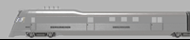
The Pioneer Zephyr is a diesel-powered trainset built by the Budd Company in 1934 for the Chicago, Burlington & Quincy Railroad (CB&Q), commonly known as the Burlington Route. The trainset was the second internal-combustion–powered streamliner built for mainline service in the United States (after the Union Pacific Railroad's M-10000), the first such train powered by a diesel engine, and the first to enter revenue service.
The trainset consists of one power/storage car, one baggage/RPO/buffet/coach car, and one coach/observation car. The cars are made of stainless steel, permanently articulated together with Jacobs bogies. The construction incorporated recent advances such as shotwelding (a specialized type of spot welding) to join the stainless steel, and unibody construction and articulation to reduce weight. It was the first of nine similarly built trainsets made for Burlington and its technologies were pivotal in the subsequent dieselization of passenger rail service.
Its operating economy, speed, and public appeal demonstrated the potential for diesel-electric-powered trains to revitalize and restore profitability to passenger rail service that had suffered a catastrophic loss of business with the Great Depression. Originally named the Burlington Zephyr during its demonstration period, it became the Pioneer Zephyr as Burlington expanded its fleet of Zephyr trainsets.
On May 26, 1934, it set a speed record for travel between Denver and Chicago when it made a 1,015.4-mile (1,633 km) non-stop "Dawn-to-Dusk" dash in 13 hours 5 minutes at an average speed of almost 78 mph (124 km/h). For one section of the run, it reached a speed of 112.5 mph (181 km/h). The historic dash inspired a film ("The Silver Streak") and the train's nickname, "The Silver Streak".
The train entered regular revenue service on November 11, between Kansas City, Missouri; Omaha, Nebraska; and Lincoln, Nebraska. It operated this and other routes until its retirement in 1960, when it was donated to Chicago's Museum of Science & Industry, where it remains on public display. The train is generally regarded as the first successful streamliner on American railroads.
Though no Pioneer Zephyr runs today, we used an 8-567C prime mover for this project.
This project is a normal idle version. It is an air throttle version. It has switcher type exhaust with a single exhaust stack.
File also contains an "Isolation Switch" Mode on F15 when Standing Still.
Pressing F15 while not moving will lower the prime mover and lock the motor. F15 must be turned off to begin moving.
Another Mode is "Reverser In Center Position". When pressing F24 while stopped, the motor will lock so you can throttle through the notches like the prototype in neutral. F24 must be turned off to begin moving.
This project has "Run 8" mode. When turning on F26 with F28 off, the prime mover goes to run 8. Turning off F26 returns the prime mover sounds back to normal mode.
This project has "Coast" mode. When turning on F27 with F28 off, the prime mover goes to idle for coasting purposes. Turning off F27 returns the prime mover sounds back to normal mode.
You can still use F26 and F27 for manual notching. You have to keep both F26 and F27 off before pressing F28 to turn on manual notching. Once F28 is on, you can use F26 to notch up and F27 to notch down. F26, F27, and F28 must be turned off to return to normal mode.
This project has "Load" mode. When turning on F29 with F15, F24, F26, F27, F28 off, the prime mover goes into load mode. While you are using load mode, the prime mover will notch up 1 or more notches based on primary load settings(CV104). The throttle notches up using speed instead of requested speed while using the load feature. F29 must be turned off to return to normal mode.
Prime mover volume selection mode. By default the prime mover has volume dynamics. Meaning idle is soft while notch 8 is loud. This is very prototypical. The next option is volume maxed out. Meaning idle and notch 8 are the same volume. This is more suitable for people who like it loud.
Change the sound configuration of the prime mover sound slot 1
CV31 = 16, CV32 = 1
----------------------
CV263 = 0 Prime Mover Dynamic Volume Control
CV263 = 1 Prime Mover Max Volume
Pioneer Zephyr Horn Pack 1
Horns (SoundCV9):
CV163=0 Leslie A-200 + Leslie A-125 Horn Combo
CV163=1 Leslie A-200 + Leslie A-125 Horn Combo Ed2
CV163=2 Leslie A-200
CV163=3 Leslie A-125
CV163=4 Leslie A-200 Ed2
CV163=5 Leslie A-125 Ed2
CV163=6 Leslie A-75 Ed2
CV163=7 Wabco E-2
CV163=8 Wabco E-2 Ed2
CV163=9 Hancock 4700 Whistle
CV163=10 Hancock 4700 Whistle Ed2
CV163=11 Nathan MS-1
CV163=12 Nathan M-5
CV163=13 Nathan M-3
CV163=14 Leslie A-75
Pioneer Zephyr Bell Template Pack 1
Bells (SoundCV10):
CV164=0 Pioneer Zephyr Air Bell 001
Auto Bell:
Many Second and Third Generation locomotives have been fitted with an Automatic Bell that is triggered when the horn is blown. In MANY cases this cannot even be bypassed on modern locos. Before the FRA mandated this feature on new locomotives the bell was of course turned on and off separately. Some locomotives were delivered with a manual bell and have been converted to an automatic bell. This creates a challenge in sound file creation.
We realize that not every loco with a particular prime mover had this feature. As such we have built in an option to turn the feature on and off. We will set the default in the file to be what is most appropriate for the particular file.
To turn the feature OFF - Auto Bell OFF:
1. Remove the Auto bell sound slot from the function mapping chart
CV31 = 16, CV32 = 8
----------------------
CV311 = 4
2. Change the sound configuration of the Auto bell sound slot
CV31 = 16, CV32 = 1
----------------------
CV287 = 0
To turn the feature ON - Auto Bell ON:
1. ADD the Auto bell sound slot from the function mapping chart
CV31 = 16, CV32 = 8
----------------------
CV311 = 12
2. Change the sound configuration of the Auto bell sound slot
CV31 = 16, CV32 = 1
----------------------
CV287 = 1
Auto Bell Timer:
The Bell timer is amount of time the bell will play after the horn if the auto timer is active. The timer is broken down into 1/4 of a second increments.
CV169=4 - 1 Second
CV169=8 - 2 Seconds
CV169=12 - 3 Seconds
CV169=16 - 4 Seconds
CV169=20 - 5 Seconds - Default
Etc...
1st Generation Brake Squeal Template Pack 1
Brake Squeal (SoundCV11)
CV165=0 Composition Shoe #1
CV165=1 Cast Iron Shoe #1
EMD 1st Generation Switcher Air Dryer Template Pack 1
Air Dryer (SoundCV12)
CV166=0 NW2 Air Dryer 1
CV166=1 NW5 Air Dryer 1
CV166=2 SW7 Air Dryer 1
CV166=3 SW10 Air Dryer 1
S0842 - Release Notes
===================================================
V-1 R-1:
===================================================
- new project
V-2 R-2:
===================================================
- bell update Hide description more…
H0 N XL L M4
- Article numbers
- S0842
- Last change
- 7/20/2026
- Manufacturer
- ESU
License Agreement
1. GRANT OF LICENSE
1.1 ESU grants you a non-transferable, limited, non-exclusive right to use the Content solely for your own personal purposes. You may load the Content into RAM, as well as installation on a hard disk or other storage device on a single computer, hardware product or mobile device owned by you or under your control. The installation process may result in a copy of the Content residing on your computer, in which case, you may retain one (1) copy of the Content on your computer, provided that you retain all copyright and other proprietary notices on the copy and the copy is kept in your possession with the original.1.2 By using the Content, you shall not obtain any ownership, copyright, proprietary or other interest in or to the Content. The Content is licensed, not sold.
1.3 You are licensed to use, modify and combine the Sound Samples with sound samples provided by third parties, to create your own sound compositions which, subject to you complying with the terms of this Agreement, you are free to distribute as you wish provided that: (i) the Sound Samples have been mixed together to create an original work; (ii) individual Sound Samples are not used in isolation and (iii) the Sound Samples or derivatives are not used to create sound libraries for distribution to third parties.
2. PROHIBITED USES
Neither you, nor anyone at your direction, shall:2.1 use the Content, or any part of it, for any public performance, live broadcast or time delayed live broadcast where the Content is used unattended for commercial purposes without ESU' s prior written consent;
2.2 use the Content, or any part of it, in any competitive product;
2.3 sub-license, copy, reproduce, transmit, assign, rent, sell, lease, offer on a pay-per-play basis, distribute for money or any other consideration, or commercially exploit in any other manner or through any medium whatsoever or otherwise transfer in any way the Content or any part thereof;
2.4 manufacture and/or distribute for money or otherwise commercially exploit any product that incorporates any part of the Content. If you wish to use any part of the Content for manufacture, resale, sub-license or further distribution, you must contact ESU (and where relevant, its licensors) to enter into an appropriate agreement with ESU (and, where relevant, its licensors);
2.5 publish the results of any analysis or comparative evaluation of the Content or any part thereof without ESU' s prior written consent;
2.6 reverse engineer, recompile or disassemble any part of the Content except to the extent and in the circumstances expressly permitted by ESU and its licensors in writing or by law;
3. INTELLECTUAL PROPERTY RIGHTS
You acknowledge that all intellectual property rights in the Content are and shall remain vested in ESU and its licensors. You undertake not to interfere with or diminish, whether by act or omission, the rights, title and interest in the Content of ESU and its licensors. You may be held responsible by ESU and/or any of its licensors for any infringement of any intellectual property rights in the Content. For the avoidance of doubt, provided that you comply with the terms of this Agreement, ESU shall not claim ownership of the intellectual property rights in any compositions created by your use of the Content.4. TERM AND TERMINATION
This Agreement is effective from the first date you install the Content. The rights granted to you under this Agreement shall terminate if you fail to abide by its terms. Upon such termination you agree to destroy the Content including any Content stored on the hard disk of any computer under your control. You may terminate this Agreement at any time by destroying or erasing all your copies of the Content. Any termination of this Agreement (howsoever occasioned) shall not affect any accrued rights or liabilities of you or ESU nor shall it affect the coming into force or the continuance in force of the provisions of Clauses 2, 3, 5 and 6 and any provision hereof which is by implication intended to come into or continue in force on or after such termination.5. NO WARRANTIES
TO THE MAXIMUM EXTENT PERMITTED BY APPLICABLE LAW, ESU AND ITS LICENSORS PROVIDE THE CONTENT "AS IS" AND ESU EXCLUDES ON BEHALF OF ITSELF AND ITS LICENSORS, ALL CONDITIONS, TERMS, REPRESENTATIONS (OTHER THAN FRAUDULENT REPRESENTATIONS) AND WARRANTIES RELATING TO THE CONTENT, WHETHER IMPOSED BY STATUTE OR BY OPERATION OF LAW OR OTHERWISE, INCLUDING BUT NOT LIMITED TO, IMPLIED WARRANTIES OF SATISFACTORY QUALITY AND FITNESS FOR A PARTICULAR PURPOSE. NEITHER ESU NOR ITS LICENSORS WARRANT THAT THE OPERATION OF THE CONTENT WILL BE UNINTERRUPTED, ERROR FREE, VIRUS FREE OR MEET YOUR SPECIFIC REQUIREMENTS. YOU MAY HAVE OTHER RIGHTS THAT VARY FROM JURISDICTION TO JURISDICTION.6. ESU's LIABILITY
Neither ESU nor its licensors shall have any liability to you for any loss or damage caused directly or indirectly in connection with the Content, any part thereof or this Agreement, except to the extent that such liability cannot be lawfully excluded. In any case, neither ESU nor its licensors shall be liable for any loss of business, data, profits, savings, or any other special, incidental, consequential, indirect or economic loss whatsoever even if such losses were contemplated at the date of this Agreement.7. GENERAL
7.1 You acknowledge that damages alone might be insufficient remedy for any breach of the terms of this Agreement and that the remedies of injunction, specific performance or other equitable relief would be suitable remedies in the event of any breach or threatened breach of this Agreement.7.2 You may not assign or otherwise transfer all or any part of this Agreement or the rights granted to you hereunder.
7.3 ESU is not obliged to provide any maintenance, technical support or upgrades to you.
7.4 You agree to comply with all applicable import and export regulations and acknowledge that you have the responsibility for obtaining all necessary licenses to export, re-export, transfer or import the Content.
7.5 This Agreement constitutes the entire agreement between you and ESU with respect to the subject matter hereof and supersedes all prior agreements, arrangements and understandings between the parties and constitutes the entire agreement between the parties relating to such subject matter hereof. No addition to or modification of any provision of this Agreement shall be binding upon ESU and you unless made by a written instrument signed by a duly authorized representative of ESU and you.
7.6 No forbearance, delay or indulgence by either party in enforcing the provisions of this Agreement shall prejudice or restrict the rights of that party nor shall any waiver of its rights operate as a waiver of any subsequent breach and no right, power or remedy herein conferred upon or reserved for either party is exclusive of any other right, power or remedy available to that party and each such right, power or remedy shall be cumulative.
7.7 Notwithstanding that the whole or any part of any provision of this Agreement may prove to be illegal or unenforceable the other provisions of this Agreement and the remainder of the provision in question shall remain in full force and effect.
If you download the designated file, you agree to be legally bound by the license given above.