- Downloads
- Sounds
- projects.esu.eu
- LokSound 5 North American and Australian Sound files
BLW-2-8-0 #29 V&T  H0 N XL L M4
- Article numbers:S0794
- Last change: 4/2/2024
- Manufacturer: ESU

Recorded from Virginia & Truckee #29
Originally built for the Longview, Portland and Northern Railway as No. 680, the Locomotive was sold to the V&T in 1977.
It is still running today.
While recorded from a 2-8-0 this file can be used for smaller locomotives in many wheel arrangments.
Whistles:
CV163=0 V&T #29
CV163=1 V&T #25
CV163=2 L&N Passenger
CV163=3 B&O 3-Chime
CV163=4 PRR Pre-War 3-Chime
CV163=5 RBMN #425
CV163=6 HVSR #3 Crosby 3-Chime
Bells:
CV164=0 #29 V&T Bell
CV164=1 Pnuematic Bell 2
CV164=2 Rope Pull Bell
CV164=3 SOO Line 1003 Bell
CV164=4 DRG&W K27 Bell
Brake Squeal:
CV165=0 Brake Squeal #1 Long
CV165=1 Brake Squeal #1 Short
CV165=2 Brake Squeal #2 Long
CV165=3 Brake Squeal #2 Short
CV165=4 Brake Squeal #3 Long
CV165=5 Brake Squeal #4Short
Dynamos:
CV166=0 Y&T #29 Dynamo
CV166=1 K27 463 Dynamo
CV166=2 T16.1 Dynamo
Air Pumps
CV167=0 Cross Compound #1 Soo Line 1003
CV167=1 Cross Compound #2 K27 463
CV167=2 Single Stage #1 Z27
CV167=3 Westinghouse Single Stage 9" Air Pump HVSR #3
Reversers
CV168=0 Johnson Bar
CV168=1 Power Reverse
The ESU Full Throttle Steam files now include a few new logic features for added operational realism while still leaving you in control of HOW YOU wish to run your locomotive.
Heavy Load: F9 by default.
Similar to the “Drive Hold” button on the Full Throttle Diesel files “Heavy Load” allows you to adjust the “Steam Cut Off Valve” at any speed allowing for a fierce full chuff or drifting with snifters and rod clanks. Heavy load can also act as an offset allowing speed adjustments when engaged if desired.
Coast: F4 by default.
Opposite of “Heavy Load” Coast allows for a negative offset allow drifting sounds of Rods and snifter valves at any speed. You again have the option to hold the speed to adjust the speed with this offset active. Even allowing for an increase of speed with no chuffs as if drifting downhill.
Independent brake: F10 by default
Identical to the Full Throttle Diesel files. This allows for the locomotive to stop more quickly than its regular momentum would normally carry it. This one is pretty self-explanatory – just press the brake and come to a stop! For additional options there are 3 Braking rates that can be set up for user preference.
Articulation: Sound Slot 2
By adding Sound Slot 2 to the F8 Function Mapping and enabling the "Secondary Trigger" (CV250) you can add a second set of drivers making any ESU Steam File articulated.
Function Mappable Air Horn: F21 by default
Sound Slot 21.
Many Steam locomotives had a single chime airhorn equipped. Those modelling SP, MILW, and others can now have this feature and put it where they would like in the function mapping in addition to the whistle.
S0794 - Release Notes
===================================================
V-3 R-3:
===================================================
- updated independent brake
- updated boiler hiss
- updated steam chuff sound slot
V-4 R-4:
===================================================
- changed whistle sound slot 3 maximum sound slot speed to 128 Hide description more…
H0 N XL L M4
- Article numbers
- S0794
- Last change
- 4/2/2024
- Manufacturer
- ESU
CR QJ 2-10-2 H0 N XL L M4
- Article numbers:S0817
- Last change: 4/2/2024
- Manufacturer: ESU
Recorded from Chinese QJ
Whistles from Iowa Interstate #6988
The QJ (Chinese: 前进; pinyin: Qián Jìn; lit. 'To go forward" or "to advance') was a type of heavy freight steam locomotive used by China Railway. The majority were built by Datong locomotive factory. The prototypes and early production of the class were designated HP (Chinese: 和平; pinyin: Hé Píng; lit. 'peace'), being redesignated as FD (Chinese: 反帝; pinyin: Fǎn Dì; lit. 'Anti-Imperialism') class during the Cultural Revolution, before becoming the QJ class in 1971.
The class became the primary mainline freight locomotive on the Chinese rail network by the 1980s, and were then displaced by diesel locomotives in 2005. After the end of steam on the national Chinese railway network many QJ locomotives were used on industrial lines, as well as on the Jitong railway. Several of the class have been preserved.
Two units withdrawn from use in China, numbers 6988 and 7081 (both former Jitong Railway), were originally acquired by the Iowa Interstate Railroad and later donated to Central States Steam Preservation Association.[12][13] A third, number 7040 (re-numbered to 2008), was acquired by the Lexington, Kentucky-based R.J. Corman Railroad Group in 2008, and operated until 2013, when it was placed on display in a specially built glass display building in Lexington.[14] In 2020, Corman donated the engine to the Kentucky Steam Heritage Corporation.[15]
Iowa Interstate 7081 retains its original Chinese appearance with the exception of the Jitong lettering and logo being replaced with the Iowa Interstate's, and the mandatory changes required by U.S. law such as hand rails and a bell. IAIS 6988 was "Americanized" in time for operation at Train Festival 2011 in Rock Island, Illinois. The diesel-style bell originally installed when it arrived in Iowa was replaced with a steam engine type bell, the Chinese headlights were replaced with an American style light with a cast number plate under it, and an American steam whistle was installed. The steel sheet on the front was removed and all red paint was painted over in black, with white trim on the running boards, wheel rims, etc. The R.J. Corman locomotive has been heavily modified. Most notably the smoke deflectors have been removed along with new paint and skirts along the running boards.
This file is set up for the American Iowa Interstate 6988 version with 3 whistles recorded from that loco.
While recorded from a 2-10-2 Chinese QJ this file can be used for large "2-10-2" "Santa Fe" type or other large locomotives in many wheel arrangments.
Whistles:
CV163=0 CR 5-Chime - Original Chinese Whistle
CV163=1 DRG&W 5 Chime
CV163=2 Soo Line 1003
CV163=3 SP 4449 Daylight
CV163=4 Single Chime Hooter
CV163=5 CPR 2317
CV163=6 Western Maryland 6 Chime
CV163=7 CN 4 Chime
CV163=8 PRR Banshee #1
CV163=9 IAIS #6988 Guatemalan
CV163=10 IAIS #6988 Southern 3 Chime
Bells:
CV164=0 #3 HVSR Bell 1
CV164=1 Pnuematic Bell 2
CV164=2 Rope Pull Bell
CV164=3 SOO Line 1003 Bell
CV164=4 DRG&W K27 Bell
Brake Squeal:
CV165=0 Brake Squeal #1 Long
CV165=1 Brake Squeal #1 Short
CV165=2 Brake Squeal #2 Long
CV165=3 Brake Squeal #2 Short
CV165=4 Brake Squeal #3 Long
CV165=5 Brake Squeal #4Short
Dynamos:
CV166=0 Soo Line 1003 Dynamo
CV166=1 K27 463 Dynamo
CV166=2 T16.1 Dynamo
Air Pumps
CV167=0 Cross Compound #1 Soo Line 1003
CV167=1 Cross Compound #2 K27 463
CV167=2 Single Stage #1 Z27
CV167=3 Westinghouse Single Stage 9" Air Pump HVSR #3
Reversers
CV168=0 Johnson Bar
CV168=1 Power Reverse
The ESU Full Throttle Steam files now include a few new logic features for added operational realism while still leaving you in control of HOW YOU wish to run your locomotive.
Heavy Load: F9 by default.
Similar to the “Drive Hold” button on the Full Throttle Diesel files “Heavy Load” allows you to adjust the “Steam Cut Off Valve” at any speed allowing for a fierce full chuff or drifting with snifters and rod clanks. Heavy load can also act as an offset allowing speed adjustments when engaged if desired.
Coast: F4 by default.
Opposite of “Heavy Load” Coast allows for a negative offset allow drifting sounds of Rods and snifter valves at any speed. You again have the option to hold the speed to adjust the speed with this offset active. Even allowing for an increase of speed with no chuffs as if drifting downhill.
Independent brake: F10 by default
Identical to the Full Throttle Diesel files. This allows for the locomotive to stop more quickly than its regular momentum would normally carry it. This one is pretty self-explanatory – just press the brake and come to a stop! For additional options there are 3 Braking rates that can be set up for user preference.
Articulation: Sound Slot 2
By adding Sound Slot 2 to the F8 Function Mapping and enabling the "Secondary Trigger" (CV250) you can add a second set of drivers making any ESU Steam File articulated.
Function Mappable Air Horn: F21 by default
Sound Slot 21.
Many Steam locomotives had a single chime airhorn equipped. Those modelling SP, MILW, and others can now have this feature and put it where they would like in the function mapping in addition to the whistle.
S0817 - Release Notes
===================================================
V-3 R-3:
===================================================
- updated independent brake
- updated boiler hiss
- updated steam chuff sound slot
V-4 R-4:
===================================================
- changed whistle sound slot 3 maximum sound slot speed to 128 Hide description more…
H0 N XL L M4
- Article numbers
- S0817
- Last change
- 4/2/2024
- Manufacturer
- ESU
D&RGW K-27 2-8-2 H0 N XL L M4
- Article numbers:S0586
- Last change: 4/2/2024
- Manufacturer: ESU
The K-27 is a class of 3 ft 0 in (914 mm) narrow gauge 2-8-2 steam locomotives built for the Denver and Rio Grande Railroad by the Baldwin Locomotive Works in 1903. Known by their nickname "Mudhens," they were the first and the most numerous of the four K classes of Rio Grande narrow gauge engines to be built. Of the original fleet of 15 locomotives, two survive to this day and operate on heritage railways in the United States.
Fifteen locomotives were built, originally class 125, they were reclassified as K-27s in 1924 when the Denver and Rio Grande became the Denver and Rio Grande Western Railroad. In the D&RGW's classification system, K was short for MiKado while 27 referred to the engine's 27,000 lbf of tractive effort. The K-27s were built as Vauclain compounds, with two cylinders on each side, expanding the steam once in the smaller cylinder and then a second time in the larger one. The extra maintenance costs of the two cylinders were greater than the fuel saving, so they were converted to simple expansion in 1907–1909. As a result, the K-27s were the Rio Grande's last purchase of compound locomotives. They were built with their main structural frames outside the driving wheels, with the counterweights and rods attached outside the frames.
They pulled freight, passenger and mixed trains on the D&RGW in and over the Colorado Rocky Mountains, traversing the entire length of the railroad. Many of them also spent time on the Rio Grande's subsidiary, the Rio Grande Southern. In later years, some were used as switchers at the D&RGW's yards in Durango, Gunnison, and Montrose.
Recorded from D&RGW (Cumbres and Toltec) K-27 463
Whistles:
CV163=0 UP 844 "Steamboat"
CV163=1 SP&S 3 Chime
CV163=2 Steamboat 3 Chime
CV163=3 SP 4449 Daylight
CV163=4 DRG&W 5 Chime
CV163=5 SOO Line 1003
CV163=6 DL&W 5 Chime
CV163=7 WM 6 Chime
CV163=8 DRGW 463 - Default
CV163=9 DRGW 484
CV163=10 DRGW 488
Bells:
CV164=0 Pnuematic Bell 1
CV164=1 Pnuematic Bell 2
CV164=2 Pnuematic Bell 3
CV164=3 Steam Loco Rope Pull Bell
CV164=4 SOO Line 1003 Bell
CV164=5 UP 844 Air Ringer Bell
CV164=6 SP 4449 Bell
CV164=7 DRG&W K27 Bell - Default
Dynamos:
CV165=0 Soo Line 1003 Dynamo
CV165=1 K27 463 Dynamo - Default
CV165=2 SPTriple Dynamo
CV165=3 UP Dual Dynamo
CV165=4 Z27 Dynamo
CV165=5 T16.1 Dynamo
Air Pumps
CV166=0 Cross Compound #1 Soo Line 1003
CV166=1 Cross Compound #2 K27 463 - Default
CV166=2 Cross Compound #3 SP 4449
CV166=3 Cross Compound #4UP 844
CV166=4 Single Stage #1 Z27
CV166=5 Single Stage #2 T16.1
The ESU Full Throttle Steam files now include a few new logic features for added operational realism while still leaving you in control of HOW YOU wish to run your locomotive.
Heavy Load: F9 by default.
Similar to the “Drive Hold” button on the Full Throttle Diesel files “Heavy Load” allows you to adjust the “Steam Cut Off Valve” at any speed allowing for a fierce full chuff or drifting with snifters and rod clanks. Heavy load can also act as an offset allowing speed adjustments when engaged if desired.
Coast: F4 by default.
Opposite of “Heavy Load” Coast allows for a negative offset allow drifting sounds of Rods and snifter valves at any speed. You again have the option to hold the speed to adjust the speed with this offset active. Even allowing for an increase of speed with no chuffs as if drifting downhill.
Independent brake: F10 by default
Identical to the Full Throttle Diesel files. This allows for the locomotive to stop more quickly than its regular momentum would normally carry it. This one is pretty self-explanatory – just press the brake and come to a stop! For additional options there are 3 Braking rates that can be set up for user preference.
Articulation: Sound Slot 2
By adding Sound Slot 2 to the F8 Function Mapping and enabling the "Secondary Trigger" (CV250) you can add a second set of drivers making any ESU Steam File articulated.
Function Mappable Air Horn: F21 by default
Sound Slot 21.
Many Steam locomotives had a single chime airhorn equipped. Those modelling SP, MILW, and others can now have this feature and put it where they would like in the function mapping in addition to the whistle.
S0586 - Release Notes
===================================================
V-2 R-2:
===================================================
- updated independent brake
- updated boiler hiss
V-3 R-3:
===================================================
- updated steam chuff sound slot
V-4 R-4:
===================================================
- changed whistle sound slot 3 maximum sound slot speed to 128 Hide description more…
H0 N XL L M4
- Article numbers
- S0586
- Last change
- 4/2/2024
- Manufacturer
- ESU
Heisler H0 N XL L M4
- Article numbers:S0787
- Last change: 4/2/2024
- Manufacturer: ESU

The Heisler locomotive was the last variant of the three major types of geared steam locomotives.
Charles L. Heisler received a patent for the design in 1892, following the construction of a prototype in 1891. Somewhat similar to a Climax locomotive, Heisler's design featured two cylinders canted inwards at a 45-degree angle to form a 'V-twin' arrangement. Power then went to a longitudinal drive shaft in the center of the frame that drove the outboard axle on each powered truck through bevel gears in an enclosed gearcase riding on the axle between the truck frames. The inboard axle on each truck was then driven from the outboard one by external side (connecting) rods.
In 1897, Heisler received a patent on a three-truck locomotive. As with Class C Shay locomotives, the tender rode on the third truck. Unlike the Shay, Heisler's design did not have a continuous string of line shafting running the length of the engine. Instead, the tender truck was driven by a line shaft above the shaft driving the main engine trucks, connected to it through spur gears. This patent also covered use of a 4-cylinder 'vee four' cylinder configuration.
The Heisler was the fastest of the geared steam locomotive designs, and yet was still claimed by its manufacturer to have the same low-speed hauling ability.
Whistles:
CV163=0 SP 4449 Daylight
CV163=1 DRG&W 5 Chime
CV163=2 SOO Line 1003 - Default
CV163=3 DL&W 5 Chime
CV163=4 WM 6 Chime
CV163=5 Heisler
Bells:
CV164=0 Pnuematic Bell 1
CV164=1 Pnuematic Bell 2
CV164=2 Pnuematic Bell 3
CV164=3 Steam Loco Rope Pull Bell
CV164=4 SOO Line 1003 Bell - Default
CV164=5 DRG&W K27 Bell
CV164=6 Heisler
Air Pumps
CV166=0 Cross Compound #1 Heisler
CV166=1 Cross Compound #2 K27 463
CV166=2 Single Stage #1 Z27
CV166=3 Single Stage #2 T16.1
The ESU Full Throttle Steam files now include a few new logic features for added operational realism while still leaving you in control of HOW YOU wish to run your locomotive.
Heavy Load: F9 by default.
Similar to the “Drive Hold” button on the Full Throttle Diesel files “Heavy Load” allows you to adjust the “Steam Cut Off Valve” at any speed allowing for a fierce full chuff or drifting with snifters and rod clanks. Heavy load can also act as an offset allowing speed adjustments when engaged if desired.
Coast: F4 by default.
Opposite of “Heavy Load” Coast allows for a negative offset allow drifting sounds of Rods and snifter valves at any speed. You again have the option to hold the speed to adjust the speed with this offset active. Even allowing for an increase of speed with no chuffs as if drifting downhill.
Independent brake: F10 by default
Identical to the Full Throttle Diesel files. This allows for the locomotive to stop more quickly than its regular momentum would normally carry it. This one is pretty self-explanatory – just press the brake and come to a stop! For additional options there are 3 Braking rates that can be set up for user preference.
Articulation: Sound Slot 2
By adding Sound Slot 2 to the F8 Function Mapping and enabling the "Secondary Trigger" (CV250) you can add a second set of drivers making any ESU Steam File articulated.
Function Mappable Air Horn: F21 by default
Sound Slot 21.
Many Steam locomotives had a single chime airhorn equipped. Those modelling SP, MILW, and others can now have this feature and put it where they would like in the function mapping in addition to the whistle.
S0787 - Release Notes
===================================================
V-3 R-3:
===================================================
- updated independent brake
- updated boiler hiss
- updated steam chuff sound slot
V-4 R-4:
===================================================
- changed whistle sound slot 3 maximum sound slot speed to 128 Hide description more…
H0 N XL L M4
- Article numbers
- S0787
- Last change
- 4/2/2024
- Manufacturer
- ESU
Hunslet Z27 Class 2-6-0 H0 N XL L M4
- Article numbers:S0740
- Last change: 4/23/2025
- Manufacturer: ESU

N.S.W.G.R. Class Z27 2705
**Please Note**
Responding to user feedback this file uses "Standard North American Function Mapping".
This is a template used for all steam files from ESU LLC.
While we realize most Australian Locomotives do not use Bells or Air Horns they are included in the mapping due to the template used. This is easily changable so the user can set the function mapping work as desired.
The Z27 class (formerly G.1204 class) was a class of steam locomotives built by Hunslet Engine Company for the New South Wales Government Railways of Australia. One example is preserved in #2705 at the New South Wales Rail Transport Museum.
Whistles:
CV163=0 UP 844 "Steamboat"
CV163=1 SP&S 3 Chime
CV163=2 Steamboat 3 Chime
CV163=3 SP 4449 Daylight
CV163=4 DRG&W 5 Chime
CV163=5 SOO Line 1003
CV163=6 DL&W 5 Chime
CV163=7 WM 6 Chime
CV163=8 Z27 Class 2705 - Default
Bells:
CV164=0 Pnuematic Bell 1
CV164=1 Pnuematic Bell 2
CV164=2 Pnuematic Bell 3
CV164=3 Steam Loco Rope Pull Bell - Default
CV164=4 SOO Line 1003 Bell
CV164=5 UP 844 Air Ringer Bell
CV164=6 SP 4449 Bell
CV164=7 DRG&W K27 Bell
Dynamos:
CV165=0 Soo Line 1003 Dynamo
CV165=1 K27 463 Dynamo
CV165=2 SPTriple Dynamo
CV165=3 UP Dual Dynamo
CV165=4 Z27 Dynamo - Default
CV165=5 T16.1 Dynamo
Air Pumps
CV166=0 Cross Compound #1 Soo Line 1003
CV166=1 Cross Compound #2 K27 463
CV166=2 Cross Compound #3 SP 4449
CV166=3 Cross Compound #4UP 844
CV166=4 Single Stage #1 Z27 - Default
CV166=5 Single Stage #2 T16.1
The ESU Full Throttle Steam files now include a few new logic features for added operational realism while still leaving you in control of HOW YOU wish to run your locomotive.
Heavy Load: F9 by default.
Similar to the “Drive Hold” button on the Full Throttle Diesel files “Heavy Load” allows you to adjust the “Steam Cut Off Valve” at any speed allowing for a fierce full chuff or drifting with snifters and rod clanks. Heavy load can also act as an offset allowing speed adjustments when engaged if desired.
Coast: F4 by default.
Opposite of “Heavy Load” Coast allows for a negative offset allow drifting sounds of Rods and snifter valves at any speed. You again have the option to hold the speed to adjust the speed with this offset active. Even allowing for an increase of speed with no chuffs as if drifting downhill.
Independent brake: F10 by default
Identical to the Full Throttle Diesel files. This allows for the locomotive to stop more quickly than its regular momentum would normally carry it. This one is pretty self-explanatory – just press the brake and come to a stop! For additional options there are 3 Braking rates that can be set up for user preference.
Articulation: Sound Slot 2
By adding Sound Slot 2 to the F8 Function Mapping and enabling the "Secondary Trigger" (CV250) you can add a second set of drivers making any ESU Steam File articulated.
Function Mappable Air Horn: F21 by default
Sound Slot 21.
Many Steam locomotives had a single chime airhorn equipped. Those modelling SP, MILW, and others can now have this feature and put it where they would like in the function mapping in addition to the whistle.
S0740 - Release Notes
===================================================
V-2 R-2:
===================================================
- updated independent brake
- updated boiler hiss
V-3 R-3:
===================================================
- updated steam chuff sound slot
V-4 R-4:
===================================================
- changed whistle sound slot 3 maximum sound slot speed to 128
V-5 R-5:
===================================================
- changed from USA project to Australia project Hide description more…
H0 N XL L M4
- Article numbers
- S0740
- Last change
- 4/23/2025
- Manufacturer
- ESU
N&W Class Y6B 2-8-8-2 H0 N XL L M4
- Article numbers:S0557
- Last change: 7/31/2024
- Manufacturer: ESU
The Norfolk and Western Class Y6b was a class of 2-8-8-2 Mallets built between 1948-1952 with a total of 30 examples built for the Norfolk and Western Railway.
The Y6b was known as the workhorse of the Norfolk and Western Railway and the epitome of the compound mallet development design.
They were an improvement of the previous Y6a class with the only difference between the Y6as and the Y6bs was that the Y6bs were longer than the Y6as, had a larger firebox and had a greater tractive effort. With the Y6as only generating a tractive effort of 166,000 lbf (738.5 kN) and the Y6bs generating a tractive effort of 170,000 lbf (756.2 kN). The locomotives delivered 5,500 horsepower. The weight of a Y6b locomotive about 582,900 lbs with 522,850 lbs directly on the drivers.
When the Norfolk and Western Railway ceased their mainline steam operations in 1959, 50 of the Y6s were still running out serviceable miles in the coal fields waiting for the final order of diesels to replace them. The last of the Class Ys were retired in the summer of 1960.
Whistles:
CV163=0 N&W Y6B
CV163=1 N&W Hooter
CV163=2 N&W #475
CV163=3 N&W Boiler Crane
CV163=4 Hooter
CV163=5 PRR Flat Top Single-Chime Banshee Ed2
CV163=6 CN #89 Hooter
CV163=7 UP #4014 Hancock 3-Chime
CV163=8 UP #844
CV163=9 GSMR #1702
Bells:
CV164=0 #3 N&W Y6B Bell
CV164=1 #765 NKP Bell
CV164=2EV #11 Bell
Brake Squeal:
CV165=0 Brake Squeal #1 Long
CV165=1 Brake Squeal #1 Short
CV165=2 Brake Squeal #2 Long
CV165=3 Brake Squeal #2 Short
CV165=4 Brake Squeal #3 Long
CV165=5 Brake Squeal #4Short
Dynamos:
CV166=0 Soo Line 1003 Dynamo
CV166=1 K27 463 Dynamo
Air Pumps
CV167=0 Cross Compound #2 K27 463
CV167=1 Cross Compound slow #2 SP 4449
CV167=2 Westinghouse Single Stage 9" Air Pump HVSR #3
Reversers
CV168=0 Johnson Bar
CV168=1 Power Reverse
The ESU Full Throttle Steam files now include a few new logic features for added operational realism while still leaving you in control of HOW YOU wish to run your locomotive.
Heavy Load: F9 by default.
Similar to the “Drive Hold” button on the Full Throttle Diesel files “Heavy Load” allows you to adjust the “Steam Cut Off Valve” at any speed allowing for a fierce full chuff or drifting with snifters and rod clanks. Heavy load can also act as an offset allowing speed adjustments when engaged if desired.
Coast: F4 by default.
Opposite of “Heavy Load” Coast allows for a negative offset allow drifting sounds of Rods and snifter valves at any speed. You again have the option to hold the speed to adjust the speed with this offset active. Even allowing for an increase of speed with no chuffs as if drifting downhill.
Independent brake: F10 by default
Identical to the Full Throttle Diesel files. This allows for the locomotive to stop more quickly than its regular momentum would normally carry it. This one is pretty self-explanatory – just press the brake and come to a stop! For additional options there are 3 Braking rates that can be set up for user preference.
Articulation: Sound Slot 2
By adding Sound Slot 2 to the F8 Function Mapping and enabling the "Secondary Trigger" (CV250) you can add a second set of drivers making any ESU Steam File articulated.
Function Mappable Air Horn: F21 by default
Sound Slot 21.
Many Steam locomotives had a single chime airhorn equipped. Those modelling SP, MILW, and others can now have this feature and put it where they would like in the function mapping in addition to the whistle.
S0557 - Release Notes
===================================================
V-1 R-1:
===================================================
- new project
V-2 R-2:
===================================================
- steam chuff secondary trigger distance adustment to 10 Hide description more…
H0 N XL L M4
- Article numbers
- S0557
- Last change
- 7/31/2024
- Manufacturer
- ESU
Shay H0 N XL L M4
- Article numbers:S0515
- Last change: 4/2/2024
- Manufacturer: ESU
The Shay locomotive was the most widely used geared steam locomotive. The locomotives were built to the patents of Ephraim Shay, who has been credited with the popularization of the concept of a geared steam locomotive.
Shay locomotives had regular fire-tube boilers offset to the left to provide space for, and counterbalance the weight of, a two or three cylinder "motor," mounted vertically on the right with longitudinal drive shafts extending fore and aft from the crankshaft at wheel axle height. These shafts had universal joints and square sliding prismatic joints to accommodate the swiveling trucks. Each axle was driven by a separate bevel gear, with no side rods.
The strength of these engines is that all wheels, including, in some engines, those under the tender, are driven so that all the weight develops tractive effort. A high ratio of piston strokes to wheel revolutions allowed them to run at partial slip, where a conventional rod engine would spin its drive wheels and burn rails, losing all traction.
Shay locomotives were often known as sidewinders or stemwinders for their side-mounted drive shafts. Most were built for use in the United States, but many were exported, to about thirty countries, either by Lima, or after they had reached the end of their usefulness in the US.
Whistles:
CV163=0 SP 4449 Daylight
CV163=1 DRG&W 5 Chime
CV163=2 SOO Line 1003 - Default
CV163=3 DL&W 5 Chime
CV163=4 WM 6 Chime
CV163=5 Shay
CV163=6 Shay #2
Bells:
CV164=0 Pnuematic Bell 1
CV164=1 Pnuematic Bell 2
CV164=2 Pnuematic Bell 3
CV164=3 Steam Loco Rope Pull Bell
CV164=4 SOO Line 1003 Bell - Default
CV164=5 DRG&W K27 Bell
CV164=6 Shay
Air Pumps
CV166=0 Cross Compound #1 Heisler
CV166=1 Cross Compound #2 K27 463
CV166=2 Single Stage #1 Z27
CV166=3 Single Stage #2 T16.1
The ESU Full Throttle Steam files now include a few new logic features for added operational realism while still leaving you in control of HOW YOU wish to run your locomotive.
Heavy Load: F9 by default.
Similar to the “Drive Hold” button on the Full Throttle Diesel files “Heavy Load” allows you to adjust the “Steam Cut Off Valve” at any speed allowing for a fierce full chuff or drifting with snifters and rod clanks. Heavy load can also act as an offset allowing speed adjustments when engaged if desired.
Coast: F4 by default.
Opposite of “Heavy Load” Coast allows for a negative offset allow drifting sounds of Rods and snifter valves at any speed. You again have the option to hold the speed to adjust the speed with this offset active. Even allowing for an increase of speed with no chuffs as if drifting downhill.
Independent brake: F10 by default
Identical to the Full Throttle Diesel files. This allows for the locomotive to stop more quickly than its regular momentum would normally carry it. This one is pretty self-explanatory – just press the brake and come to a stop! For additional options there are 3 Braking rates that can be set up for user preference.
Articulation: Sound Slot 2
By adding Sound Slot 2 to the F8 Function Mapping and enabling the "Secondary Trigger" (CV250) you can add a second set of drivers making any ESU Steam File articulated.
Function Mappable Air Horn: F21 by default
Sound Slot 21.
Many Steam locomotives had a single chime airhorn equipped. Those modelling SP, MILW, and others can now have this feature and put it where they would like in the function mapping in addition to the whistle.
S0514 - Release Notes
===================================================
V-6 R-2:
===================================================
- updated independent brake
- updated boiler hiss
V-7 R-3:
===================================================
- updated independent brake
V-8 R-4:
===================================================
- changed whistle sound slot 3 maximum sound slot speed to 128 Hide description more…
H0 N XL L M4
- Article numbers
- S0515
- Last change
- 4/2/2024
- Manufacturer
- ESU
Soo Line 1003 2-8-2 H0 N XL L M4
- Article numbers:S0574
- Last change: 4/2/2024
- Manufacturer: ESU
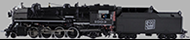
The 2-8-2 wheel configuration on steam locomotives was one of the most highly used configurations made. This type of locomotive with 2 pilot wheels, 8 drive wheels, and 2 trailing wheels to support a larger firebox was first built for the Emperor of Japan, thus the name Mikado type. The first Mikado built for service in the US was built in 1901 and was owed by the Bismarck, Washburn and Great Falls until 1904 when it was acquired by the Soo Line.
This recording comes from the newer L-1 Class SOO Line 2-8-2 #1003. The SOO #1003 is a very average 2-8-2 not much different than the USRA light Mikado design. It does have slightly larger cylinders and a boiler pressure of about 170 PSI.
Originally delivered with a Westinghouse Cross Compound Air Pump, Walschaerts valve gear, an oil headlight, and a manual Johnson Bar, it was gradually upgraded to include a Power Reverse gear and electric headlights and class lights by about 1920.
It is important to note that wheel arrangement does very little to change the sounds of a steam locomotive. (Articulation aside). Boiler pressure, Stack size, Cylinder size and even the engineer at the throttle can all have more effect on the sound of locomotive than how many wheels are beneath it. While our dedication to accuracy is paramount, causing us to release very specific files, we will also be releasing some more generic files to try to give broad range to locomotives owned by MANY railroads. While this is a fairly common design and the sounds are similar to many locomotives, this ESU Full Throttle File is quite specific to the SOO #1003. We've included a few extra whistles for some variation.
Whistles:
CV163=0 UP 844 "Steamboat"
CV163=1 SP&S 3 Chime
CV163=2 Steamboat 3 Chime
CV163=3 SP 4449 Daylight
CV163=4 DRG&W 5 Chime
CV163=5 SOO Line 1003 - Default
CV163=6 DL&W 5 Chime
CV163=7 WM 6 Chime
Bells:
CV164=0 Pnuematic Bell 1
CV164=1 Pnuematic Bell 2
CV164=2 Pnuematic Bell 3
CV164=3 Steam Loco Rope Pull Bell
CV164=4 SOO Line 1003 Bell - Default
CV164=5 UP 844 Air Ringer Bell
CV164=6 SP 4449 Bell
CV164=7 DRG&W K27 Bell
Dynamos:
CV165=0 Soo Line 1003 Dynamo
CV165=1 K27 463 Dynamo
CV165=2 SPTriple Dynamo
CV165=3 UP Dual Dynamo
CV165=4 Z27 Dynamo
CV165=5 T16.1 Dynamo
Air Pumps
CV166=0 Cross Compound #1 Soo Line 1003
CV166=1 Cross Compound #2 K27 463
CV166=2 Cross Compound #3 SP 4449
CV166=3 Cross Compound #4UP 844
CV166=4 Single Stage #1 Z27
CV166=5 Single Stage #2 T16.1
The ESU Full Throttle Steam files now include a few new logic features for added operational realism while still leaving you in control of HOW YOU wish to run your locomotive.
Heavy Load: F9 by default.
Similar to the “Drive Hold” button on the Full Throttle Diesel files “Heavy Load” allows you to adjust the “Steam Cut Off Valve” at any speed allowing for a fierce full chuff or drifting with snifters and rod clanks. Heavy load can also act as an offset allowing speed adjustments when engaged if desired.
Coast: F4 by default.
Opposite of “Heavy Load” Coast allows for a negative offset allow drifting sounds of Rods and snifter valves at any speed. You again have the option to hold the speed to adjust the speed with this offset active. Even allowing for an increase of speed with no chuffs as if drifting downhill.
Independent brake: F10 by default
Identical to the Full Throttle Diesel files. This allows for the locomotive to stop more quickly than its regular momentum would normally carry it. This one is pretty self-explanatory – just press the brake and come to a stop! For additional options there are 3 Braking rates that can be set up for user preference.
Articulation: Sound Slot 2
By adding Sound Slot 2 to the F8 Function Mapping and enabling the "Secondary Trigger" (CV250) you can add a second set of drivers making any ESU Steam File articulated.
Function Mappable Air Horn: F21 by default
Sound Slot 21.
Many Steam locomotives had a single chime airhorn equipped. Those modelling SP, MILW, and others can now have this feature and put it where they would like in the function mapping in addition to the whistle.
S0574 - Release Notes
===================================================
V-3 R-3:
===================================================
- updated independent brake
- updated boiler hiss
V-4 R-4:
===================================================
- updated steam chuff sound slot
V-5 R-5:
===================================================
- changed whistle sound slot 3 maximum sound slot speed to 128 Hide description more…
H0 N XL L M4
- Article numbers
- S0574
- Last change
- 4/2/2024
- Manufacturer
- ESU
SP 4449 GS-4 4-8-4 H0 N XL L M4
- Article numbers:S0737
- Last change: 4/2/2024
- Manufacturer: ESU
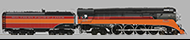
Southern Pacific 4449, also known as the Daylight, is the only surviving example of Southern Pacific Railroad's GS-4 class of steam locomotives and one of only two GS-class locomotives surviving, the other being GS-6 4460. The locomotive is a streamlined 4-8-4 "Northern"-type steam locomotive. GS is abbreviated from "Golden State", a nickname for California (where the locomotive was operated in regular service), or "General Service".
The locomotive was built by Lima Locomotive Works in Lima, Ohio, for SP in May 1941; it received the red-and-orange "Daylight" paint scheme for the passenger trains of the same name which it hauled for most of its service career. No. 4449 was retired from revenue service in 1956 and put into storage. In 1958, the SP donated the locomotive to the City of Portland, Oregon. The City then put the locomotive on static display in Oaks Amusement Park, where it remained until 1974.
The locomotive was then restored to operation for use in the American Freedom Train, which toured the 48 contiguous United States as part of the nation's 1976 Bicentennial celebration. The engine has operated in excursion service throughout that area since 1984.
The locomotive's operations are based at the Oregon Rail Heritage Center in Portland, Oregon, where it is maintained by a group of volunteers named the Friends of SP 4449. In 1983, a poll of Trains magazine readers selected 4449 as being the most popular locomotive in the nation.
This recording comes from SP 4449.
Whistles:
CV163=0 UP 844 "Steamboat"
CV163=1 SP&S 3 Chime
CV163=2 Steamboat 3 Chime
CV163=3 SP 4449 Daylight - Default
CV163=4 DRG&W 5 Chime
CV163=5 SOO Line 1003
CV163=6 DL&W 5 Chime
CV163=7 WM 6 Chime
Bells:
CV164=0 Pnuematic Bell 1
CV164=1 Pnuematic Bell 2
CV164=2 Pnuematic Bell 3
CV164=3 Steam Loco Rope Pull Bell
CV164=4 SOO Line 1003 Bell
CV164=5 UP 844 Air Ringer Bell
CV164=6 SP 4449 Bell - Default
CV164=7 DRG&W K27 Bell
Dynamos:
CV165=0 Soo Line 1003 Dynamo
CV165=1 K27 463 Dynamo
CV165=2 SPTriple Dynamo - Default
CV165=3 UP Dual Dynamo
CV165=4 Z27 Dynamo
CV165=5 T16.1 Dynamo
Air Pumps
CV166=0 Cross Compound #1 Soo Line 1003
CV166=1 Cross Compound #2 K27 463
CV166=2 Cross Compound #3 SP 4449 - Default
CV166=3 Cross Compound #4UP 844
CV166=4 Single Stage #1 Z27
CV166=5 Single Stage #2 T16.1
The ESU Full Throttle Steam files now include a few new logic features for added operational realism while still leaving you in control of HOW YOU wish to run your locomotive.
Heavy Load: F9 by default.
Similar to the “Drive Hold” button on the Full Throttle Diesel files “Heavy Load” allows you to adjust the “Steam Cut Off Valve” at any speed allowing for a fierce full chuff or drifting with snifters and rod clanks. Heavy load can also act as an offset allowing speed adjustments when engaged if desired.
Coast: F4 by default.
Opposite of “Heavy Load” Coast allows for a negative offset allow drifting sounds of Rods and snifter valves at any speed. You again have the option to hold the speed to adjust the speed with this offset active. Even allowing for an increase of speed with no chuffs as if drifting downhill.
Independent brake: F10 by default
Identical to the Full Throttle Diesel files. This allows for the locomotive to stop more quickly than its regular momentum would normally carry it. This one is pretty self-explanatory – just press the brake and come to a stop! For additional options there are 3 Braking rates that can be set up for user preference.
Articulation: Sound Slot 2
By adding Sound Slot 2 to the F8 Function Mapping and enabling the "Secondary Trigger" (CV250) you can add a second set of drivers making any ESU Steam File articulated.
Function Mappable Air Horn: F21 by default
Sound Slot 21.
Many Steam locomotives had a single chime airhorn equipped. Those modelling SP, MILW, and others can now have this feature and put it where they would like in the function mapping in addition to the whistle.
S0737 - Release Notes
===================================================
V-3 R-3:
===================================================
- updated independent brake
- updated boiler hiss
V-4 R-4:
===================================================
- updated steam chuff sound slot
V-5 R-5:
===================================================
- changed whistle sound slot 3 maximum sound slot speed to 128 Hide description more…
H0 N XL L M4
- Article numbers
- S0737
- Last change
- 4/2/2024
- Manufacturer
- ESU
SP Cab Forward 4-8-8-2 H0 N XL L M4
- Article numbers:S0509
- Last change: 4/2/2024
- Manufacturer: ESU
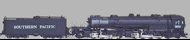
Cab Forwards were designed to keep the crews from getting asfixiated from smoke while long tunnels. While a few other railroads considered purchasing the design, only the Southern Pacific Railroad ever bought any. Many wheel arrangements were used but most of them were of the 4-8-8-2 design.
AC-6 through AC-12 Cab Forwards Used a Saturated airpump mounted on the front of the boiler. These had a very distinct sound which we have gone through great lengths to duplicate.
Whistles:
CV163=0 UP 844 "Steamboat"
CV163=1 SP&S 3 Chime
CV163=2 Steamboat 3 Chime
CV163=3 SP - Default
CV163=4 DRG&W 5 Chime
CV163=5 SOO Line 1003
CV163=6 DL&W 5 Chime
CV163=7 WM 6 Chime
Bells:
CV164=0 Pnuematic Bell 1
CV164=1 Pnuematic Bell 2
CV164=2 Pnuematic Bell 3
CV164=3 Steam Loco Rope Pull Bell
CV164=4 SOO Line 1003 Bell
CV164=5 UP 844 Air Ringer Bell
CV164=6 SP 4449 Bell - Default
CV164=7 DRG&W K27 Bell
Dynamos:
CV165=0 Soo Line 1003 Dynamo
CV165=1 K27 463 Dynamo
CV165=2 SPTriple Dynamo - Default
CV165=3 UP Dual Dynamo
CV165=4 Z27 Dynamo
CV165=5 T16.1 Dynamo
Air Pumps
CV166=0 Cross Compound #1 Soo Line 1003
CV166=1 Cross Compound #2 K27 463
CV166=2 Cross Compound #3 SP 4449
CV166=3 Cross Compound #4UP 844
CV166=4 Dual Pumps CabForward- Default
CV166=5 Single Stage #2 T16.1
The ESU Full Throttle Steam files now include a few new logic features for added operational realism while still leaving you in control of HOW YOU wish to run your locomotive.
Heavy Load: F9 by default.
Similar to the “Drive Hold” button on the Full Throttle Diesel files “Heavy Load” allows you to adjust the “Steam Cut Off Valve” at any speed allowing for a fierce full chuff or drifting with snifters and rod clanks. Heavy load can also act as an offset allowing speed adjustments when engaged if desired.
Coast: F4 by default.
Opposite of “Heavy Load” Coast allows for a negative offset allow drifting sounds of Rods and snifter valves at any speed. You again have the option to hold the speed to adjust the speed with this offset active. Even allowing for an increase of speed with no chuffs as if drifting downhill.
Independent brake: F10 by default
Identical to the Full Throttle Diesel files. This allows for the locomotive to stop more quickly than its regular momentum would normally carry it. This one is pretty self-explanatory – just press the brake and come to a stop! For additional options there are 3 Braking rates that can be set up for user preference.
Articulation: Sound Slot 2
By adding Sound Slot 2 to the F8 Function Mapping and enabling the "Secondary Trigger" (CV250) you can add a second set of drivers making any ESU Steam File articulated.
Function Mappable Air Horn: F21 by default
Sound Slot 21.
Many Steam locomotives had a single chime airhorn equipped. Those modelling SP, MILW, and others can now have this feature and put it where they would like in the function mapping in addition to the whistle.
S0509 - Release Notes
===================================================
V-4 R-4:
===================================================
- updated independent brake
- updated boiler hiss
- updated steam chuff sound slot
V-5 R-5:
===================================================
- changed whistle sound slot 3 maximum sound slot speed to 128 Hide description more…
H0 N XL L M4
- Article numbers
- S0509
- Last change
- 4/2/2024
- Manufacturer
- ESU
License Agreement
1. GRANT OF LICENSE
1.1 ESU grants you a non-transferable, limited, non-exclusive right to use the Content solely for your own personal purposes. You may load the Content into RAM, as well as installation on a hard disk or other storage device on a single computer, hardware product or mobile device owned by you or under your control. The installation process may result in a copy of the Content residing on your computer, in which case, you may retain one (1) copy of the Content on your computer, provided that you retain all copyright and other proprietary notices on the copy and the copy is kept in your possession with the original.1.2 By using the Content, you shall not obtain any ownership, copyright, proprietary or other interest in or to the Content. The Content is licensed, not sold.
1.3 You are licensed to use, modify and combine the Sound Samples with sound samples provided by third parties, to create your own sound compositions which, subject to you complying with the terms of this Agreement, you are free to distribute as you wish provided that: (i) the Sound Samples have been mixed together to create an original work; (ii) individual Sound Samples are not used in isolation and (iii) the Sound Samples or derivatives are not used to create sound libraries for distribution to third parties.
2. PROHIBITED USES
Neither you, nor anyone at your direction, shall:2.1 use the Content, or any part of it, for any public performance, live broadcast or time delayed live broadcast where the Content is used unattended for commercial purposes without ESU' s prior written consent;
2.2 use the Content, or any part of it, in any competitive product;
2.3 sub-license, copy, reproduce, transmit, assign, rent, sell, lease, offer on a pay-per-play basis, distribute for money or any other consideration, or commercially exploit in any other manner or through any medium whatsoever or otherwise transfer in any way the Content or any part thereof;
2.4 manufacture and/or distribute for money or otherwise commercially exploit any product that incorporates any part of the Content. If you wish to use any part of the Content for manufacture, resale, sub-license or further distribution, you must contact ESU (and where relevant, its licensors) to enter into an appropriate agreement with ESU (and, where relevant, its licensors);
2.5 publish the results of any analysis or comparative evaluation of the Content or any part thereof without ESU' s prior written consent;
2.6 reverse engineer, recompile or disassemble any part of the Content except to the extent and in the circumstances expressly permitted by ESU and its licensors in writing or by law;
3. INTELLECTUAL PROPERTY RIGHTS
You acknowledge that all intellectual property rights in the Content are and shall remain vested in ESU and its licensors. You undertake not to interfere with or diminish, whether by act or omission, the rights, title and interest in the Content of ESU and its licensors. You may be held responsible by ESU and/or any of its licensors for any infringement of any intellectual property rights in the Content. For the avoidance of doubt, provided that you comply with the terms of this Agreement, ESU shall not claim ownership of the intellectual property rights in any compositions created by your use of the Content.4. TERM AND TERMINATION
This Agreement is effective from the first date you install the Content. The rights granted to you under this Agreement shall terminate if you fail to abide by its terms. Upon such termination you agree to destroy the Content including any Content stored on the hard disk of any computer under your control. You may terminate this Agreement at any time by destroying or erasing all your copies of the Content. Any termination of this Agreement (howsoever occasioned) shall not affect any accrued rights or liabilities of you or ESU nor shall it affect the coming into force or the continuance in force of the provisions of Clauses 2, 3, 5 and 6 and any provision hereof which is by implication intended to come into or continue in force on or after such termination.5. NO WARRANTIES
TO THE MAXIMUM EXTENT PERMITTED BY APPLICABLE LAW, ESU AND ITS LICENSORS PROVIDE THE CONTENT "AS IS" AND ESU EXCLUDES ON BEHALF OF ITSELF AND ITS LICENSORS, ALL CONDITIONS, TERMS, REPRESENTATIONS (OTHER THAN FRAUDULENT REPRESENTATIONS) AND WARRANTIES RELATING TO THE CONTENT, WHETHER IMPOSED BY STATUTE OR BY OPERATION OF LAW OR OTHERWISE, INCLUDING BUT NOT LIMITED TO, IMPLIED WARRANTIES OF SATISFACTORY QUALITY AND FITNESS FOR A PARTICULAR PURPOSE. NEITHER ESU NOR ITS LICENSORS WARRANT THAT THE OPERATION OF THE CONTENT WILL BE UNINTERRUPTED, ERROR FREE, VIRUS FREE OR MEET YOUR SPECIFIC REQUIREMENTS. YOU MAY HAVE OTHER RIGHTS THAT VARY FROM JURISDICTION TO JURISDICTION.6. ESU's LIABILITY
Neither ESU nor its licensors shall have any liability to you for any loss or damage caused directly or indirectly in connection with the Content, any part thereof or this Agreement, except to the extent that such liability cannot be lawfully excluded. In any case, neither ESU nor its licensors shall be liable for any loss of business, data, profits, savings, or any other special, incidental, consequential, indirect or economic loss whatsoever even if such losses were contemplated at the date of this Agreement.7. GENERAL
7.1 You acknowledge that damages alone might be insufficient remedy for any breach of the terms of this Agreement and that the remedies of injunction, specific performance or other equitable relief would be suitable remedies in the event of any breach or threatened breach of this Agreement.7.2 You may not assign or otherwise transfer all or any part of this Agreement or the rights granted to you hereunder.
7.3 ESU is not obliged to provide any maintenance, technical support or upgrades to you.
7.4 You agree to comply with all applicable import and export regulations and acknowledge that you have the responsibility for obtaining all necessary licenses to export, re-export, transfer or import the Content.
7.5 This Agreement constitutes the entire agreement between you and ESU with respect to the subject matter hereof and supersedes all prior agreements, arrangements and understandings between the parties and constitutes the entire agreement between the parties relating to such subject matter hereof. No addition to or modification of any provision of this Agreement shall be binding upon ESU and you unless made by a written instrument signed by a duly authorized representative of ESU and you.
7.6 No forbearance, delay or indulgence by either party in enforcing the provisions of this Agreement shall prejudice or restrict the rights of that party nor shall any waiver of its rights operate as a waiver of any subsequent breach and no right, power or remedy herein conferred upon or reserved for either party is exclusive of any other right, power or remedy available to that party and each such right, power or remedy shall be cumulative.
7.7 Notwithstanding that the whole or any part of any provision of this Agreement may prove to be illegal or unenforceable the other provisions of this Agreement and the remainder of the provision in question shall remain in full force and effect.
If you download the designated file, you agree to be legally bound by the license given above.