- Downloads
- Sounds
- projects.esu.eu
- LokSound 5 North American and Australian Sound files
EMD 16-645E3B LATE EXH T Ed3  H0 N XL L M4
- Article numbers:S0846
- Last change: 10/7/2024
- Manufacturer: ESU

The EMD 645 series engine was an evolution of the earlier 567 series and a precursor to the later 710 series. When the 645 prime mover entered production in 1965, a large series of new locomotive models were introduced. The turbocharged version was used in EMD's 40 Series (GP40, SD40 and SD45) in 3,000 horsepower (2,200 kW), sixteen-cylinder form and in 3,600 horsepower (2,700 kW), twenty-cylinder form. EMD also introduced the Roots-blown 38 Series (GP38, SD38) and turbocharged, twelve-cylinder 39 Series (GP39, SD39). All of these locomotive models extensively share common components and subsystems, thereby significantly reducing cost and increasing interchangeability. The GP38-2 and SD40-2 became the most popular models of the series and among the most popular locomotive models ever built.
This 16cyl 645E3B Turbo sound file would be appropriate for the following locomotives:
SD40-3, SD40-2W, GP40, GP40P, GP40P-2, SD40A, SD45T-2, GP40-2, GP40X, SD40X, SD40-2, F40C, F40PH, F40PH-2, F40PH-2M, SDP40F, SD40-2F
Export locomotives:
GT26MC, GT26CW, GT26CW-1, GT26CW-2, GT26CU-2
This file is made specifically for the use in the CSX SD40-3
These locos were rebuilt with 16cyl 645E3B Prime Movers, had Air Start added, Modern E-Bells, updated Air Dryers, Electric Handbrakes, Smart Start, and other components that made them unique from traditional SD40-2s.
This project has a notch based low idle with automatic high idle. It has a single turbo late (silenced) exhaust stack.
File also contains an "Isolation Switch" Mode on F15 when Standing Still.
Pressing F15 while not moving will lower the prime mover and lock the motor. F15 must be turned off to begin moving.
Another Mode is "Reverser In Center Position". When pressing F24 while stopped, the motor will lock so you can throttle through the notches like the prototype in neutral. F24 must be turned off to begin moving.
This project has "Run 8" mode. When turning on F26 with F28 off, the prime mover goes to run 8. Turning off F26 returns the prime mover sounds back to normal mode.
This project has "Coast" mode. When turning on F27 with F28 off, the prime mover goes to idle for coasting purposes. Turning off F27 returns the prime mover sounds back to normal mode.
You can still use F26 and F27 for manual notching. You have to keep both F26 and F27 off before pressing F28 to turn on manual notching. Once F28 is on, you can use F26 to notch up and F27 to notch down. F26, F27, and F28 must be turned off to return to normal mode.
This project has "Load" mode. When turning on F29 with F15, F24, F26, F27, F28 off, the prime mover goes into load mode. While you are using load mode, the prime mover will notch up 1 or more notches based on primary load settings(CV104). The throttle notches up using speed instead of requested speed while using the load feature. F29 must be turned off to return to normal mode.
Prime mover volume selection mode. By default the prime mover has volume dynamics. Meaning idle is soft while notch 8 is loud. This is very prototypical. The next option is volume maxed out. Meaning idle and notch 8 are the same volume. This is more suitable for people who like it loud.
Change the sound configuration of the prime mover sound slot 1
CV31 = 16, CV32 = 1
----------------------
CV263 = 0 Prime Mover Dynamic Volume Control
CV263 = 1 Prime Mover Max Volume
This file is also equipped with a Smart Start feature that cycles the prime mover on and off at intervals of your choice if the throttle is left at Idle and the loco is stopped.
Smart Start (Sound CV14):
CV168=0 No Smart Start Cycle - Default
CV168=1 - 1 Minute Cycle Engine On & 1 Minute Cycle Engine Off
CV168=2 - 2 Minute Cylcle Engine On & 2 Minute Cycle Engine Off
CV168=3 - 3 Minute Cylcle Engine On & 3 Minute Cycle Engine Off
CV168=4 - 4 Minute Cylcle Engine On & 4 Minute Cycle Engine Off
Etc.....
CV168=255 - 255 Minute Cycle
SD40-3 Horn Pack 1
Horns (SoundCV9):
CV163=0 Nathan K-5LA-R24
CV163=1 Nathan K-5LA (AMTK ALC-42)
CV163=2 Nathan K-5LA-R23
CV163=3 Nathan K-5LA (NJT)
CV163=4 Nathan K-5LA-R35
CV163=5 Nathan K-5LA
CV163=6 Nathan K-5LA (Metra)
CV163=7 Nathan K-5LA-R25
CV163=8 Nathan K-5LA (AMTK ALC-42) Ed2
CV163=9 Nathan K-5LA (MARC)
CV163=10 Nathan K-5LA-R45
SD40-3 Bell Template Pack 1
Bells (SoundCV10):
CV164=0 Graham-White E-Bell 006
CV164=1 Graham-White E-Bell 009
CV164=2 Graham-White E-Bell 001
CV164=3 Graham-White E-Bell 004
CV164=4 Transtronic E-Bell 001
CV164=5 Ekyrail E-Bell 001
Auto Bell:
Many Second and Third Generation locomotives have been fitted with an Automatic Bell that is triggered when the horn is blown. In MANY cases this cannot even be bypassed on modern locos. Before the FRA mandated this feature on new locomotives the bell was of course turned on and off separately. Some locomotives were delivered with a manual bell and have been converted to an automatic bell. This creates a challenge in sound file creation.
We realize that not every loco with a particular prime mover had this feature. As such we have built in an option to turn the feature on and off. We will set the default in the file to be what is most appropriate for the particular file.
To turn the feature OFF - Auto Bell OFF:
1. Remove the Auto bell sound slot from the function mapping chart
CV31 = 16, CV32 = 8
----------------------
CV311 = 4
2. Change the sound configuration of the Auto bell sound slot
CV31 = 16, CV32 = 1
----------------------
CV287 = 0
To turn the feature ON - Auto Bell ON:
1. ADD the Auto bell sound slot from the function mapping chart
CV31 = 16, CV32 = 8
----------------------
CV311 = 12
2. Change the sound configuration of the Auto bell sound slot
CV31 = 16, CV32 = 1
----------------------
CV287 = 1
Auto Bell Timer:
The Bell timer is amount of time the bell will play after the horn if the auto timer is active. The timer is broken down into 1/4 of a second increments.
CV169=4 - 1 Second
CV169=8 - 2 Seconds
CV169=12 - 3 Seconds
CV169=16 - 4 Seconds
CV169=20 - 5 Seconds - Default
Etc...
2nd Generation Brake Squeal Template Pack 1
Brake Squeal (SoundCV11)
CV165=0 Composition Shoe
CV165=1 Cast Iron Shoe
EMD 3rd Generation Air Dryer Template Pack 1
Air Dryer (SoundCV12)
CV166=0 GP60 Air Dryer 1
CV166=1 SD60E Air Dryer 2
CV166=2 SD70M-2 Air Dryer 3
CV166=3 SD70MAC Air Dryer 4
S0846 - Release Notes
===================================================
V-3 R-3:
===================================================
- Prime mover volume selection mode
V-4 R-4:
===================================================
- Smart start ms fix
- Smart start timer fix Hide description more…
H0 N XL L M4
- Article numbers
- S0846
- Last change
- 10/7/2024
- Manufacturer
- ESU
BLW 6-606SC H0 N XL L M4
- Article numbers:S0547
- Last change: 9/17/2024
- Manufacturer: ESU

Baldwin 606SC and 606A Prime Movers were used in quite a few Baldwin prototypes.
DS-4-4-1000, RS-12, S-12, DRS-6-4-1000, DRS-4-4-1000, DR-6-2-1000, DT-6-6-2000, RT-624, DR-6-4-2000, DR-6-2-1000.
Though not quite correct the 606SC/606A Prime Mover sounds very similar to the 608SC/608A Prime movers This would be appropriate for:
DRS-6-4-1500, DRS-4-4-1500, DRS-6-6-1500, AS-416, AS-16, AS-616, DR-6-4-1500, DR-4-4-1500 and the RF-16(Sharknose).
Recorded from a BLW DS-4-4-1000-SC
This project is a normal idle version. It is an air throttle version. It has a single exhaust stack.
File also contains an "Isolation Switch" Mode on F15 when Standing Still.
Pressing F15 while not moving will lower the prime mover and lock the motor. F15 must be turned off to begin moving.
Another Mode is "Reverser In Center Position". When pressing F24 while stopped, the motor will lock so you can throttle through the notches like the prototype in neutral. F24 must be turned off to begin moving.
This project has "Run 8" mode. When turning on F26 with F28 off, the prime mover goes to run 8. Turning off F26 returns the prime mover sounds back to normal mode.
This project has "Coast" mode. When turning on F27 with F28 off, the prime mover goes to idle for coasting purposes. Turning off F27 returns the prime mover sounds back to normal mode.
You can still use F26 and F27 for manual notching. You have to keep both F26 and F27 off before pressing F28 to turn on manual notching. Once F28 is on, you can use F26 to notch up and F27 to notch down. F26, F27, and F28 must be turned off to return to normal mode.
This project has "Load" mode. When turning on F29 with F15, F24, F26, F27, F28 off, the prime mover goes into load mode. While you are using load mode, the prime mover will notch up 1 or more notches based on primary load settings(CV104). The throttle notches up using speed instead of requested speed while using the load feature. F29 must be turned off to return to normal mode.
Prime mover volume selection mode. By default the prime mover has volume dynamics. Meaning idle is soft while notch 8 is loud. This is very prototypical. The next option is volume maxed out. Meaning idle and notch 8 are the same volume. This is more suitable for people who like it loud.
Change the sound configuration of the prime mover sound slot 1
CV31 = 16, CV32 = 1
----------------------
CV263 = 0 Prime Mover Dynamic Volume Control
CV263 = 1 Prime Mover Max Volume
1st Generation Switcher Horn Pack 3
Horns (SoundCV9):
CV163=0 Hancock 4700 Whistle
CV163=1 Hancock 4700 Whistle Ed2
CV163=2 Wabco E-2
CV163=3 Wabco E-2 Ed2
CV163=4 Wabco A-2
CV163=5 Leslie A-75
CV163=6 Leslie A-75 Ed2
CV163=7 Leslie A-125
CV163=8 Leslie A-200
CV163=9 Leslie A-200 Ed2
CV163=10 Leslie S-25
CV163=11 Leslie S-31
CV163=12 Leslie S-2M-RB
CV163=13 Leslie S-2M Ed2
CV163=14 Leslie S-3L
CV163=15 Leslie S-3L Ed2
Baldwin Bell Template Pack 1
Bells (SoundCV10):
CV164=0 Baldwin Brass Bell 001
CV164=1 UKM B443 Steel Bell 005
Auto Bell:
Many Second and Third Generation locomotives have been fitted with an Automatic Bell that is triggered when the horn is blown. In MANY cases this cannot even be bypassed on modern locos. Before the FRA mandated this feature on new locomotives the bell was of course turned on and off separately. Some locomotives were delivered with a manual bell and have been converted to an automatic bell. This creates a challenge in sound file creation.
We realize that not every loco with a particular prime mover had this feature. As such we have built in an option to turn the feature on and off. We will set the default in the file to be what is most appropriate for the particular file.
To turn the feature OFF - Auto Bell OFF:
1. Remove the Auto bell sound slot from the function mapping chart
CV31 = 16, CV32 = 8
----------------------
CV311 = 4
2. Change the sound configuration of the Auto bell sound slot
CV31 = 16, CV32 = 1
----------------------
CV287 = 0
To turn the feature ON - Auto Bell ON:
1. ADD the Auto bell sound slot from the function mapping chart
CV31 = 16, CV32 = 8
----------------------
CV311 = 12
2. Change the sound configuration of the Auto bell sound slot
CV31 = 16, CV32 = 1
----------------------
CV287 = 1
Auto Bell Timer:
The Bell timer is amount of time the bell will play after the horn if the auto timer is active. The timer is broken down into 1/4 of a second increments.
CV169=4 - 1 Second
CV169=8 - 2 Seconds
CV169=12 - 3 Seconds
CV169=16 - 4 Seconds
CV169=20 - 5 Seconds - Default
Etc...
Switcher Brake Squeal Template Pack 1
Brake Squeal (SoundCV11)
CV165=0 Composition Shoe #1
CV166=1 Cast Iron Shoe #1
ALCO Air Dryer Template Pack 1
Air Dryer (SoundCV12)
CV166=0 S-1 Air Dryer 1
CV166=1 C-425 Air Dryer 1
CV166=2 RS-18 Air Dryer 1
CV166=3 RS-18 Air Dryer 2
S0547 - Release Notes
===================================================
V-10 R-6:
===================================================
- description mispelling fix
- description brake squeal error fix
- soundslot brake squeal spelling mistake
- remastered prime mover
- new horn pack "1st Generation Switcher Horn Pack 3" Hide description more…
H0 N XL L M4
- Article numbers
- S0547
- Last change
- 9/17/2024
- Manufacturer
- ESU
BLW Dual 6-606SC H0 N XL L M4
- Article numbers:S0702
- Last change: 9/17/2024
- Manufacturer: ESU

Baldwin 6 cylinder 606SC with Dual Prime Movers
Locomotives:
DT-6-6-2000 - CenterCab Transfer Units, Baldwin Demo, ATSF, EJ&E, Cotton Belt, DSS&A, MN&S, Trona
DR-6-4-2000 - Six axle Sharks, PRR -Classified as BP-20s
This project is a normal idle version. It is an air throttle version. It has single exhaust stacks per motor.
File also contains an "Isolation Switch" Mode on F15 when Standing Still.
Pressing F15 while not moving will lower the prime mover and lock the motor. F15 must be turned off to begin moving.
Another Mode is "Reverser In Center Position". When pressing F24 while stopped, the motor will lock so you can throttle through the notches like the prototype in neutral. F24 must be turned off to begin moving.
This project has "Run 8" mode. When turning on F26 with F28 off, the prime mover goes to run 8. Turning off F26 returns the prime mover sounds back to normal mode.
This project has "Coast" mode. When turning on F27 with F28 off, the prime mover goes to idle for coasting purposes. Turning off F27 returns the prime mover sounds back to normal mode.
You can still use F26 and F27 for manual notching. You have to keep both F26 and F27 off before pressing F28 to turn on manual notching. Once F28 is on, you can use F26 to notch up and F27 to notch down. F26, F27, and F28 must be turned off to return to normal mode.
This project has "Load" mode. When turning on F29 with F15, F24, F26, F27, F28 off, the prime mover goes into load mode. While you are using load mode, the prime mover will notch up 1 or more notches based on primary load settings(CV104). The throttle notches up using speed instead of requested speed while using the load feature. F29 must be turned off to return to normal mode.
Prime mover volume selection mode. By default the prime mover has volume dynamics. Meaning idle is soft while notch 8 is loud. This is very prototypical. The next option is volume maxed out. Meaning idle and notch 8 are the same volume. This is more suitable for people who like it loud.
Change the sound configuration of the prime mover sound slot 1
CV31 = 16, CV32 = 1
----------------------
CV263 = 0 Prime Mover Dynamic Volume Control
CV263 = 1 Prime Mover Max Volume
1st Generation Switcher Horn Pack 3
Horns (SoundCV9):
CV163=0 Hancock 4700 Whistle
CV163=1 Hancock 4700 Whistle Ed2
CV163=2 Wabco E-2
CV163=3 Wabco E-2 Ed2
CV163=4 Wabco A-2
CV163=5 Leslie A-75
CV163=6 Leslie A-75 Ed2
CV163=7 Leslie A-125
CV163=8 Leslie A-200
CV163=9 Leslie A-200 Ed2
CV163=10 Leslie S-25
CV163=11 Leslie S-31
CV163=12 Leslie S-2M-RB
CV163=13 Leslie S-2M Ed2
CV163=14 Leslie S-3L
CV163=15 Leslie S-3L Ed2
Baldwin Bell Template Pack 1
Bells (SoundCV10):
CV164=0 Baldwin Brass Bell 001
CV164=1 UKM B443 Steel Bell 005
Auto Bell:
Many Second and Third Generation locomotives have been fitted with an Automatic Bell that is triggered when the horn is blown. In MANY cases this cannot even be bypassed on modern locos. Before the FRA mandated this feature on new locomotives the bell was of course turned on and off separately. Some locomotives were delivered with a manual bell and have been converted to an automatic bell. This creates a challenge in sound file creation.
We realize that not every loco with a particular prime mover had this feature. As such we have built in an option to turn the feature on and off. We will set the default in the file to be what is most appropriate for the particular file.
To turn the feature OFF - Auto Bell OFF:
1. Remove the Auto bell sound slot from the function mapping chart
CV31 = 16, CV32 = 8
----------------------
CV311 = 4
2. Change the sound configuration of the Auto bell sound slot
CV31 = 16, CV32 = 1
----------------------
CV287 = 0
To turn the feature ON - Auto Bell ON:
1. ADD the Auto bell sound slot from the function mapping chart
CV31 = 16, CV32 = 8
----------------------
CV311 = 12
2. Change the sound configuration of the Auto bell sound slot
CV31 = 16, CV32 = 1
----------------------
CV287 = 1
Auto Bell Timer:
The Bell timer is amount of time the bell will play after the horn if the auto timer is active. The timer is broken down into 1/4 of a second increments.
CV169=4 - 1 Second
CV169=8 - 2 Seconds
CV169=12 - 3 Seconds
CV169=16 - 4 Seconds
CV169=20 - 5 Seconds - Default
Etc...
Switcher Brake Squeal Template Pack 1
Brake Squeal (SoundCV11)
CV165=0 Composition Shoe #1
CV166=1 Cast Iron Shoe #1
ALCO Air Dryer Template Pack 1
Air Dryer (SoundCV12)
CV166=0 S-1 Air Dryer 1
CV166=1 C-425 Air Dryer 1
CV166=2 RS-18 Air Dryer 1
CV166=3 RS-18 Air Dryer 2
S0702 - Release Notes
===================================================
V-5 R-5:
===================================================
- description mispelling fix
- description brake squeal error fix
- soundslot brake squeal spelling mistake
- remastered prime mover
- new horn pack "1st Generation Switcher Horn Pack 3" Hide description more…
H0 N XL L M4
- Article numbers
- S0702
- Last change
- 9/17/2024
- Manufacturer
- ESU
ALCO 12-251B Ed3 H0 N XL L M4
- Article numbers:S0807
- Last change: 9/12/2024
- Manufacturer: ESU

The ALCO 251 prime mover was the most popular and abundant prime mover ever made by the company. While it proved to be quite successful, it sadly outlived its original manufacturer, ALCO who closed their doors in 1969. The 251 prime mover is actually still available to purchase today from Fairbanks Morse for use in Marine, Generator, and locomotive uses.
The 1800 horsepower 12cyl version of the 251B could be found in the following locomotives:
RS-11, RSD-12, RS-18, RS-36, FPA-4, FPB-4, RSC-14, FD-6, FD-7, FD-9, RSD-16, DL-560, 44 Class, 930 Class
The 2000 Horsepower 12cyl 251C version was extremely close to 251B in the way that is sounded. The 12cyl 251C can be found in the following Locomotives:
RS-32, C420, M420, M420B, M420R, M420TR, HR-412, M424, 45 Class, 442 Class, 600 Class, 700 Class, A-321
The 12cyl 251 was also used in many rebuilt locomotives including:
RS-3m, C424m, and others...
Recorded from a ALCO RS-11
This project is a normal idle version. It has a single exhaust stack.
File also contains an "Isolation Switch" Mode on F15 when Standing Still.
Pressing F15 while not moving will lower the prime mover and lock the motor. F15 must be turned off to begin moving.
Another Mode is "Reverser In Center Position". When pressing F24 while stopped, the motor will lock so you can throttle through the notches like the prototype in neutral. F24 must be turned off to begin moving.
This project has "Run 8" mode. When turning on F26 with F28 off, the prime mover goes to run 8. Turning off F26 returns the prime mover sounds back to normal mode.
This project has "Coast" mode. When turning on F27 with F28 off, the prime mover goes to idle for coasting purposes. Turning off F27 returns the prime mover sounds back to normal mode.
You can still use F26 and F27 for manual notching. You have to keep both F26 and F27 off before pressing F28 to turn on manual notching. Once F28 is on, you can use F26 to notch up and F27 to notch down. F26, F27, and F28 must be turned off to return to normal mode.
This project has "Load" mode. When turning on F29 with F15, F24, F26, F27, F28 off, the prime mover goes into load mode. While you are using load mode, the prime mover will notch up 1 or more notches based on primary load settings(CV104). The throttle notches up using speed instead of requested speed while using the load feature. F29 must be turned off to return to normal mode.
Prime mover volume selection mode. By default the prime mover has volume dynamics. Meaning idle is soft while notch 8 is loud. This is very prototypical. The next option is volume maxed out. Meaning idle and notch 8 are the same volume. This is more suitable for people who like it loud.
Change the sound configuration of the prime mover sound slot 1
CV31 = 16, CV32 = 1
----------------------
CV263 = 0 Prime Mover Dynamic Volume Control
CV263 = 1 Prime Mover Max Volume
1st Generation Horn Pack 3
Horns (SoundCV9):
CV163=0 Leslie RS-3L
CV163=1 Leslie RS-5T-RRO
CV163=2 Leslie S-3K-R
CV163=3 Leslie SU-3L-LR
CV163=4 Nathan K-3H
CV163=5 Nathan K-3L
CV163=6 Nathan K-3LA
CV163=7 Nathan K-5H
CV163=8 Nathan K-5LA-R23
CV163=9 Nathan K-5LA-R24
CV163=10 Nathan P-2
CV163=11 Nathan P-3
CV163=12 Nathan P-5
CV163=13 Nathan P-5A
CV163=14 Nathan P-5-R24
ALCO Bell Template Pack 2
Bells (SoundCV10):
CV164=0 ALCO Bronze Bell 001
CV164=1 ALCO Bronze Bell 002
CV164=2 ALCO Bronze Bell 008
CV164=3 ALCO Bronze Bell 011
CV164=4 Transtronic E-Bell 001
Auto Bell:
Many Second and Third Generation locomotives have been fitted with an Automatic Bell that is triggered when the horn is blown. In MANY cases this cannot even be bypassed on modern locos. Before the FRA mandated this feature on new locomotives the bell was of course turned on and off separately. Some locomotives were delivered with a manual bell and have been converted to an automatic bell. This creates a challenge in sound file creation.
We realize that not every loco with a particular prime mover had this feature. As such we have built in an option to turn the feature on and off. We will set the default in the file to be what is most appropriate for the particular file.
To turn the feature OFF - Auto Bell OFF:
1. Remove the Auto bell sound slot from the function mapping chart
CV31 = 16, CV32 = 8
----------------------
CV311 = 4
2. Change the sound configuration of the Auto bell sound slot
CV31 = 16, CV32 = 1
----------------------
CV287 = 0
To turn the feature ON - Auto Bell ON:
1. ADD the Auto bell sound slot from the function mapping chart
CV31 = 16, CV32 = 8
----------------------
CV311 = 12
2. Change the sound configuration of the Auto bell sound slot
CV31 = 16, CV32 = 1
----------------------
CV287 = 1
Auto Bell Timer:
The Bell timer is amount of time the bell will play after the horn if the auto timer is active. The timer is broken down into 1/4 of a second increments.
CV169=4 - 1 Second
CV169=8 - 2 Seconds
CV169=12 - 3 Seconds
CV169=16 - 4 Seconds
CV169=20 - 5 Seconds - Default
Etc...
1st Generation Brake Squeal Template Pack 1
Brake Squeal (SoundCV11)
CV165=0 Composition Shoe #1
CV165=1 Cast Iron Shoe #1
ALCO Air Dryer Template Pack 2
Air Dryer (SoundCV12)
CV166=0 RS-18 Air Dryer 3
CV166=1 RS-18 Air Dryer 4
CV166=2 RS-18 Air Dryer 5
CV166=3 C-425 Air Dryer 2
S0807 - Release Notes
===================================================
V-2 R-2:
===================================================
- description mispelling fix
- description brake squeal error fix
- soundslot brake squeal spelling mistake
- remastered prime mover
Hide description more…
H0 N XL L M4
- Article numbers
- S0807
- Last change
- 9/12/2024
- Manufacturer
- ESU
EMD 12-645E 2EXH NT H0 N XL L M4
- Article numbers:S0733
- Last change: 9/10/2024
- Manufacturer: ESU

The EMD 645 family of diesel engines were designed and manufactured by the Electro-Motive Division of General Motors. The 645 series was an evolution of the earlier 567 series and a precursor to the later 710 series. The 645 series engines entered production in 1965. All 645 engines utilize forced induction, with either a Roots blower or a turbocharger. The 645 series has a maximum engine speed of between 900 and 950 revolutions per minute (rpm), an increase over the 800 to 900 rpm maximum speed for the 567 series.
Our 12cyl 645E variation is appropriate for the following locomotives:
GP15-1, GP15AC, SW-1500, SW-1504, MP15AC, MP15DC
Recorded from a EMD SW1500
This project is a normal idle version. It has switcher type exhaust with 2 exhaust stacks.
File also contains an "Isolation Switch" Mode on F15 when Standing Still.
Pressing F15 while not moving will lower the prime mover and lock the motor. F15 must be turned off to begin moving.
Another Mode is "Reverser In Center Position". When pressing F24 while stopped, the motor will lock so you can throttle through the notches like the prototype in neutral. F24 must be turned off to begin moving.
This project has "Run 8" mode. When turning on F26 with F28 off, the prime mover goes to run 8. Turning off F26 returns the prime mover sounds back to normal mode.
This project has "Coast" mode. When turning on F27 with F28 off, the prime mover goes to idle for coasting purposes. Turning off F27 returns the prime mover sounds back to normal mode.
You can still use F26 and F27 for manual notching. You have to keep both F26 and F27 off before pressing F28 to turn on manual notching. Once F28 is on, you can use F26 to notch up and F27 to notch down. F26, F27, and F28 must be turned off to return to normal mode.
This project has "Load" mode. When turning on F29 with F15, F24, F26, F27, F28 off, the prime mover goes into load mode. While you are using load mode, the prime mover will notch up 1 or more notches based on primary load settings(CV104). The throttle notches up using speed instead of requested speed while using the load feature. F29 must be turned off to return to normal mode.
Prime mover volume selection mode. By default the prime mover has volume dynamics. Meaning idle is soft while notch 8 is loud. This is very prototypical. The next option is volume maxed out. Meaning idle and notch 8 are the same volume. This is more suitable for people who like it loud.
Change the sound configuration of the prime mover sound slot 1
CV31 = 16, CV32 = 1
----------------------
CV263 = 0 Prime Mover Dynamic Volume Control
CV263 = 1 Prime Mover Max Volume
This file is also equipped with a Smart Start feature that cycles the prime mover on and off at intervals of your choice if the throttle is left at Idle and the loco is stopped.
Smart Start (Sound CV14):
CV168=0 No Smart Start Cycle - Default
CV168=1 - 1 Minute Cycle Engine On & 1 Minute Cycle Engine Off
CV168=2 - 2 Minute Cylcle Engine On & 2 Minute Cycle Engine Off
CV168=3 - 3 Minute Cylcle Engine On & 3 Minute Cycle Engine Off
CV168=4 - 4 Minute Cylcle Engine On & 4 Minute Cycle Engine Off
Etc.....
CV168=255 - 255 Minute Cycle
2nd Generation Switcher Horn Pack 1
Horns (SoundCV9):
CV163=0 Leslie A-125
CV163=1 Leslie S-25
CV163=2 Leslie S-3K-R
CV163=3 Leslie S-3L-R
CV163=4 Leslie S-5T-R
CV163=5 Nathan K-3L
CV163=6 Nathan K-3LA
CV163=7 Nathan K-5LA
CV163=8 Nathan M-3H
CV163=9 Nathan P-3
CV163=10 Nathan P-5
CV163=11 Prime PM-920
CV163=12 Prime PM-990
EMD 2nd Generation Switcher Bell Template Pack 1
Bells (SoundCV10):
CV164=0 EMD 8475495 Steel Bell 008
CV164=1 EMD 8004156 Bronze Bell 006
CV164=2 EMD 8004156 Bronze Bell 033
CV164=3 EMD 8004156 Bronze Bell 036
CV164=4 Graham-White E-Bell 007
Auto Bell:
Many Second and Third Generation locomotives have been fitted with an Automatic Bell that is triggered when the horn is blown. In MANY cases this cannot even be bypassed on modern locos. Before the FRA mandated this feature on new locomotives the bell was of course turned on and off separately. Some locomotives were delivered with a manual bell and have been converted to an automatic bell. This creates a challenge in sound file creation.
We realize that not every loco with a particular prime mover had this feature. As such we have built in an option to turn the feature on and off. We will set the default in the file to be what is most appropriate for the particular file.
To turn the feature OFF - Auto Bell OFF:
1. Remove the Auto bell sound slot from the function mapping chart
CV31 = 16, CV32 = 8
----------------------
CV311 = 4
2. Change the sound configuration of the Auto bell sound slot
CV31 = 16, CV32 = 1
----------------------
CV287 = 0
To turn the feature ON - Auto Bell ON:
1. ADD the Auto bell sound slot from the function mapping chart
CV31 = 16, CV32 = 8
----------------------
CV311 = 12
2. Change the sound configuration of the Auto bell sound slot
CV31 = 16, CV32 = 1
----------------------
CV287 = 1
Auto Bell Timer:
The Bell timer is amount of time the bell will play after the horn if the auto timer is active. The timer is broken down into 1/4 of a second increments.
CV169=4 - 1 Second
CV169=8 - 2 Seconds
CV169=12 - 3 Seconds
CV169=16 - 4 Seconds
CV169=20 - 5 Seconds - Default
Etc...
Switcher Brake Squeal Template Pack 1
Brake Squeal (SoundCV11)
CV165=0 Composition Shoe
CV165=1 Cast Iron Shoe
EMD 2nd Generation Switcher Air Dryer Template Pack 1
Air Dryer (SoundCV12)
CV166=0 SW1500 Air Dryer 1
CV166=1 SW1500 Air Dryer 2
CV166=2 SW1500 Air Dryer 3
CV166=3 MP15DC Air Dryer 4
S0733 - Release Notes
===================================================
V-4 R-4:
===================================================
- description mispelling fix
- description brake squeal error fix
- soundslot brake squeal spelling mistake
- remastered prime mover
- smart start timer fix Hide description more…
H0 N XL L M4
- Article numbers
- S0733
- Last change
- 9/10/2024
- Manufacturer
- ESU
GE 16-7FDL16G19 H0 N XL L M4
- Article numbers:S0812
- Last change: 9/10/2024
- Manufacturer: ESU

The GE FDL-16 prime mover was first used in 1959 in the General Electric U25B locomotive. Over the years little changed in terms of sound until the "Dash-8" series of GE locomotives was introduced. Known for their throaty chug and shaft driven compressor (rather than the more modern “Whoop” electric compressor). There was an interim period following the "U Boats" that began the era in GE called the "Dash-7s". During this time many locos started receiving exhaust silencers and the shape of the exhaust changed to the "Bathtub" type. This created a subtle change in sound. The following GE locomotives used the 16cyl FDL prime mover with this type of configuration.
Locomotives:
B30-7, B36-7, C30-7, C36-7, and others.
The following locomotives would use early 16cyl FDL configurations, but this file would work for them as it is very close. Check your prototype as some of the later “U boats” were upgraded with more modern exhausts.
U25B, U28B, U30B, U33B, U36B, U25C, U28C, U28CG, U30C, U30CG, P30CH, U34CH, U33C, U36C
Recorded from a GE C30-7
This project is a normal idle version. It has a single early exhaust stack.
File also contains an "Isolation Switch" Mode on F15 when Standing Still.
Pressing F15 while not moving will lower the prime mover and lock the motor. F15 must be turned off to begin moving.
Another Mode is "Reverser In Center Position". When pressing F24 while stopped, the motor will lock so you can throttle through the notches like the prototype in neutral. F24 must be turned off to begin moving.
This project has "Run 8" mode. When turning on F26 with F28 off, the prime mover goes to run 8. Turning off F26 returns the prime mover sounds back to normal mode.
This project has "Coast" mode. When turning on F27 with F28 off, the prime mover goes to idle for coasting purposes. Turning off F27 returns the prime mover sounds back to normal mode.
You can still use F26 and F27 for manual notching. You have to keep both F26 and F27 off before pressing F28 to turn on manual notching. Once F28 is on, you can use F26 to notch up and F27 to notch down. F26, F27, and F28 must be turned off to return to normal mode.
This project has "Load" mode. When turning on F29 with F15, F24, F26, F27, F28 off, the prime mover goes into load mode. While you are using load mode, the prime mover will notch up 1 or more notches based on primary load settings(CV104). The throttle notches up using speed instead of requested speed while using the load feature. F29 must be turned off to return to normal mode.
Prime mover volume selection mode. By default the prime mover has volume dynamics. Meaning idle is soft while notch 8 is loud. This is very prototypical. The next option is volume maxed out. Meaning idle and notch 8 are the same volume. This is more suitable for people who like it loud.
Change the sound configuration of the prime mover sound slot 1
CV31 = 16, CV32 = 1
----------------------
CV263 = 0 Prime Mover Dynamic Volume Control
CV263 = 1 Prime Mover Max Volume
2nd Generation Horn Pack 1
Horns (SoundCV9):
CV163=0 Leslie S-3K-R
CV163=1 Leslie RS-3L-R
CV163=2 Leslie S-5T-F
CV163=3 Leslie S-5T-R
CV163=4 Nathan K-3H
CV163=5 Nathan K-3L
CV163=6 Nathan K-3LA
CV163=7 Nathan K-5H
CV163=8 Nathan K-5LA
CV163=9 Nathan K-5LA-R24
CV163=10 Nathan M-3
CV163=11 Nathan M-3H
CV163=12 Nathan P-3
CV163=13 Nathan P-5-R24
GE Dash 7 Bell Template Pack 2
Bells (SoundCV10):
CV164=0 GE M 6731022A Steel Bell 011
CV164=1 GE M 6731022A Steel Bell 014
CV164=2 GE M 6731022A Steel Bell 023
CV164=3 GE M 6731022A Steel Bell 024
Auto Bell:
Many Second and Third Generation locomotives have been fitted with an Automatic Bell that is triggered when the horn is blown. In MANY cases this cannot even be bypassed on modern locos. Before the FRA mandated this feature on new locomotives the bell was of course turned on and off separately. Some locomotives were delivered with a manual bell and have been converted to an automatic bell. This creates a challenge in sound file creation.
We realize that not every loco with a particular prime mover had this feature. As such we have built in an option to turn the feature on and off. We will set the default in the file to be what is most appropriate for the particular file.
To turn the feature OFF - Auto Bell OFF:
1. Remove the Auto bell sound slot from the function mapping chart
CV31 = 16, CV32 = 8
----------------------
CV311 = 4
2. Change the sound configuration of the Auto bell sound slot
CV31 = 16, CV32 = 1
----------------------
CV287 = 0
To turn the feature ON - Auto Bell ON:
1. ADD the Auto bell sound slot from the function mapping chart
CV31 = 16, CV32 = 8
----------------------
CV311 = 12
2. Change the sound configuration of the Auto bell sound slot
CV31 = 16, CV32 = 1
----------------------
CV287 = 1
Auto Bell Timer:
The Bell timer is amount of time the bell will play after the horn if the auto timer is active. The timer is broken down into 1/4 of a second increments.
CV169=4 - 1 Second
CV169=8 - 2 Seconds
CV169=12 - 3 Seconds
CV169=16 - 4 Seconds
CV169=20 - 5 Seconds - Default
Etc...
2nd Generation Brake Squeal Template Pack 1
Brake Squeal (SoundCV11)
CV165=0 Composition Shoe
CV165=1 Cast Iron Shoe
GE Dash 7 Air Dryer Template Pack 1
Air Dryer (SoundCV12)
CV166=0 B36-7 Air Dryer 1
CV166=1 B30-7 Air Dryer 1
CV166=2 C30-7 Air Dryer 1
CV166=3 C30-7 Air Dryer 2
S0812 - Release Notes
===================================================
V-2 R-2:
===================================================
- description mispelling fix
- description brake squeal error fix
- soundslot brake squeal spelling mistake
- remastered prime mover
- updated prime mover comment
- prime mover volume selection mode
Hide description more…
H0 N XL L M4
- Article numbers
- S0812
- Last change
- 9/10/2024
- Manufacturer
- ESU
EMD 12-645E 2EXH NT Ed3 H0 N XL L M4
- Article numbers:S0828
- Last change: 9/10/2024
- Manufacturer: ESU

The EMD 645 family of diesel engines were designed and manufactured by the Electro-Motive Division of General Motors. The 645 series was an evolution of the earlier 567 series and a precursor to the later 710 series. The 645 series engines entered production in 1965. All 645 engines utilize forced induction, with either a Roots blower or a turbocharger. The 645 series has a maximum engine speed of between 900 and 950 revolutions per minute (rpm), an increase over the 800 to 900 rpm maximum speed for the 567 series.
Our 12cyl 645E variation is appropriate for the following locomotives:
GP15-1, GP15AC, SW-1500, SW-1504, MP15AC, MP15DC
Recorded from a EMD MP15AC
This project is a normal idle version. It has switcher type exhaust with 2 exhaust stacks.
File also contains an "Isolation Switch" Mode on F15 when Standing Still.
Pressing F15 while not moving will lower the prime mover and lock the motor. F15 must be turned off to begin moving.
Another Mode is "Reverser In Center Position". When pressing F24 while stopped, the motor will lock so you can throttle through the notches like the prototype in neutral. F24 must be turned off to begin moving.
This project has "Run 8" mode. When turning on F26 with F28 off, the prime mover goes to run 8. Turning off F26 returns the prime mover sounds back to normal mode.
This project has "Coast" mode. When turning on F27 with F28 off, the prime mover goes to idle for coasting purposes. Turning off F27 returns the prime mover sounds back to normal mode.
You can still use F26 and F27 for manual notching. You have to keep both F26 and F27 off before pressing F28 to turn on manual notching. Once F28 is on, you can use F26 to notch up and F27 to notch down. F26, F27, and F28 must be turned off to return to normal mode.
This project has "Load" mode. When turning on F29 with F15, F24, F26, F27, F28 off, the prime mover goes into load mode. While you are using load mode, the prime mover will notch up 1 or more notches based on primary load settings(CV104). The throttle notches up using speed instead of requested speed while using the load feature. F29 must be turned off to return to normal mode.
Prime mover volume selection mode. By default the prime mover has volume dynamics. Meaning idle is soft while notch 8 is loud. This is very prototypical. The next option is volume maxed out. Meaning idle and notch 8 are the same volume. This is more suitable for people who like it loud.
Change the sound configuration of the prime mover sound slot 1
CV31 = 16, CV32 = 1
----------------------
CV263 = 0 Prime Mover Dynamic Volume Control
CV263 = 1 Prime Mover Max Volume
This file is also equipped with a Smart Start feature that cycles the prime mover on and off at intervals of your choice if the throttle is left at Idle and the loco is stopped.
Smart Start (Sound CV14):
CV168=0 No Smart Start Cycle - Default
CV168=1 - 1 Minute Cycle Engine On & 1 Minute Cycle Engine Off
CV168=2 - 2 Minute Cylcle Engine On & 2 Minute Cycle Engine Off
CV168=3 - 3 Minute Cylcle Engine On & 3 Minute Cycle Engine Off
CV168=4 - 4 Minute Cylcle Engine On & 4 Minute Cycle Engine Off
Etc.....
CV168=255 - 255 Minute Cycle
2nd Generation Switcher Horn Pack 1
Horns (SoundCV9):
CV163=0 Leslie A-125
CV163=1 Leslie S-25
CV163=2 Leslie S-3K-R
CV163=3 Leslie RS-3L
CV163=4 Leslie S-5T-R
CV163=5 Nathan K-3L
CV163=6 Nathan K-3LA
CV163=7 Nathan K-5LA
CV163=8 Nathan M-3H
CV163=9 Nathan P-3
CV163=10 Nathan P-5
CV163=11 Prime PM-920
CV163=12 Prime PM-990
EMD 2nd Generation Switcher Bell Template Pack 1
Bells (SoundCV10):
CV164=0 EMD 8475495 Steel Bell 008
CV164=1 EMD 8004156 Bronze Bell 006
CV164=2 EMD 8004156 Bronze Bell 033
CV164=3 EMD 8004156 Bronze Bell 036
CV164=4 Graham-White E-Bell 007
Auto Bell:
Many Second and Third Generation locomotives have been fitted with an Automatic Bell that is triggered when the horn is blown. In MANY cases this cannot even be bypassed on modern locos. Before the FRA mandated this feature on new locomotives the bell was of course turned on and off separately. Some locomotives were delivered with a manual bell and have been converted to an automatic bell. This creates a challenge in sound file creation.
We realize that not every loco with a particular prime mover had this feature. As such we have built in an option to turn the feature on and off. We will set the default in the file to be what is most appropriate for the particular file.
To turn the feature OFF - Auto Bell OFF:
1. Remove the Auto bell sound slot from the function mapping chart
CV31 = 16, CV32 = 8
----------------------
CV311 = 4
2. Change the sound configuration of the Auto bell sound slot
CV31 = 16, CV32 = 1
----------------------
CV287 = 0
To turn the feature ON - Auto Bell ON:
1. ADD the Auto bell sound slot from the function mapping chart
CV31 = 16, CV32 = 8
----------------------
CV311 = 12
2. Change the sound configuration of the Auto bell sound slot
CV31 = 16, CV32 = 1
----------------------
CV287 = 1
Auto Bell Timer:
The Bell timer is amount of time the bell will play after the horn if the auto timer is active. The timer is broken down into 1/4 of a second increments.
CV169=4 - 1 Second
CV169=8 - 2 Seconds
CV169=12 - 3 Seconds
CV169=16 - 4 Seconds
CV169=20 - 5 Seconds - Default
Etc...
Switcher Brake Squeal Template Pack 1
Brake Squeal (SoundCV11)
CV165=0 Composition Shoe
CV165=1 Cast Iron Shoe
EMD 2nd Generation Switcher Air Dryer Template Pack 1
Air Dryer (SoundCV12)
CV166=0 SW1500 Air Dryer 1
CV166=1 SW1500 Air Dryer 2
CV166=2 SW1500 Air Dryer 3
CV166=3 MP15DC Air Dryer 4
S0828 - Release Notes
===================================================
V-2 R-2:
===================================================
- description mispelling fix
- description brake squeal error fix
- soundslot brake squeal spelling mistake
- remastered prime mover
- smart start timer fix Hide description more…
H0 N XL L M4
- Article numbers
- S0828
- Last change
- 9/10/2024
- Manufacturer
- ESU
ALCO 8-251F H0 N XL L M4
- Article numbers:S0769
- Last change: 8/12/2024
- Manufacturer: ESU

The ALCO 251 prime mover was the most popular and abundant prime mover ever made by the company. While it proved to be quite successful, it sadly outlived its original manufacturer, ALCO who closed their doors in 1969. The 251 prime mover is actually still available to purchase today from Fairbanks Morse for use in Marine, Generator, and locomotive uses.
The 1500 horsepower 8cyl version of the 251F could be found in the following locomotives:
C-415
The C415 was a large switcher or small road switcher equipped with a raised cab mounted slightly off-center, with a lower, narrower hood on either side. The longer one contained the diesel engine, a 1,500 hp (1.1 MW) eight-cylinder turbocharged Alco 251-F, while the shorter contained auxiliaries. The C415 could be ordered with three different cab heights; a low one for minimum clearances, a regular height one, and an extra-height one for maximum visibility.
Trucks fitted were either Type B road trucks or ALCO Hi-Ad (high adhesion).
Recorded from a ALCO RS-3
This project is a normal idle version. It has a single exhaust stack.
File also contains an "Isolation Switch" Mode on F15 when Standing Still.
Pressing F15 while not moving will lower the prime mover and lock the motor. F15 must be turned off to begin moving.
Another Mode is "Reverser In Center Position". When pressing F24 while stopped, the motor will lock so you can throttle through the notches like the prototype in neutral. F24 must be turned off to begin moving.
This project has "Run 8" mode. When turning on F26 with F28 off, the prime mover goes to run 8. Turning off F26 returns the prime mover sounds back to normal mode.
This project has "Coast" mode. When turning on F27 with F28 off, the prime mover goes to idle for coasting purposes. Turning off F27 returns the prime mover sounds back to normal mode.
You can still use F26 and F27 for manual notching. You have to keep both F26 and F27 off before pressing F28 to turn on manual notching. Once F28 is on, you can use F26 to notch up and F27 to notch down. F26, F27, and F28 must be turned off to return to normal mode.
This project has "Load" mode. When turning on F29 with F15, F24, F26, F27, F28 off, the prime mover goes into load mode. While you are using load mode, the prime mover will notch up 1 or more notches based on primary load settings(CV104). The throttle notches up using speed instead of requested speed while using the load feature. F29 must be turned off to return to normal mode.
Prime mover volume selection mode. By default the prime mover has volume dynamics. Meaning idle is soft while notch 8 is loud. This is very prototypical. The next option is volume maxed out. Meaning idle and notch 8 are the same volume. This is more suitable for people who like it loud.
Change the sound configuration of the prime mover sound slot 1
CV31 = 16, CV32 = 1
----------------------
CV263 = 0 Prime Mover Dynamic Volume Control
CV263 = 1 Prime Mover Max Volume
1st Generation Switcher Horn Pack 1
Horns (SoundCV9):
CV163=0 Handcock 4700 Whistle
CV163=1 Leslie A-125
CV163=2 Leslie A-200
CV163=3 Leslie S-25
CV163=4 Leslie S-2M
CV163=5 Leslie S-3K
CV163=6 Leslie S-3L
CV163=7 Nathan M-3
CV163=8 Nathan M-5
CV163=9 Nathan P-2
CV163=10 Nathan P-3-OC
CV163=11 Nathan P-5-OC
CV163=12 Wabco A-2
CV163=13 Wabco AA-2
CV163=14 Wabco E-2
CV163=15 Nathan K-3L
ALCO Bell Template Pack 3
Bells (SoundCV10):
CV164=0 ALCO Bronze Bell 004
CV164=1 ALCO Bronze Bell 007
CV164=2 ALCO Bronze Bell 009
CV164=3 ALCO Bronze Bell 012
CV164=4 ALCO Bronze Bell 013
Auto Bell:
Many Second and Third Generation locomotives have been fitted with an Automatic Bell that is triggered when the horn is blown. In MANY cases this cannot even be bypassed on modern locos. Before the FRA mandated this feature on new locomotives the bell was of course turned on and off separately. Some locomotives were delivered with a manual bell and have been converted to an automatic bell. This creates a challenge in sound file creation.
We realize that not every loco with a particular prime mover had this feature. As such we have built in an option to turn the feature on and off. We will set the default in the file to be what is most appropriate for the particular file.
To turn the feature OFF - Auto Bell OFF:
1. Remove the Auto bell sound slot from the function mapping chart
CV31 = 16, CV32 = 8
----------------------
CV311 = 4
2. Change the sound configuration of the Auto bell sound slot
CV31 = 16, CV32 = 1
----------------------
CV287 = 0
To turn the feature ON - Auto Bell ON:
1. ADD the Auto bell sound slot from the function mapping chart
CV31 = 16, CV32 = 8
----------------------
CV311 = 12
2. Change the sound configuration of the Auto bell sound slot
CV31 = 16, CV32 = 1
----------------------
CV287 = 1
Auto Bell Timer:
The Bell timer is amount of time the bell will play after the horn if the auto timer is active. The timer is broken down into 1/4 of a second increments.
CV169=4 - 1 Second
CV169=8 - 2 Seconds
CV169=12 - 3 Seconds
CV169=16 - 4 Seconds
CV169=20 - 5 Seconds - Default
Etc...
Switcher Brake Squeal Template Pack 1
Brake Squeal (SoundCV11)
CV165=0 Composition Shoe #1
CV165=1 Cast Iron Shoe #1
ALCO Air Dryer Template Pack 1
Air Dryer (SoundCV12)
CV166=0 S-1 Air Dryer 1
CV166=1 C-425 Air Dryer 1
CV166=2 RS-18 Air Dryer 1
CV166=3 RS-18 Air Dryer 2
S0769 - Release Notes
===================================================
V-4 R-4:
===================================================
- description mispelling fix
- description brake squeal error fix
- soundslot brake squeal spelling mistake
- remastered prime mover
- updated prime mover comment
- prime mover volume selection mode
Hide description more…
H0 N XL L M4
- Article numbers
- S0769
- Last change
- 8/12/2024
- Manufacturer
- ESU
ALCO 12-244 H0 N XL L M4
- Article numbers:S0501
- Last change: 7/31/2024
- Manufacturer: ESU

The American Locomotive Company's model 244 prime mover was developed during the mid-1940s to power its post-war diesel locomotives. Interestingly, while Alco helped pioneer diesel technology dating back to the 1920s it had difficulty truly competing against Electro-Motive-Division due to reliability issues with its diesel engines. Before Alco began implementing the 244 in its locomotives the builder had spent most of the 1930s developing an earlier model that was used in most of its early switchers. The new prime mover was supposed to usher in a new era for Alco but instead saw it slip further behind EMD in the marketplace. During the early 1950s the manufacturer replaced the engine with the more reliable 251 that powered its Century series. It would prove to be the company's last engine as it exited the market before 1970.
This sound file would be appropriate for the following locomotives:
RS-2, RS-3, RSC-2, RSC-3, RSD-4, RSD-5
Although there are slight differences, this sound file could also be used in the following locomotives:
FA-1, FB-1, FA-2, FB-2, FPA-2, FPB-2
Recorded from a ALCO RS-3
This project is a normal idle version. It has a single exhaust stack.
File also contains an "Isolation Switch" Mode on F15 when Standing Still.
Pressing F15 while not moving will lower the prime mover and lock the motor. F15 must be turned off to begin moving.
Another Mode is "Reverser In Center Position". When pressing F24 while stopped, the motor will lock so you can throttle through the notches like the prototype in neutral. F24 must be turned off to begin moving.
This project has "Run 8" mode. When turning on F26 with F28 off, the prime mover goes to run 8. Turning off F26 returns the prime mover sounds back to normal mode.
This project has "Coast" mode. When turning on F27 with F28 off, the prime mover goes to idle for coasting purposes. Turning off F27 returns the prime mover sounds back to normal mode.
You can still use F26 and F27 for manual notching. You have to keep both F26 and F27 off before pressing F28 to turn on manual notching. Once F28 is on, you can use F26 to notch up and F27 to notch down. F26, F27, and F28 must be turned off to return to normal mode.
This project has "Load" mode. When turning on F29 with F15, F24, F26, F27, F28 off, the prime mover goes into load mode. While you are using load mode, the prime mover will notch up 1 or more notches based on primary load settings(CV104). The throttle notches up using speed instead of requested speed while using the load feature. F29 must be turned off to return to normal mode.
Prime mover volume selection mode. By default the prime mover has volume dynamics. Meaning idle is soft while notch 8 is loud. This is very prototypical. The next option is volume maxed out. Meaning idle and notch 8 are the same volume. This is more suitable for people who like it loud.
Change the sound configuration of the prime mover sound slot 1
CV31 = 16, CV32 = 1
----------------------
CV263 = 0 Prime Mover Dynamic Volume Control
CV263 = 1 Prime Mover Max Volume
1st Generation Switcher Horn Pack 1
Horns (SoundCV9):
CV163=0 Handcock 4700 Whistle
CV163=1 Leslie A-125
CV163=2 Leslie A-200
CV163=3 Leslie S-25
CV163=4 Leslie S-2M
CV163=5 Leslie S-3K
CV163=6 Leslie S-3L
CV163=7 Nathan M-3
CV163=8 Nathan M-5
CV163=9 Nathan P-2
CV163=10 Nathan P-3-OC
CV163=11 Nathan P-5-OC
CV163=12 Wabco A-2
CV163=13 Wabco AA-2
CV163=14 Wabco E-2
CV163=15 Nathan K-3L
ALCO Bell Template Pack 3
Bells (SoundCV10):
CV164=0 ALCO Bronze Bell 004
CV164=1 ALCO Bronze Bell 007
CV164=2 ALCO Bronze Bell 009
CV164=3 ALCO Bronze Bell 012
CV164=4 ALCO Bronze Bell 013
Auto Bell:
Many Second and Third Generation locomotives have been fitted with an Automatic Bell that is triggered when the horn is blown. In MANY cases this cannot even be bypassed on modern locos. Before the FRA mandated this feature on new locomotives the bell was of course turned on and off separately. Some locomotives were delivered with a manual bell and have been converted to an automatic bell. This creates a challenge in sound file creation.
We realize that not every loco with a particular prime mover had this feature. As such we have built in an option to turn the feature on and off. We will set the default in the file to be what is most appropriate for the particular file.
To turn the feature OFF - Auto Bell OFF:
1. Remove the Auto bell sound slot from the function mapping chart
CV31 = 16, CV32 = 8
----------------------
CV311 = 4
2. Change the sound configuration of the Auto bell sound slot
CV31 = 16, CV32 = 1
----------------------
CV287 = 0
To turn the feature ON - Auto Bell ON:
1. ADD the Auto bell sound slot from the function mapping chart
CV31 = 16, CV32 = 8
----------------------
CV311 = 12
2. Change the sound configuration of the Auto bell sound slot
CV31 = 16, CV32 = 1
----------------------
CV287 = 1
Auto Bell Timer:
The Bell timer is amount of time the bell will play after the horn if the auto timer is active. The timer is broken down into 1/4 of a second increments.
CV169=4 - 1 Second
CV169=8 - 2 Seconds
CV169=12 - 3 Seconds
CV169=16 - 4 Seconds
CV169=20 - 5 Seconds - Default
Etc...
Switcher Brake Squeal Template Pack 1
Brake Squeal (SoundCV11)
CV165=0 Composition Shoe #1
CV165=1 Cast Iron Shoe #1
ALCO Air Dryer Template Pack 1
Air Dryer (SoundCV12)
CV166=0 S-1 Air Dryer 1
CV166=1 C-425 Air Dryer 1
CV166=2 RS-18 Air Dryer 1
CV166=3 RS-18 Air Dryer 2
S0501 - Release Notes
===================================================
V-5 R-5:
===================================================
- description mispelling fix
- description brake squeal error fix
- soundslot brake squeal spelling mistake
- remastered prime mover
- updated prime mover note
- new prime mover volume mode Hide description more…
H0 N XL L M4
- Article numbers
- S0501
- Last change
- 7/31/2024
- Manufacturer
- ESU
GE 12-7FDL12F8 H0 N XL L M4
- Article numbers:S0705
- Last change: 7/31/2024
- Manufacturer: ESU
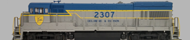
First introduced in the late 50's, the GE FDL is one of the most popular locomotive prime movers ever produced. Aside from a very few HDL prime movers installed in the AC6000CW's, FDL prime movers were still being put in every new GE locomotive until 2003 when the first Evolution Series was implemented.
Our GE 12cyl 7FDL Early Prime mover would be appropriate for the following locomotives:
U23B, U20C, U23C, U26C
Some newer GE 12cyl 7FDL equipped locomotive had a SLIGHTLY different sound due to a larger exhaust and other hardware. While we will be releasing that sound file shortly, this file will be a VERY close substitute until then. Those locomotives would include:
B23-7, BQ23-7, B30-7A, C30-7A
Recorded from a GE U23B
This project is a normal idle version. It has a single early exhaust stack.
File also contains an "Isolation Switch" Mode on F15 when Standing Still.
Pressing F15 while not moving will lower the prime mover and lock the motor. F15 must be turned off to begin moving.
Another Mode is "Reverser In Center Position". When pressing F24 while stopped, the motor will lock so you can throttle through the notches like the prototype in neutral. F24 must be turned off to begin moving.
This project has "Run 8" mode. When turning on F26 with F28 off, the prime mover goes to run 8. Turning off F26 returns the prime mover sounds back to normal mode.
This project has "Coast" mode. When turning on F27 with F28 off, the prime mover goes to idle for coasting purposes. Turning off F27 returns the prime mover sounds back to normal mode.
You can still use F26 and F27 for manual notching. You have to keep both F26 and F27 off before pressing F28 to turn on manual notching. Once F28 is on, you can use F26 to notch up and F27 to notch down. F26, F27, and F28 must be turned off to return to normal mode.
This project has "Load" mode. When turning on F29 with F15, F24, F26, F27, F28 off, the prime mover goes into load mode. While you are using load mode, the prime mover will notch up 1 or more notches based on primary load settings(CV104). The throttle notches up using speed instead of requested speed while using the load feature. F29 must be turned off to return to normal mode.
Prime mover volume selection mode. By default the prime mover has volume dynamics. Meaning idle is soft while notch 8 is loud. This is very prototypical. The next option is volume maxed out. Meaning idle and notch 8 are the same volume. This is more suitable for people who like it loud.
Change the sound configuration of the prime mover sound slot 1
CV31 = 16, CV32 = 1
----------------------
CV263 = 0 Prime Mover Dynamic Volume Control
CV263 = 1 Prime Mover Max Volume
1st Generation Horn Pack 2
Horns (SoundCV9):
CV163=0 Leslie S-3J
CV163=1 Leslie S-3K-R
CV163=2 Leslie RS-3L
CV163=3 Leslie S-5T-F
CV163=4 Leslie S-5T-R
CV163=5 Leslie S-5T-RRO
CV163=6 Leslie SL-4T
CV163=7 Nathan K-5LA
CV163=8 Nathan M-3H-R2
CV163=9 Nathan M-3-R1
CV163=10 Nathan M-3-RT1
CV163=11 Nathan M-5-R24
CV163=12 Wabco A-2
GE U-Boats Bell Template Pack 1
Bells (SoundCV10):
CV164=0 GE M 6731022A Steel Bell 004
CV164=1 GE M 6731022A Steel Bell 005
CV164=2 GE M 6731022A Steel Bell 009
CV164=3 GE M 6731022A Steel Bell 021
Auto Bell:
Many Second and Third Generation locomotives have been fitted with an Automatic Bell that is triggered when the horn is blown. In MANY cases this cannot even be bypassed on modern locos. Before the FRA mandated this feature on new locomotives the bell was of course turned on and off separately. Some locomotives were delivered with a manual bell and have been converted to an automatic bell. This creates a challenge in sound file creation.
We realize that not every loco with a particular prime mover had this feature. As such we have built in an option to turn the feature on and off. We will set the default in the file to be what is most appropriate for the particular file.
To turn the feature OFF - Auto Bell OFF:
1. Remove the Auto bell sound slot from the function mapping chart
CV31 = 16, CV32 = 8
----------------------
CV311 = 4
2. Change the sound configuration of the Auto bell sound slot
CV31 = 16, CV32 = 1
----------------------
CV287 = 0
To turn the feature ON - Auto Bell ON:
1. ADD the Auto bell sound slot from the function mapping chart
CV31 = 16, CV32 = 8
----------------------
CV311 = 12
2. Change the sound configuration of the Auto bell sound slot
CV31 = 16, CV32 = 1
----------------------
CV287 = 1
Auto Bell Timer:
The Bell timer is amount of time the bell will play after the horn if the auto timer is active. The timer is broken down into 1/4 of a second increments.
CV169=4 - 1 Second
CV169=8 - 2 Seconds
CV169=12 - 3 Seconds
CV169=16 - 4 Seconds
CV169=20 - 5 Seconds - Default
Etc...
1st Generation Brake Squeal Template Pack 1
Brake Squeal (SoundCV11)
CV165=0 Composition Shoe #1
CV165=1 Cast Iron Shoe #1
GE U-Boats Air Dryer Template Pack 1
Air Dryer (SoundCV12)
CV166=0 U23B Air Dryer 1
CV166=1 U23B Air Dryer 2
CV166=2 U30C Air Dryer 1
CV166=3 U36B Air Dryer 1
S0705 - Release Notes
===================================================
V-4 R-4:
===================================================
- description mispelling fix
- description brake squeal error fix
- soundslot brake squeal spelling mistake
- remastered prime mover Hide description more…
H0 N XL L M4
- Article numbers
- S0705
- Last change
- 7/31/2024
- Manufacturer
- ESU
License Agreement
1. GRANT OF LICENSE
1.1 ESU grants you a non-transferable, limited, non-exclusive right to use the Content solely for your own personal purposes. You may load the Content into RAM, as well as installation on a hard disk or other storage device on a single computer, hardware product or mobile device owned by you or under your control. The installation process may result in a copy of the Content residing on your computer, in which case, you may retain one (1) copy of the Content on your computer, provided that you retain all copyright and other proprietary notices on the copy and the copy is kept in your possession with the original.1.2 By using the Content, you shall not obtain any ownership, copyright, proprietary or other interest in or to the Content. The Content is licensed, not sold.
1.3 You are licensed to use, modify and combine the Sound Samples with sound samples provided by third parties, to create your own sound compositions which, subject to you complying with the terms of this Agreement, you are free to distribute as you wish provided that: (i) the Sound Samples have been mixed together to create an original work; (ii) individual Sound Samples are not used in isolation and (iii) the Sound Samples or derivatives are not used to create sound libraries for distribution to third parties.
2. PROHIBITED USES
Neither you, nor anyone at your direction, shall:2.1 use the Content, or any part of it, for any public performance, live broadcast or time delayed live broadcast where the Content is used unattended for commercial purposes without ESU' s prior written consent;
2.2 use the Content, or any part of it, in any competitive product;
2.3 sub-license, copy, reproduce, transmit, assign, rent, sell, lease, offer on a pay-per-play basis, distribute for money or any other consideration, or commercially exploit in any other manner or through any medium whatsoever or otherwise transfer in any way the Content or any part thereof;
2.4 manufacture and/or distribute for money or otherwise commercially exploit any product that incorporates any part of the Content. If you wish to use any part of the Content for manufacture, resale, sub-license or further distribution, you must contact ESU (and where relevant, its licensors) to enter into an appropriate agreement with ESU (and, where relevant, its licensors);
2.5 publish the results of any analysis or comparative evaluation of the Content or any part thereof without ESU' s prior written consent;
2.6 reverse engineer, recompile or disassemble any part of the Content except to the extent and in the circumstances expressly permitted by ESU and its licensors in writing or by law;
3. INTELLECTUAL PROPERTY RIGHTS
You acknowledge that all intellectual property rights in the Content are and shall remain vested in ESU and its licensors. You undertake not to interfere with or diminish, whether by act or omission, the rights, title and interest in the Content of ESU and its licensors. You may be held responsible by ESU and/or any of its licensors for any infringement of any intellectual property rights in the Content. For the avoidance of doubt, provided that you comply with the terms of this Agreement, ESU shall not claim ownership of the intellectual property rights in any compositions created by your use of the Content.4. TERM AND TERMINATION
This Agreement is effective from the first date you install the Content. The rights granted to you under this Agreement shall terminate if you fail to abide by its terms. Upon such termination you agree to destroy the Content including any Content stored on the hard disk of any computer under your control. You may terminate this Agreement at any time by destroying or erasing all your copies of the Content. Any termination of this Agreement (howsoever occasioned) shall not affect any accrued rights or liabilities of you or ESU nor shall it affect the coming into force or the continuance in force of the provisions of Clauses 2, 3, 5 and 6 and any provision hereof which is by implication intended to come into or continue in force on or after such termination.5. NO WARRANTIES
TO THE MAXIMUM EXTENT PERMITTED BY APPLICABLE LAW, ESU AND ITS LICENSORS PROVIDE THE CONTENT "AS IS" AND ESU EXCLUDES ON BEHALF OF ITSELF AND ITS LICENSORS, ALL CONDITIONS, TERMS, REPRESENTATIONS (OTHER THAN FRAUDULENT REPRESENTATIONS) AND WARRANTIES RELATING TO THE CONTENT, WHETHER IMPOSED BY STATUTE OR BY OPERATION OF LAW OR OTHERWISE, INCLUDING BUT NOT LIMITED TO, IMPLIED WARRANTIES OF SATISFACTORY QUALITY AND FITNESS FOR A PARTICULAR PURPOSE. NEITHER ESU NOR ITS LICENSORS WARRANT THAT THE OPERATION OF THE CONTENT WILL BE UNINTERRUPTED, ERROR FREE, VIRUS FREE OR MEET YOUR SPECIFIC REQUIREMENTS. YOU MAY HAVE OTHER RIGHTS THAT VARY FROM JURISDICTION TO JURISDICTION.6. ESU's LIABILITY
Neither ESU nor its licensors shall have any liability to you for any loss or damage caused directly or indirectly in connection with the Content, any part thereof or this Agreement, except to the extent that such liability cannot be lawfully excluded. In any case, neither ESU nor its licensors shall be liable for any loss of business, data, profits, savings, or any other special, incidental, consequential, indirect or economic loss whatsoever even if such losses were contemplated at the date of this Agreement.7. GENERAL
7.1 You acknowledge that damages alone might be insufficient remedy for any breach of the terms of this Agreement and that the remedies of injunction, specific performance or other equitable relief would be suitable remedies in the event of any breach or threatened breach of this Agreement.7.2 You may not assign or otherwise transfer all or any part of this Agreement or the rights granted to you hereunder.
7.3 ESU is not obliged to provide any maintenance, technical support or upgrades to you.
7.4 You agree to comply with all applicable import and export regulations and acknowledge that you have the responsibility for obtaining all necessary licenses to export, re-export, transfer or import the Content.
7.5 This Agreement constitutes the entire agreement between you and ESU with respect to the subject matter hereof and supersedes all prior agreements, arrangements and understandings between the parties and constitutes the entire agreement between the parties relating to such subject matter hereof. No addition to or modification of any provision of this Agreement shall be binding upon ESU and you unless made by a written instrument signed by a duly authorized representative of ESU and you.
7.6 No forbearance, delay or indulgence by either party in enforcing the provisions of this Agreement shall prejudice or restrict the rights of that party nor shall any waiver of its rights operate as a waiver of any subsequent breach and no right, power or remedy herein conferred upon or reserved for either party is exclusive of any other right, power or remedy available to that party and each such right, power or remedy shall be cumulative.
7.7 Notwithstanding that the whole or any part of any provision of this Agreement may prove to be illegal or unenforceable the other provisions of this Agreement and the remainder of the provision in question shall remain in full force and effect.
If you download the designated file, you agree to be legally bound by the license given above.