BR420 / ET420  H0
H0
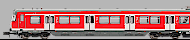
Since the three-car Class 420 S-Bahn multiple units were introduced for the 1972 Munich Olympic Games, they are often referred to as the "Olympic multiple units." With their thyristor-controlled traction control, Deutsche Bahn (DB) was breaking new ground at the time. Because the 2400 kW of power was distributed across all twelve axles, the three-car units, equipped with axle-hung traction motors, exhibited excellent acceleration. The three prototypes were followed by eight production series, more…
SBB RBe4/4 / RBe540 H0
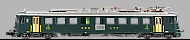
To replace locomotive-hauled express trains, the Swiss Federal Railways (SBB) procured six pre-production models of the RBe 4/4 electric multiple unit in 1959. The somewhat rough-shifting tap changer earned the four-axle units the nickname "shaker cups." The 76 production units built from 1963 onwards were equipped with a command-line control system, which enabled smoother switching operations. Since the specifications required the transport of at least three cars, the four traction motors more…
FS E.652 H0
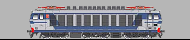
Italian State railway FS ordered 175 samples of 6 axle electric loco E652 in the late 1980s. The three traction motors work one in each of the three trucks. The motors deliver 5100 kW and enable the locos to reach a maximum speed of 160 km/h. The locos are used for traction of heavy freight and passenger trains on steep grades. Over the years, the E.652 proved itself to be a robust and versatile locomotive and is still in service with Trenitalia today. With its distinctive, angular design and more…
PKP EN57 H0
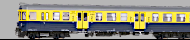
Between 1963 and 1993, the Polish PKP procured 1412 samples of the three-part electric multiple unit EN57 for the 3kV direct current network. The four traction motors in the middle car have an output of 580 kW and accelerate the train to 110 km/h. The technically largely identical series differ from the outside in some cases considerably. After 20 multiple units delivered from the factory as four-car units and designated as EN71, the PKP converted 30 more into four-car units. Manufacturer more…
SNCF BB7200 H0

Between 1976 and 1985, the French State Railways (SNCF) procured a total of 237 BB 7200 electric locomotives for their 1.5 kV DC lines. These four-axle locomotives, equipped with two TAB 674 motors, deliver 4040 kW, reach a top speed of 160 km/h, and haul both passenger and freight trains. BB 7261–7263 locomotives were upgraded for a maximum speed of 200 km/h. With the increasing modernization and expansion of the TGV network, many locomotives were gradually withdrawn from high-quality more…
BR250 DR / BR155 H0
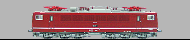
To haul fast and heavy passenger and freight trains on electrified main lines, the Deutsche Reichsbahn (DR) developed the Class 250 electric locomotives in the early 1970s. With a power output of 5400 kW, the 273 six-axle locomotives built between 1974 and 1984 were the most powerful electric locomotives in the DR's fleet. Reaching speeds of up to 125 km/h, the Class 250 could even haul express trains, as the maximum permissible line speed in East Germany was 120 km/h. Classified as Class 155 more…
BR243 DR / BR143 H0

In the late 1970s DR in German Democratic Republic ordered an multi-purpose electric loco. 646 units were produced. The four motor BR 243 (renumbered for BR 143 in 1994) reaches a maximum speed of 120 km/h. In Western Germany 143 successfully replaced worn out electrics BR 140/141 and 110 in commuter service.
Engineer/driver mode:
F4 - Pantograph up / down (only available in Engineer/driver mode). Engineer/driver mode switch on with CV170 = 1, Engineer/driver mode switch off with CV170 = more…
SNCF BB 26000 H0
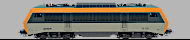
Between 1988 and 1998, the French national railway company SNCF purchased 234 BB26000 electric locomotives. Designed for operation with 1.5 kV direct current and 25 kV/50 Hz alternating current, these four-axle locomotives produce 5600 kW. Their two traction motors accelerate the locomotives, known as Sybics, to 200 km/h. After the SNCF was divided into business units, 139 locomotives, the majority of which went to the Fret freight division, and 20 to long-distance services. 14 were allocated more…
Class 350 H0
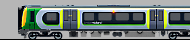
Siemens developed four-car electric multiple units known as Class 350 on the Desiro platform. The vehicles, which were purchased from 2004 onwards, have an output of 1500 kW and can be powered either by the direct current rail next to the track or by the 25 kV overhead line. The top speed of the first two series is 180 km/h, while series 3 and 4 are approved for 160 km/h.
F1 will activate the driving sound with the third rail
F2 will activate the driving sound with pantograph
F17 will bring more…
FS E.428 H0
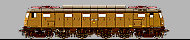
Starting in 1934, the Italian State Railways (FS) purchased a total of 242 E.428s for express train service on the direct-current electrified regional lines. Eight paired motors powered the four driving axles, producing a combined output of 2,800 kW. Two leading bogies reduced the axle load of the 135-ton, 130 km/h locomotives. The three series differ significantly in the driver's cab area. By 1989 the last machines were retired.
Heavy load operation:
F5 - Activates heavy load operation. more…