V36/V36.4 WR360 C 14 / MWM  H0
H0

From 1938 onwards, the German Wehrmacht procured several series of the three-axle WR 360 C 14 diesel locomotive in a largely standardized configuration for shunting operations within military installations. Many locomotives were equipped with the 360 hp MWM six-cylinder four-stroke RHS 235 S engine. These diesel-hydraulic locomotives reached a top speed of 60 km/h at a maximum engine speed of 700 rpm. After the Second World War, the DB (German Federal Railway) and DR (German State Railway) more…
BR 247 Vectron DE H0

Based on the Vectron electric locomotives, Siemens introduced a diesel-electric variant in 2014, featuring an overall length one meter greater than that of the electric models. In the Vectron DE, the 2,400 kW MTU 16V 4000 R84 diesel engine generates the power for the four electric traction motors. Designed for use with freight and express trains, this four-axle locomotive reaches a top speed of 160 km/h.
Although the electric Vectron family became highly successful throughout Europe, more…
BR 248 Vectron Dual Mode H0
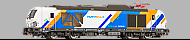
German Siemens company developed a dual mode version of electric loco Vectron. This locos immatriculated as BR 248 can operate under 15 kV catanery as well as powered by 16 cylinder diesel motor MTU 16V 4000 R84 with 2400 kW. Tractive power of 300 kN and the maximum speed of 160 km/h is available in both operations.
It was developed primarily for freight transport and quickly attracted interest from private railway companies. Press F1 to select different starting modes: Press the button once more…
V36/V36.4 WR360 C 14 / Deutz H0
From 1938 onwards, the German Wehrmacht procured several series of the three-axle WR 360 C 14 diesel locomotive in a largely standardized configuration for shunting operations in military installations. Many locomotives were equipped with the 360 hp Deutz V6M 436 six-cylinder engine. These diesel-hydraulic locomotives reached a top speed of 55 km/h at a maximum engine speed of 700 rpm. After World War II, the DB (German Federal Railway) and DR (German State Railway) refurbished many of the more…
BR 225 MTU MA 12V 956 TB10 H0

When DB AG allocated its locomotive series to the newly established business units DB Regio, DB Fernverkehr, and DB Cargo at the end of the 1990s, the steam-heated 215 locomotives were allocated to DB Regio. While DB Regio only needed a few 215 locomotives, but DB Cargo needed to replace many 216 locomotives due for major overhauls, it was decided to sell Regio's surplus 215 locomotives to DB Cargo and upgrade them for further years of freight service by removing the boiler and installing a more…
BR 215 MTU MB 16V 652 TB10 H0
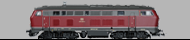
The 215 011-070 and 215 091-150 were equipped ex works with 1900 hp MTU MB 16V 652 TB10 engines. The engines heated their trains with steam generated by a Hagenuk OK 4610 steam boiler (licensed by Vapor Heating). While the boiler only hisses discreetly during operation, a characteristic multiple slapping sound can be heard when it is switched off. Since most DB passenger car types were equipped with both steam and electric train heating, the 215 series could also be used to haul high-quality more…
VT 11.5 H0
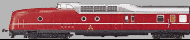
For the international TEE service, launched in 1956, the German Federal Railway (DB) procured a total of 19 power cars starting in 1957. Between each pair of power cars, five intermediate cars were coupled together. In addition to compartment and open-plan seating cars, there was also one car with a kitchen and dining area and one with a dining area and bar. Scharfenberg couplers connected the cars. Each power car was driven by a 12-cylinder, four-stroke diesel engine. As in the technically more…
BR 215 MTU MA 12V 956 TB10 H0
The classes (BR) 215 and 218 diesel locomotives of the Western German Railway (DB) are used in mixed service since 1968.
218 101 to 194, 218 242 to 288 were equipped with a 12 cylinder 4 stroke main Diesel from MAN that was later called MTU 12 V 956 TB10 that generates 2500 HP. The 2800 HP version of this motor is called MTU 12 V 956 TB11.
In the late 1980s the exhaust system of BR 218 with the 12 V motor had been optimized. Since 1995 many of the 218 are equipped with motors called "MTU 12 more…
V80 H0

The V80, procured in ten units starting in 1952, was the prototype of all diesel-hydraulic mainline diesel locomotives of the German Federal Railway (DB). These 100 km/h locomotives were intended for light mainline service and heavy shunting and served as testbeds for hydrodynamic transmissions, cardan shaft drives, and diesel engines. The results of these trials contributed to the development of the V100, V200, and V160 series. The diesel engines used were either two 800 hp engines from more…
ADtranz DE AC33C Blue-Tiger H0
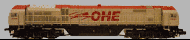
With diesel-electric Blue Tiger DE-AC 33C German ADtranz entered the market of heavy freight diesel locos in 1996. After delivery of 30 samples for Pakistan and 20 for Malaysia another 10 were ship to some private railroads in Germany. The prime mover GE 7FDL 12 EFI delivers 2460 kW at 1050 rpm and produces the energy for the six traction motors GE GEB 15. The loco reaches a maximum speed of 120 km/h.