E32 / BR 132  H0
H0

In 1924 German Deutsche Reichsbahn-Gesellschaft DRG received the first sample of side rod equipped electric loco E32. The 29 locos developed 1170 kW and reached a maximum speed of 75 km/h. In the 1930s eight locos were re-geared for a maximum speed of 90 km/h. In 1971 the last remaining locos quitted service at the DB.
Engineer/driver mode:
F4 - Pantograph up / down (only available in Engineer/driver mode). Engineer/driver mode switch on with CV170 = 1, Engineer/driver mode switch off with more…

E44/BR144 / E44.5/BR144.5

In 1932 German Deutsche Reichsbahn-Gesellschaft DRG received 1st of 174 samples of four-axle electric loco E44. The four motors delivered 2200 kW and enabled the E44 to reach a maximum speed of 90 km/h. The reliable locos rested in service at DB until 1985, last DR locos quitted service in 1991. For electric service on Bavarian mountain line Freilassing – Berchtesgaden DRG ordered eight samples of electric E44.5. The four-axle four-motor loco developed 2000 kW and reached a maximum speed of 90 more…
E50 / BR 150

In 1957 German State Railway (DB) introduced it’s most powerful member of the so called “Einheits” electro locomotive family. The massive six axle six motor locomotives delivered 4500 kW and reached a maximum speed of 100 km/h. In 2003 last remaining 150 quitted service, but two locos are preserved in DB Museum.

E94

In the late 1930s the German DRG wanted to increase the weight of freight trains. Therefor six axle E94 had been developed. During WWII 146 samples were built. The six motor locos develop 3300 kW and reach a maximum speed of 90 km/h. After the war 44 locos were overtaken by Austrian Railway OEBB, another 23 were refitted by DR of German Democratic Republic of Germany. After building some new locos till 1956 the DB used 124 locos for heavy freight service. Sometimes the locos could be seen also more…
ELNA H0

To standardize steam locomotives, the Engere Locomotive Standards Committee (ELNA) was founded in 1917. In addition to the framework conditions for the Einheitslokomotiven of the Deutsche Reichsbahn-Gesellschaft DRG, the ELNA also laid down principles for steam locomotives of non-state-owned railways. Three types were developed, of which the 1’C and D versions were by far the most common. Many parts could be exchanged for one another. Since frames, water boxes and driver's cabs were not more…
ET403 DB H0
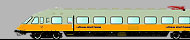
In 1973, the Deutsche Bundesbahn DB received three electric multiple units for inter-city express transport. All 16 axles of the four-part vehicle were powered. As was usual at the time, the trains only had first class places. Due to the small number of units, various assemblies from the already proven ET 420 S-Bahn multiple unit were installed, which enabled a reasonably secure stock of spare parts for wearing parts. The output was 3840 kW, the maximum speed in passenger operation was 200 more…
ET65 DR / BR465 DB H0
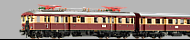
For suburban traffic in Stuttgart, the Deutsche Reichsbahn-Gesellschaft DRG initially purchased 21 units of the ET65 electric multiple unit from 1933. The four-axle vehicles with a top speed of 85 km/h initially drove as firmly coupled to the control car. Due to the increased space requirement, the sets in the middle of the train were supplemented by non-powered double wagons. Another, technically unchanged series of 23 powered rail cars and control cars followed in 1938. In the 1960s, the DB more…
ET85 DR / BR485 DB H0
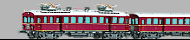
Deutsche Reichsbahn-Gesellschaft DRG ordered 32 samples of electric railcar ET 85 in 1927. The four-axle units develop 500 kW and reach a maximum speed of 75 km/h (ET 85 05 and 09 enabled for 100 km/h).
Engineer/driver mode:
F4 / F5 - Pantograph up / down (only available in Engineer/driver mode). Engineer/driver mode switch on with CV170 = 1, Engineer/driver mode switch off with CV170 = 0)
The Engineer/driver mode serves as a prototypical control of the train. The realistic start up process more…