MaK 650D  H0

In 1957 German MaK Kiel factory offered a four axle side rod diesel locomotive MaK 650D. The 21 samples of this loco were equip with 6 cylinder prime mover MS301CK that delivered 650 HP at 750 rpm and enabled the loco to reach a maximum speed of 71 km/h.
BR03.10 DB Neubaukessel H0

In the early days of the Deutsche Bundesbahn DB, the 03.10, which had been freed from the streamlining, were heavily used in express train service, which revealed the boiler's weaknesses. In order to remedy these deficiencies, the DB equipped a total of 25 units with new replacement boilers from 1957, which had proven themselves in the 41 series. With an output of 1870 hp and a top speed of 140 km/h, the locomotives from Hagen mainly pulled express trains. Since the locomotives were very more…
BR227 / V170 / AA16 NoHAB MY H0

After the Second World War, various European locomotive manufacturers began developing diesel-electric locomotives, which began to displace steam traction in the USA. In Sweden, Nydqvist and Holm AB (NoHAB) acquired the license to manufacture diesel locomotives for the Electro-Motive Division (EMD) in 1949. The Americans owned an export version of the F-series, which had a driver's cab at both ends. For the lighter superstructure in Europe, locos were equipped qith six instead of four axles. more…
BR 218 / MTU-MA-12V-956-TB11 H0

The classes (BR) 215 and 218 diesel locomotives of the Western German Railway (DB) are used in mixed service since 1968.
218 101 to 194, 218 242 to 288 were equipped with a 12 cylinder 4 stroke main Diesel from MAN that was later called MTU 12 V 956 TB10 that generates 2500 HP. The 2800 HP version of this motor is called MTU 12 V 956 TB11.
In the late 1980s the exhaust system of BR 218 with the 12 V motor had been optimized. Since 1995 many of the 218 are equipped with motors called "MTU 12 more…
Class 66/77 / EMD JT42CWR H0
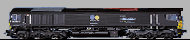
Mit der im Jahr 2001 festgelegten Liberalisierung des internationalen Eisenbahngüterverkehrs benötigten die neu gegründeten Eisenbahnverkehrsunternehmen (EVU) Triebfahrzeuge, um die den staatlichen Bahnen abgerungenen Verkehre zu bewältigen. Die Beschaffung technisch hochentwickelter Neufahrzeuge kam aus Kostengründen oftmals nicht in Frage. Eine preisgünstige Lösung bot die amerikanische Electro-Motive Division (EMD) mit der bereits in Großbritannien erprobten Class 66 an. Die als JT 42 CWR more…
BR 45 H0
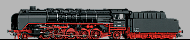
German Deutsche Reichsbahn-Gesellschaft DRG ordered 28 samples of steam locomotive BR 45 for heavy and fast freight duty. The 3-cylinder locos developed 2800 HP and reached a maximum speed of 90 km/h. After WW II seven locos were given to testing department BZA of Deutsche Bundesbahn to simulate heavy trains during approval runs of new locomotives.
BR 85 H0

BR 85 had been develop for trains on steep grades by the Deutsche Reichsbahn-Gesellschaft (DRG) in 1932. Ten units of the 3 cylinder 2-10-2 had been built. They developed 1500 HP and reached a maximum speed of 80 km/h. In 1961 last sample of 85 quitted service at Deutsche Bundesbahn (DB).
BR 44 Kohle H0

BR 44 had been the most successful steam loco for heavy freight trains at the Deutsche Reichsbahn-Gesellschaft (DRG). Between 1926 an end of WWII 1989 units of the 3 cylindred 2-10 had been built. They developed 1919 HP and reached a maximum speed of 80 km/h. In the 1950s Deutsche Bundesbahn (DB) and Deutsche Reichsbahn (DR) rebuilt 36 (DB) and 95 (DR) with oil firing equipment.
BR 44 Oel H0
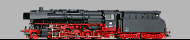
BR 44 had been the most successful steam loco for heavy freight trains at the Deutsche Reichsbahn-Gesellschaft (DRG). Between 1926 an end of WWII 1989 units of the 3 cylindred 2-10 had been built. They developed 1919 HP and reached a maximum speed of 80 km/h. In the 1950s Deutsche Bundesbahn (DB) and Deutsche Reichsbahn (DR) rebuilt 36 (DB) and 95 (DR) with oil firing equipment.
BR 111 H0

Electric loco 111 of Deutsche Bundesbahn DB was purchased for fast passenger service on main lines. The four traction motors develop 3620 kW and enable the loco to reach 160 km/h. For consist use with heavy Intercity trains some locos received new pantographs. Some years ago all of the locos were given to DB Regio for push-pull operation.
Engineer/driver mode:
F4 - Pantograph up / down (only available in Engineer/driver mode). Engineer/driver mode switch on with CV170 = 1, Engineer/driver more…