BR Class 08  H0
H0

To modernize the shunting service, the British State Railways BR procured 996 units of the Class 08 based on an LMS design from 1952. The three-axle diesel-electric locomotive had an output of 350 hp(261 kW/h, Speed 15 mph) and reached a top speed of 32 km/h. The two DC traction motors transmit their power to the wheel sets via coupling rods. 26 other locomotives received a gear reduction adapted for higher speeds and were listed as Class 09..
Different starting processes can be selected with more…
BR Class 150 H0
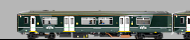
Between 1984 and 1987 British Rail BR of England received 137 samples of diesel hydraulic railcars Class 150. Cummins 6 cylinder Diesel engine (213 kW at 2100 rpm) enalbles the raicars to speed up to 121 km/h.
Different starting processes can be selected with F1: 1x press button = warm start / press button 2x = false start / press button 3x = cold start
F2 slows down the locomotive slowly.
F5 enables the heavy load mode: The diesel notch is always one up compared with normal operation. If more…
BR Class 20 H0

From 1957, the British Rail BR procured a total of 228 units of the diesel-electric Class 20 for light freight train service. The supercharged eight-cylinder EE 8-CSVT engine from English Electric generated the energy for the four DC traction motors. The top speed of 120 km/h, which is still sufficient today, and good reliability are among the reasons why some of the locomotives are still in service today. Since the driver's cab was at one end of the locomotive and visibility was poor ahead of more…
BR Class 31 H0

After twenty pre-series locomotives of the six-axle Class 31 diesel locomotive, British Rail (BR) procured a further 243 units by 1962. The less reliable Mirrless diesel engine was replaced at an early stage by one from English Electric, which resulted in the 31/1 design, which was also equipped with an electropneumatic control system that had already proven its worth in other series. The 1100 kW diesel engine generates the energy for the four electric traction motors. The middle axles of the more…
BR Class 37 H0
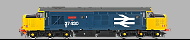
With 309 units built, the Class 37, originally built as the English Electric Type 3, was a familiar sight on English main and branch lines from 1967. The power for the six electric traction motors was initially generated by a 1305 kW English Electric twelve-cylinder 12CSVT diesel engine. Originally, most locomotives for heating passenger trains were equipped with a steam boiler; some locomotives that were initially delivered without a boiler for cost reasons were retrofitted with the component more…
BR Class 40 H0
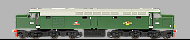
Between 1958 and 1962, the British State Railways BR 200 had diesel-electric Class 40s built for heavy-duty express train service. The 16-cylinder diesel engine delivered 2000 HP and generated the energy for the six DC motors, which accelerated the 136-ton locomotive to 140 km/h. The high weight made two running axles necessary, which were combined with three driving axles to form a bogie. With the introduction of the high-speed trains in the late 1970s, the star of the Class 40 sank and so in more…
BR Class 47 H0
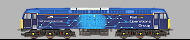
British Rail BR ordered 512 samples of dieselelectric Class 47. The Sulzer 12LDA28C prime mover 2750 HP and enable the six-axle locos to reach a speed of 153 km/h or 121 km/h depending on gearing.
Different starting processes can be selected with F1: 1x press button = warm start / press button 2x = false start / press button 3x = cold start
F2 slows down the locomotive slowly.
For F3 and F4, a total of 2 different signal horn variants can be selected with CV167: Value 0 = Horn variant 1 more…
BR Class 55 Deltic H0
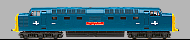
Few locomotives have captured the imagination quite like British Rail’s English Electric Type 5/class 55 ‘Deltics’. First introduced in 1961, their twin Napier Deltic engines generated 3,300 horsepower, making them the most powerful single unit diesel locomotives yet produced at that time. Capable of speeds in excess of 100 miles per hour, the Deltics were worthy successors to the famous express steam locomotives of Gresley, Peppercorn and Thompson on BR’s East Coast Main Line, working top link more…
BR Class 57 (EMD 12 645E3) H0
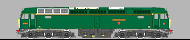
The emergence of the Class 57 went back to the idea of the British freight train service provider Freightliner, founded in the 1990s, who wanted to buy some of the state-owned British Rail Class 47s, which were prone to damage and were inefficient, and wanted to use them again after modernization. As a life-prolonging measure, for example, the 12-cylinder diesel engine 12-645 from EMD, which has been tried and tested ten thousand times over, was installed, which accelerated the six-axle vehicle more…
BR Class 57 (EMD 12 645F3B) H0

The emergence of the Class 57 went back to the idea of the British freight train service provider Freightliner, founded in the 1990s, who wanted to buy some of the state-owned British Rail Class 47s, which were prone to damage and were inefficient, and wanted to use them again after modernization. As a life-prolonging measure, for example, the 12-cylinder diesel engine 12-645 from EMD, which has been tried and tested ten thousand times over, was installed, which accelerated the six-axle vehicle more…