SBB Re450  H0
H0
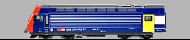
The Swiss Federal Railways (SBB) commissioned the Re 450 series to be developed for use with double-decker trains on the Zurich S-Bahn network. Technically, the locomotive is based on the KTU converter-type Re 4/4 locomotive developed for several private railways. Unlike these, the S-Bahn locomotive has only one driver's cab and no conventional buffers or drawbars, but instead features automatic couplers. The 115 four-axle, 3000 kW locomotives, purchased in several series, reach a top speed of more…
Adler H0

Bavarian Railway Ludwigs-Eisenbahn-Gesellschaft bought famous „Adler“ steam locomotive at British manufacturer Robert Louis Stephenson. The loco with its single-axle drive delivered 41 HP and reached a maximum speed of 65 km/h.
140-C ÉTAT SNCF H0
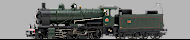
Between 1913 and 1917 the French state railway company ÉTAT purchased 340 copies of the 1’D 140 C steam locomotive. After the beginning of the First World War, production was outsourced to British manufacturers. A third series of 70 machines was ordered for the transport of French artillery trains and after the War sold in equal parts to the French Eastern Railway EST and the PLM. The locomotives intended for freight train service developed 1210 hp and achieved an impressive 70 km/h for a more…
ETAT 231 981-996, SNCF H0
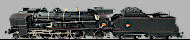
After the First World War, the French ETAT received 16 examples of the Bavarian express train locomotive type S3/6. The four-cylinder locomotives were classified as 3-231 A981-996. The three-coupled locomotives, which had 1770 hp and could reach speeds of 120 km/h, were used in the south-west of France and proved very effective on express and passenger trains. During the Second World War, the German occupying forces drove the locomotives to southern Germany and returned them to scrap after the more…
SNCF 141TA H0

Between 1911 and 1923 French Railway Company Prais-Orleans PO received 190 samples of two cylinder tank engine 141 TA. The locos reached a maximum speed of 70 km/h and had been used in commuter service around Paris as well as on branch lines in Massif Central area. In 1970 the last 141 TA had been withdrawn.
ET403 DB H0
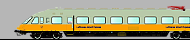
In 1973, the Deutsche Bundesbahn DB received three electric multiple units for inter-city express transport. All 16 axles of the four-part vehicle were powered. As was usual at the time, the trains only had first class places. Due to the small number of units, various assemblies from the already proven ET 420 S-Bahn multiple unit were installed, which enabled a reasonably secure stock of spare parts for wearing parts. The output was 3840 kW, the maximum speed in passenger operation was 200 more…
SNCF 141R / 1244 Mikado H0
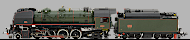
Based on approved USRA light Mikado design French State Railway SNCF ordered 1323 samples of 2-8-2 steam loco 141 R. The dependable 2 cylinder locos reached a maximum speed of 100 km/h and were used in freight and passenger service until 1974. F4: coal shoveling / oilburner selectable via Sound CV169 value 0-1
61 001 Stromlinien-Tenderlok H0

In 1935, the Deutsche Reichsbahn-Gesellschaft DRG acquired the streamlined 61 001 to haul the famous Henschel-Wegmann train. The two-cylinder locomotive had an output of 1450 hp and reached a speed of 175 km/h. After the Second World War, the one-off remained with the DB, which used it to pull express trains after dismantling the engine cover before it suffered damage in 1951. As the DB no longer wanted to finance repairs to the locomotive, the machine was taken out of service in 1952, but was more…
BR 01.5 Rekolok DR H0
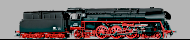
After the Second World War, the Deutsche Reichsbahn DR had 65 Class 01 locomotives. At the end of the 1950s, the DR included the indispensable 01 in its reconstruction program and from 1961 onwards equipped a total of 35 machines with new boilers, new pumps and, for the most part, new cylinders. By 1966, the majority of the 2240 hp, 130 km/h 01.5s had also been fitted with oil main firing, which made the powerful and reliable three-coupler very popular with the staff. It was only after the more…
GWR Class 41xx H0

From 1908, the British Great Western Railway GWR purchased several series of a steam locomotive type generally known as the Large Prairie (wheel arrangement 2-6-2T). The last series were the 4100-4179, built between 1934 and 1949. The three-coupled locomotives, which were equally fast forwards and backwards, were primarily used on suburban trains, but also proved their worth on light freight trains. The last of the 1039 hp, 75 mph two-cylinder superheated steam locomotives were retired by 1965, more…