BR227 / V170 / AA16 NoHAB MY  H0
H0

After the Second World War, various European locomotive manufacturers began developing diesel-electric locomotives, which began to displace steam traction in the USA. In Sweden, Nydqvist and Holm AB (NoHAB) acquired the license to manufacture diesel locomotives for the Electro-Motive Division (EMD) in 1949. The Americans owned an export version of the F-series, which had a driver's cab at both ends. For the lighter superstructure in Europe, locos were equipped qith six instead of four axles. more…
V200.0 H0

In early 1950s young German Federal Railway (DB) introduced four axle two motor dieselhydraulic V200. The loco is powered by two 12 cylinder 1100 HP diesel made by Daimler-Benz, MAN or mostly a MD650 made by Maybach. For use in passenger service all locos received steam heating equipment by Hagenuk. With its maximum speed of 140 km/h the locos were used for multi purpose. After around 30 years DB discharged the locos. 13 locos went to Italian users, seven were sold to swiss SBB for traction of more…
BR 218 / MTU-MA-12V-956-TB11 H0
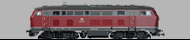
The classes (BR) 215 and 218 diesel locomotives of the Western German Railway (DB) are used in mixed service since 1968.
218 101 to 194, 218 242 to 288 were equipped with a 12 cylinder 4 stroke main Diesel from MAN that was later called MTU 12 V 956 TB10 that generates 2500 HP. The 2800 HP version of this motor is called MTU 12 V 956 TB11.
In the late 1980s the exhaust system of BR 218 with the 12 V motor had been optimized. Since 1995 many of the 218 are equipped with motors called "MTU 12 more…
Class 66/77 / EMD JT42CWR H0
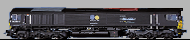
Mit der im Jahr 2001 festgelegten Liberalisierung des internationalen Eisenbahngüterverkehrs benötigten die neu gegründeten Eisenbahnverkehrsunternehmen (EVU) Triebfahrzeuge, um die den staatlichen Bahnen abgerungenen Verkehre zu bewältigen. Die Beschaffung technisch hochentwickelter Neufahrzeuge kam aus Kostengründen oftmals nicht in Frage. Eine preisgünstige Lösung bot die amerikanische Electro-Motive Division (EMD) mit der bereits in Großbritannien erprobten Class 66 an. Die als JT 42 CWR more…
MAN Schienenbus
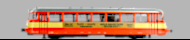
German MAN developed a 2 axle Diesel railcar in 1955. The car was delivered with one or two MAN diesel engines. Single engine cars and developed 150 to 180 HP, double engine cars developed 300 up to 400 HP. Many customers ordered the railcars with two motors to pull freight cars on branch lines. Maximum speed was between 70 and 90 km/h depending on gearing.
Please note: With CV 168, the motor sequence can be changed from two to one drive motor.
Twin engine: CV 168 = 0 (default)
Single engine: more…
Henschel-BBC DE2500/BR202 DB

The DB Class 202, also commonly referred to under its manufacturers' designation Henschel-BBC DE2500, since it was only in experimental use and never purchased by the DB, is a class of diesel-electric locomotives designed for use on main and secondary lines for both passenger and freight trains.
MaK DE 1002 (MTU-12V-396)
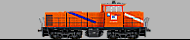
Diesel electric loco DE 1002 of German manufacturer MaK is a reliable design for medium freight service of private owners. The 12-cylinder diesel prime mover develops 1120 or 1320 kW at 1800 rpm and enables the DE 1002 to reach a maximum speed of 90 km/h. The 24 locos are delivered between 1982 and 1988.
MaK DE 1002 (MWM-TBD-604B)

Diesel electric loco DE 1002 of German manufacturer MaK is a reliable design for medium freight service of private owners. The 12-cylinder diesel prime mover develops 1120 or 1320 kW at 1800 rpm and enables the DE 1002 to reach a maximum speed of 90 km/h. The 24 locos are delivered between 1982 and 1988.
BR265

For heavy switching and freight service German State Railway DB ordered 31 samples of diesel hydraulic Voith-Gravita® loco. Prime mover MTU 12V 4000 R43L delivers 1800 kW at 1800 rpm and enables the loco to reach a maximum speed of 100 km/h. Also loco rental service Northrail and HzL in Southern Germany bought two samples each.
Wismarer Schienenbus

In the early 1930s the German Waggonfabrik Wismar developed a small two motor railcar. Each of the two motors develop 50 HP at the cars with 4000 mm wheelbase and 90 HP at the longer ones with 6000 mm wheelbase. The railcars reach a maximum speed of 60 km/h.