BR 78 / pr. T18  H0
H0

In 1912 Prussian State Railway ordered the first of 462 samples of the 4-6-4 saddle tank loco T18. The two-cylinder loco developed 1140 HP and reached a maximum speed of 100 km/h. The locos were used for passenger trains on main and branch lines and stayed in service until 1974. SoundCV9 (CV163): train driver's dialogue (different languages selectable with value 0-1)
BR 80 H0

In order to replace uneconomical old worn out locomotives in shunting service, the Deutsche Reichsbahn-Gesellschaft DRG also included a shunting locomotive with an axle load of 18 t in the Einheitslok program. From 1928 the DRG put 39 copies of the 575 hp three-coupler into service. After the Second World War, 21 machines remained with the DR and 17 locomotives with the DB. Despite convincing operating characteristics, the DB stopped its 80 until 1965, as the new V60s were available in more…
BR 81 H0

German Deutsche Reichsbahn-Gesellschaft DRG ordered 10 samples of four axle steam locomotive for shunting service in 1928. The two cylinder locos BR 81 developed 860 HP and reached a maximum speed of 45 km/h. In 1963 final loco quitted service at DB.
BR 85 H0

BR 85 had been develop for trains on steep grades by the Deutsche Reichsbahn-Gesellschaft (DRG) in 1932. Ten units of the 3 cylinder 2-10-2 had been built. They developed 1500 HP and reached a maximum speed of 80 km/h. In 1961 last sample of 85 quitted service at Deutsche Bundesbahn (DB).
BR 95 DRG/DR/DB pr.T20 H0

For service on steep grades prussian state railway (KPEV) ordered 45 samples of 2-10-2 steam locos T20. Successor DRG re-numbered them for 95.0. The locos delivered 1620 HP and reach a maximum speed of 65 km/h. The powerful locos were used for short line passenger and freight service. After WW II 14 locos were used by DB till 1958. DR rebuilt 24 samples with oil firing equipment and used them till 1981.
F4: coal shoveling or oil bruner (coal shoveling CV166 = 0 / oil bruner CV166 = 1)
F17: more…
BR 96 bay. Gt 2x 4/4 H0

From 1913 onwards, the Bavarian State Railway purchased a total of 15 samples of the Gt 2x 4/4 Mallet tank locomotive to push heavy freight trains on the steep routes in the Franconian Forest and Thuringian Forest. Although the 1,470 hp eight-axle locomotives were considered the most powerful tank locomotives in Europe at the time, manufacturer Maffei was able to limit the maximum axle load to 15.5 t, which is why the powerful locomotives could even be used on branch lines. With various more…
BR 98.8 Bayr. GtL 4/4 H0

From 1911 onwards, Krauss delivered 117 examples of the GtL 4/4 two-cylinder local railway locomotive in several series to the Bavarian State Railways. The Deutsche Reichsbahn-Gesellschaft DRG received the last 17 in 1927 and grouped them as the 98.8 series. With an output of 450 hp, the four-couplers were the most powerful Bavarian local railway machines. The DRG only considered the top speed of 40 km/h to be in need of improvement and equipped the most recently delivered locomotives with a more…
BR Class 08 H0

To modernize the shunting service, the British State Railways BR procured 996 units of the Class 08 based on an LMS design from 1952. The three-axle diesel-electric locomotive had an output of 350 hp(261 kW/h, Speed 15 mph) and reached a top speed of 32 km/h. The two DC traction motors transmit their power to the wheel sets via coupling rods. 26 other locomotives received a gear reduction adapted for higher speeds and were listed as Class 09..
Different starting processes can be selected with more…
BR Class 14 H0

From 1964, British Rail (BR) purchased a total of 56 diesel-hydraulic Class 14s to transport light trains between marshalling yards and industrial areas. The Paxman six-cylinder engine, which was set to produce 650 hp at 1500 rpm, transmitted its power to the three axles via a jackshaft and coupling rods. The maximum speed limit of 40 km/h was beneficial for traction, but was hardly sufficient for long-distance travel. For this reason, the BR began selling its Class 14s to industrial companies more…
BR Class 150 H0
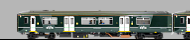
Between 1984 and 1987 British Rail BR of England received 137 samples of diesel hydraulic railcars Class 150. Cummins 6 cylinder Diesel engine (213 kW at 2100 rpm) enalbles the raicars to speed up to 121 km/h.
Different starting processes can be selected with F1: 1x press button = warm start / press button 2x = false start / press button 3x = cold start
F2 slows down the locomotive slowly.
F5 enables the heavy load mode: The diesel notch is always one up compared with normal operation. If more…