DR V100  H0

The dieselhydraulic V100 (1968 BR 110 – 115, ab 1992 BR 201 – 204, 293) had been developed by VEB Lokomotivbau „Karl Marx“ for GDR state railway DR for multi purpose service on main and branch lines. The traction motors delivered 1000 HP at 1500 rpm and enabled the loco to reach a maximum speed of 100 km/h. The turbocharged engine 12 KVD 21 SVW is similar to the motor of V180/V100.
.
Different starting processes can be selected with F1:
1x press button = warm start / press button 2x = more…
DRG DB 701 407/408 H0

The German Deutsche Reichsbahn-Gesellschaft DRG ordered six samples of electric driven tower cars for maintainance of catenary between 1929 and 1933. The vehicles delivered 105 kW and reached a maximum speed of 65 km/h if driven full electric under wire. During work at catenary the traction motor was powered by batteries.
Braking functions:
F17 - Brake function 1. The locomotive slowly brakes to a standstill with the sound of the brake valve.
Deactivate braking Sound:
F27 - more…
DSB ME H0
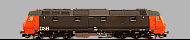
Between 1981 and 1985 the Danish State Railways DSB purchased 37 units of the diesel-electric series ME from the consortium Henschel, BBC, Scandia. Due to the positive experience with American drive technology, the 2427 kW (at 900 rpm) 16-cylinder two-stroke engine 16-645 E3B from EMD was chosen as the diesel engine, which generates the energy for the six traction motors. With a top speed of 175 km/h, the six-axle vehicles equipped with push-pull and multiple traction control were initially more…
DSB MO (Frichs 6185CA) H0
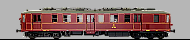
Between 1935 and 1955, the Danish State Railways (DSB) placed 139 examples of the MO diesel-electric multiple unit into service in several series. Manufactured by Scandia, the vehicles featured two Frichs 6185CA six-cylinder diesel engines, each with a combined output of 368 kW (at 1000 RPM), mounted above the three-axle bogie and generating power for the two electric traction motors mounted in the two-axle power bogie. The multiple units were equipped with multiple-traction and push-pull more…
DSB MT H0

Between 1958 and 1960 the Danish State Railways DSB purchased 16 units of the diesel-electric MT series from Frichs. The diesel engine chosen was a 361 kW (at 1400 rpm) 12-cylinder four-stroke Mercedes 820B engine without turbocharging, which generates the energy for the traction motors. With a top speed of 90 km/h and an axle load of only 52.1 tons, the four-axle bogie locomotives were mainly used on secondary lines for pulling light passenger and freight trains. The class MT is a prime more…
DSB MX (II) H0
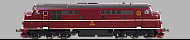
After the Second World War, various European locomotive manufacturers began developing diesel-electric locomotives, which began to displace steam traction in the USA. In Sweden, Nydqvist and Holm AB (NoHAB) acquired the license to manufacture diesel locomotives for the Electro-Motive Division (EMD) in 1949. The Americans owned an export version of the F-series, which had a driver's cab at both ends. For the lighter superstructure in Europe, locos were equipped qith six instead of four axles. more…
DSB MY (II) H0

After the Second World War, various European locomotive manufacturers began developing diesel-electric locomotives, which began to displace steam traction in the USA. In Sweden, Nydqvist and Holm AB (NoHAB) acquired the license to manufacture diesel locomotives for the Electro-Motive Division (EMD) in 1949. The Americans owned an export version of the F-series, which had a driver's cab at both ends. For the lighter superstructure in Europe, locos were equipped qith six instead of four axles. more…
DSB MZ I H0
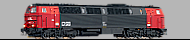
Between 1967 and 1969 the Danish State Railways DSB purchased 10 units of the diesel-electric series MZ I, and in the following year 16 units of the type MZ II, which differ from the former only in a changed position of the battery box and the air reservoir. Traditional American engine technology works in the locomotive bodies manufactured by Frichs. The diesel engine chosen was the 2426 kW (at 900 rpm) 16-cylinder two-stroke engine 16-645 E3 from EMD, which generates the energy for the six more…
DSB MZ II H0
Between 1967 and 1969 the Danish State Railways DSB purchased 10 units of the diesel-electric series MZ I, and in the following year 16 units of the type MZ II, which differ from the former only in a changed position of the battery box and the air reservoir. Traditional American engine technology works in the locomotive bodies manufactured by Frichs. The diesel engine chosen was the 2426 kW (at 900 rpm) 16-cylinder two-stroke engine 16-645 E3 from EMD, which generates the energy for the six more…
DSB MZ III H0

Due to increased train loads, the Danish State Railways DSB purchased a total of 20 units of the diesel-electric MZ III series between 1972 and 74. The diesel engine chosen was the 2867 kW (at 900 rpm) 20-cylinder two-stroke engine 20-645 E3 from EMD, which generates the energy for the six traction motors manufactured in Denmark. With a top speed of 165 km/h, the six-axle vehicles were mainly used in front of passenger trains, for which they initially had steam heating. From 1978 an electric more…