18 201  H0
H0
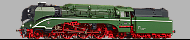
In the 1950s Deutsche Reichsbahn DR of GDR needed a high-speed locomotive to test new passenger cars. The testing department of DR developed the 18 201 out of tank loco 61 002, a new boiler (out of “Reko” re-design programme) and the cylinders of a test loco. The loco develops 1590 HP and reaches a maximum speed of 176 km/h. 18 201 is the fastest operable steam locomotive in the world.
2 - 4 Zylinder Universal

Steam locomotive universal sound 2 - 4 cylinders
suitable for German Baureihe 64 and similar loco types and sizes
61 001 Stromlinien-Tenderlok H0

In 1935, the Deutsche Reichsbahn-Gesellschaft DRG acquired the streamlined 61 001 to haul the famous Henschel-Wegmann train. The two-cylinder locomotive had an output of 1450 hp and reached a speed of 175 km/h. After the Second World War, the one-off remained with the DB, which used it to pull express trains after dismantling the engine cover before it suffered damage in 1951. As the DB no longer wanted to finance repairs to the locomotive, the machine was taken out of service in 1952, but was more…
Adler H0

Bavarian Railway Ludwigs-Eisenbahn-Gesellschaft bought famous „Adler“ steam locomotive at British manufacturer Robert Louis Stephenson. The loco with its single-axle drive delivered 41 HP and reached a maximum speed of 65 km/h.
ADtranz DE AC33C Blue-Tiger
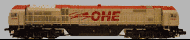
With diesel-electric Blue Tiger DE-AC 33C German ADtranz entered the market of heavy freight diesel locos in 1996. After delivery of 30 samples for Pakistan and 20 for Malaysia another 10 were ship to some private railroads in Germany. The prime mover GE 7FDL 12 EFI delivers 2460 kW at 1050 rpm and produces the energy for the six traction motors GE GEB 15. The loco reaches a maximum speed of 120 km/h.
BR 01.5 Rekolok DR H0

After the Second World War, the Deutsche Reichsbahn DR had 65 Class 01 locomotives. At the end of the 1950s, the DR included the indispensable 01 in its reconstruction program and from 1961 onwards equipped a total of 35 machines with new boilers, new pumps and, for the most part, new cylinders. By 1966, the majority of the 2240 hp, 130 km/h 01.5s had also been fitted with oil main firing, which made the powerful and reliable three-coupler very popular with the staff. It was only after the more…
BR 03 DRG H0

The Deutsche Reichsbahn-Gesellschaft had the class 03 developed to supplement the heavy express train locomotive 01, which was designed for operation on well-developed main lines. Between 1930 and 1937, 298 examples of the 1980 hp two-cylinder locomotive with a top speed of 130 km/h were built. In front of light and medium-heavy passenger trains, the three-couplers impressed with their good driving characteristics, but in many DB departments in the 1950s the travel times of the express trains more…
BR 03 Reko DR H0
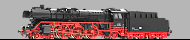
Due to the lack of heavy express train steam locomotives of the 01 series, the 03, which was less suitable for these services, had to step in in the 1950s and 1960s. Since the locomotives were still quite new in the 1950s and in good general condition, the DR decided not to reconstruct them. However, after the very new boilers of the 22 decommissioned (reconstructed BR 39, ex. pr. P10) were available from 1969, 52 old building 03s were equipped with these Reko boilers. At this point, the DR's more…
BR 111 H0

Electric loco 111 of Deutsche Bundesbahn DB was purchased for fast passenger service on main lines. The four traction motors develop 3620 kW and enable the loco to reach 160 km/h. For consist use with heavy Intercity trains some locos received new pantographs. Some years ago all of the locos were given to DB Regio for push-pull operation.
Engineer/driver mode:
F4 - Pantograph up / down (only available in Engineer/driver mode). Engineer/driver mode switch on with CV170 = 1, Engineer/driver more…
BR 120

BR 120 had been the first DB loco with 3-phase motors. In 1980 five pre-series locos had been in test service. After many successful test runs e.g. in Austria, Switzerland and Sweden DB ordered another 60 locos in slightly improved design.