V 60

File adapted to V60 ESU Engineering Edition Art. no. 31060 - 31064
ESU V60
Zu Beginn der 1950er-Jahre musste die junge Deutsche Bundesbahn (DB) ihre Lokomotivflotte erneuern. Neben Streckenloks kamen auch Rangierloks auf die Reißbretter. Für den leichten Rangierdienst gab es etwa 500 Exemplare der Kleinloks der Typen Kö/Köf. Die modernsten, speziell für den leichten und mittelschweren Verschiebedienst beschafften Einheits-Dampflok-Baureihen BR 80 und 81 waren nur in einer bescheidenen more…
V 60  H0
H0
ESU V60
Zu Beginn der 1950er-Jahre musste die junge Deutsche Bundesbahn (DB) ihre Lokomotivflotte erneuern. Neben Streckenloks kamen auch Rangierloks auf die Reißbretter. Für den leichten Rangierdienst gab es etwa 500 Exemplare der Kleinloks der Typen Kö/Köf. Die modernsten, speziell für den leichten und mittelschweren Verschiebedienst beschafften Einheits-Dampflok-Baureihen BR 80 und 81 waren nur in einer bescheidenen Stückzahl von zusammen 27 Exemplaren vorhanden. Den schweren Rangierdienst more…
BR 218 MTU-MA-12V-956-TB10 H0

The classes (BR) 215 and 218 diesel locomotives of the Western German Railway (DB) are used in mixed service since 1968.
218 101 to 194, 218 242 to 288 were equipped with a 12 cylinder 4 stroke main Diesel from MAN that was later called MTU 12 V 956 TB10 that generates 2500 HP. The 2800 HP version of this motor is called MTU 12 V 956 TB11.
In the late 1980s the exhaust system of BR 218 with the 12 V motor had been optimized. Since 1995 many of the 218 are equipped with motors called "MTU 12 more…
V90/294-074 (MTU-12V-652)

In the 1960s the German State Railway (DB) replaced old fashioned steam locos in heavy shunting service. The total new dieselhydraulic V90 is driven by a 12 cyl engine MTU MB 12 V 652 TA that delivers 1100 HP at 1400 rpm. The locos have a maximum speed of 80 km/h. In the 1980s DB installed shunting couplers and a radio control in the now called BR 290 and renumbered them in BR 294. Many of the very dependable locos are still in service.
V90/290/294 (MTU-12V-652)
In the 1960s the German State Railway (DB) replaced old fashioned steam locos in heavy shunting service. The total new dieselhydraulic V90 is driven by a 12 cyl engine MTU MB 12 V 652 TA that delivers 1100 HP at 1400 rpm. The locos have a maximum speed of 80 km/h. In the 1980s DB installed shunting couplers and a radio control in the now called BR 290 and renumbered them in BR 294. Many of the very dependable locos are still in service.
BR245 / Traxx DE ME

BR 245 is the brand new diesel electric multi-motor loco of German State Railway DB. Based on the electric locos BR 145-185 new 245 shares around 75 % of the parts with them. The four Caterpillar CAT C18 diesel motors develop 563 kW each. The loco is able to reach a maximum speed of 160 km/h. Only sometimes the traction motors need the energy of all of the four motors, so the electronic system decides by itself to start or to switch off motors during operation.
Vt858

For relations with less passenger traffic Deutsche Reichsbahn-Gesellschaft (DRG) ordered a quantity of 17 rail diesel cars with the VT 851-861 and VT 866-871. The 6-cylinder four stroke engine gave his power via four speed gear box onto one side rod equipped truck. Based on the passenger rail diesel cars the DRG also built three cars for light part load traffic. After WWII one passenger car stayed in service at DB till 1957, another one at DR till around 1960.
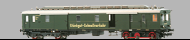
BR 265

For heavy switching and freight service German State Railway DB ordered 31 samples of diesel hydraulic Voith-Gravita® loco. Prime mover MTU 12V 4000 R43L delivers 1800 kW at 1800 rpm and enables the loco to reach a maximum speed of 100 km/h. Also loco rental service Northrail and HzL in Southern Germany bought two samples each.
BR 261

After Millenium the German State Railway (DB) need to order new locos to replace old fashioned shunting locos of Classes 362 - 365 (former BR V60) and 290 - 295 (former BR V90). The German Voith Turbo Lokomotivtechnik GmbH & Co KG developed the BR261 diesel locomotive. The prime mover of version 10BB is MTU 8V 4000 R42 and develops 1000 kW at 1800 rpm. With a maximum speed of 100 km/h and a tractive power of 258 kN the BR261 is used in heavy shunting service as well as for mid range freight more…