Class 66  H0
H0
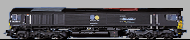
Mit der im Jahr 2001 festgelegten Liberalisierung des internationalen Eisenbahngüterverkehrs benötigten die neu gegründeten Eisenbahnverkehrsunternehmen (EVU) Triebfahrzeuge, um die den staatlichen Bahnen abgerungenen Verkehre zu bewältigen. Die Beschaffung technisch hochentwickelter Neufahrzeuge kam aus Kostengründen oftmals nicht in Frage. Eine preisgünstige Lösung bot die amerikanische Electro-Motive Division (EMD) mit der bereits in Großbritannien erprobten Class 66 an. Die als JT 42 CWR more…
Class 77 H0
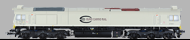
Mit der im Jahr 2001 festgelegten Liberalisierung des internationalen Eisenbahngüterverkehrs benötigten die neu gegründeten Eisenbahnverkehrsunternehmen (EVU) Triebfahrzeuge, um die den staatlichen Bahnen abgerungenen Verkehre zu bewältigen. Die Beschaffung technisch hochentwickelter Neufahrzeuge kam aus Kostengründen oftmals nicht in Frage. Eine preisgünstige Lösung bot die amerikanische Electro-Motive Division (EMD) mit der bereits in Großbritannien erprobten Class 66 an. Die als JT 42 CWR more…
DB V 60 H0

ESU V60
Zu Beginn der 1950er-Jahre musste die junge Deutsche Bundesbahn (DB) ihre Lokomotivflotte erneuern. Neben Streckenloks kamen auch Rangierloks auf die Reißbretter. Für den leichten Rangierdienst gab es etwa 500 Exemplare der Kleinloks der Typen Kö/Köf. Die modernsten, speziell für den leichten und mittelschweren Verschiebedienst beschafften Einheits-Dampflok-Baureihen BR 80 und 81 waren nur in einer bescheidenen Stückzahl von zusammen 27 Exemplaren vorhanden. Den schweren Rangierdienst more…
ESU BR 215 - 12V H0

The classes (BR) 215 and 218 diesel locomotives of the Western German Railway (DB) are used in mixed service since 1968.
218 101 to 194, 218 242 to 288 were equipped with a 12 cylinder 4 stroke main Diesel from MAN that was later called MTU 12 V 956 TB10 that generates 2500 HP. The 2800 HP version of this motor is called MTU 12 V 956 TB11.
In the late 1980s the exhaust system of BR 218 with the 12 V motor had been optimized. Since 1995 many of the 218 are equipped with motors called "MTU 12 more…
ESU BR 215 - 16V H0

In 1964 series production of dieselhydraulic main line loco V160 of the Deutsche Bundesbahn DB started.The four axle loco was driven by a 16 cylinder diesel motor MB 16V 652 TB. The 1900-HP-locos were used in medium passenger and freight duty and reached a maximum speed of 120 km/h.
This sound file is adjusted for use in ESU Engineering Edition BR215, tem numbers 31018, 31019, 31020, 32020, 31021, 32021, 31022, 32022, 31024, 31028, 31029. To replace / upgrade the originally installed more…
G 1000 BB H0

At the beginning of the 2000s, the Austrian Federal Railways ÖBB ordered 90 class 2070 shunting locomotives from Maschinenbau Kiel MaK with Caterpillar diesel motor. These locomotives, known as MaK G 800 BB at MaK, form the basis of the 4th type program of the manufacturer. As a more powerful version of the G800, the G1000, equipped with an MTU 8V4000 diesel engine, came onto the market on the same chassis. The 1100 kW strong (at 1860 rpm) and 100 km/h fast locomotive can be ordered for axle more…
G 1000 BB H0
At the beginning of the 2000s, the Austrian Federal Railways ÖBB ordered 90 class 2070 shunting locomotives from Maschinenbau Kiel MaK with Caterpillar diesel motor. These locomotives, known as MaK G 800 BB at MaK, form the basis of the 4th type program of the manufacturer. As a more powerful version of the G800, the G1000, equipped with an MTU 8V4000 diesel engine, came onto the market on the same chassis. The 1100 kW strong (at 1860 rpm) and 100 km/h fast locomotive can be ordered for axle more…
G 1000 BB H0
At the beginning of the 2000s, the Austrian Federal Railways ÖBB ordered 90 class 2070 shunting locomotives from Maschinenbau Kiel MaK with Caterpillar diesel motor. These locomotives, known as MaK G 800 BB at MaK, form the basis of the 4th type program of the manufacturer. As a more powerful version of the G800, the G1000, equipped with an MTU 8V4000 diesel engine, came onto the market on the same chassis. The 1100 kW strong (at 1860 rpm) and 100 km/h fast locomotive can be ordered for axle more…
KG230 A12L-714 H0

From 1962 Deutz offered the two-axle dieselhydraulic KG 230 B in the power class of a Köf III. KG stands for small locomotive with cardan shaft drive, 230 for the power in PS and B for the wheel arrangement. The in-house air-cooled twelve-cylinder engine A12L714 developed 230 hp at 2000 rpm. The seven KG 230s built for explosion-sensitive plants were not equipped with a water-cooled six-cylinder diesel engine. The gears of most locomotives were set to a maximum speed of between 20 and 30 km / h more…
Lint 27

For contemporary commuter and branch line passenger service DB ordered 30 samples of diesel mechanic rail cars Alstom-LHB Lint 27 in 1999. The tognum six cylinder engine delivers 428 HP and reaches a maximum speed of 120 km/h.