RhB Gmf 4/4 II 234 01-234 04
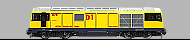
Für die Beförderung schwerer Bauzüge und Schneeräumfahrzeugen beschaffte die Rhätische Bahn RhB bei der Schalker Eisenhütte vier vierachsige dieselelektrische Loks Gmf 4/4 II. Der Dieselmotor MTU 12V 4000 R43L leistet 1800 kW und erreicht eine Höchstgeschwindigkeit von 100 km/h.
RhB Gmf 4/4

Gmf 4/4
Zur Traktion von Bauzügen u.a. zum Bau des Vereina-Tunnels beschaffte die Rhätische Bahn (RhB) 1991 die beiden dieselelektrischen Lokomotiven Gmf 4/4 242 und 243 mit Mittelführerstand. Die von Kaelble-Gmeinder gefertigten Maschinen werden durch einen 592 kW starken 12-Zylinder-Motor 3412 DI-TA von Caterpillar angetrieben und erreichen eine Höchstgeschwindigkeit von 60 km/h.
V200.0  H0
H0

Nach dem Zweiten Weltkrieg wollte die 1949 gegründete Deutsche Bundesbahn (DB) die Traktionsumstellung auch im mittelschweren Reiszugdienst vorantreiben. Auf dem Plan stand dabei auch eine vierachsige 140 km/h schnelle Diesellok mit dieselhydraulischer Kraftübertragung. Nach der damaligen Nomenklatur der DB bezeichnete man die Loks als V200. Da noch keine ausreichend starken Dieselmotoren verfügbar waren, entschied sich die DB mit dem für die Entwicklung verantwortlichen Lokhersteller mehr…
BR 216 / V160 H0

V160 der DB Serienlok
Nach neun Vorserienloks der dieselhydraulischen Baureihe V160 mit aufwändig zu fertigender runder Front (Spitzname Lollo, nach der italienischen Filmschauspielerin Gina Lollobrigida) fertigte Henschel 1963 die letzte Vorserienlok mit einer kantigen Front, ähnlich der der sechsachsigen V320. Allen Vorserienloks gemein war der Antrieb durch den 16-Zylinder-Dieselmotor Maybach MD 870 (später umbenannt in MTU 16V 538 TB). Die mit einer Dampfheizung ausgestatteten Loks mehr…
G 1000 BB H0

Zu Beginn der 2000er-Jahre bestellte die Österreichische Bundesbahn ÖBB bei der Maschinenbau Kiel MaK 90 Rangierloks der Baureihe 2070. Der 12-Zylinder-Dieselmotor von Caterpillar leistet 738 kW bei 2100 1/min. Die Höchstgeschwindigkeit liegt bei 100 km/h. Diese bei MaK als Typ G 800 BB bezeichneten Loks stellen die Basis des 4. Typenprogramms des Herstellers dar. Der Lokbau in Kiel wurde von Vossloh übernommen und weiter entwickelt. Als leistungsstärkere Version der G800 kam auf demselben mehr…
Nohab H0
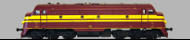
Die Entwicklung der unter dem Namen “NoHAB” zusammengefassten Loks reicht bis ins Jahr 1954 zurück. Der der schwedische Hersteller NoHAB stellte für den europäischen Markt auf Basis amerikanischer EMD-Loks eine sechsachsige Diesellok mit der Achsfolge (A1A‘)(A1A‘) in Lizenz her. Die nicht angetriebenen Laufachsen waren dem sonst zu hohen Gewicht geschuldet. Auch in Belgien wurde die Lok in Lizenz produziert. In den Einsatzländern Belgien, Dänemark, Luxemburg, Norwegen und Ungarn waren die Loks mehr…
SBB Tm232 H0

Tm 232 SBB ex. Tm IV
Die Sparten Güter- und Personenverkehr sowie Infrastruktur der Schweizerischen Bundesbahnen SBB ließen insgesamt 64 Exemplare ihrer ab 1970 beschafften Rangiertraktoren Tm IV aufarbeiten. Die ab 2007 im Industriewerk Biel renovierten Zweiachser erhielten Caterpillar-Sechszylinder-Dieselmotoren des Typs 13C Acert. Die Leistung der dieselhydraulischen Loks blieb bei 280 kW bei 1400 1/min, da das Getriebe keine Änderungen erfuhr. Die Höchstgeschwindigkeit beträgt 30 km/h im mehr…
ÖBB 2070 H0

2070 ÖBB
Zu Beginn der 2000er-Jahre bestellte die Österreichische Bundesbahn ÖBB bei Vossloh 90 Rangierloks der Baureihe 2070, die den Beinamen Hector trägt. Der 12-Zylinder-Dieselmotor von Caterpillar leistet 738 kW bei 2100 1/min. Die Höchstgeschwindigkeit liegt bei 100 km/h. Diese bei MaK als Typ G 800 BB bezeichneten Loks stellen die Basis des 4. Typenprogramms des Herstellers dar. Die Loks kommen im schweren Rangierdienst und vor regionalen Güterzügen zum Einsatz.
ESU BR 215 - 12V H0

BR 215 mit Zwölfzylindermotor MTU MA 12 V 956 TB 10 und Dampfkessel
Die 215 001 – 010 sowie 215 071 – 093 waren ab Werk mit 2500 PS starken Motoren MTU 12V 956 TB10 ausgerüstet. Die Maschinen heizten ihre Züge mit Dampf, den ein Dampfkessel des Typs OK 4616 von Hagenuk (Lizenzbau Vapor Heating) erzeugte. Während der Kessel im Betrieb nur dezent faucht, dringt beim Abschalten ein charakteristisches mehrfaches Patschen ans Ohr. Da die meisten Personenwagen-Typen der DB sowohl mit Dampf- als auch mehr…
ESU BR 215 - 16V H0
BR 215/216 mit Sechzehnzylindermotor
Die Baurehe V160 oder 216, wie sie ab 1968 hieß, war die Mutter aller einmotorigen Streckendieselloks mit Endführerständen. Ab 1960 gebaut, verließen insgesamt 808 Loks der Baureihen 210, 215, 216, 217 und 218 die Werkshallen der wichtigsten deutschen Lokfabriken. Die Serien-V160 waren mit Motoren von Mercedes (MB 839 Bb) oder Maybach (MD 870 1B) ausgerüstet. Nach Zusammenlegen der Motorenfertigungen von Mercedes und Maybach zur MTU kam nur noch der mehr…