E03 / BR 103  H0
H0

In 1965 German Deutsche Bundesbahn developed a six axle electric loco for fast passenger service. The unique design made the E03 (later 103) for the most famous German electric loco. All sample of the three designs reached a maximum speed of 200 km/h. Although they were developed only for light trains the 103 succeeded in heavy intercity service for more than 30 years.
Engineer/driver mode: Engineer/driver mode switch on with CV170 = 1, Engineer/driver mode switch off with CV170 = 0)
The more…
V200.0 H0

In early 1950s young German Federal Railway (DB) introduced four axle two motor dieselhydraulic V200. The loco is powered by two 12 cylinder 1100 HP diesel made by Daimler-Benz, MAN or mostly a MD650 made by Maybach. For use in passenger service all locos received steam heating equipment by Hagenuk. With its maximum speed of 140 km/h the locos were used for multi purpose. After around 30 years DB discharged the locos. 13 locos went to Italian users, seven were sold to swiss SBB for traction of more…
DB V 60 H0

ESU V60
Zu Beginn der 1950er-Jahre musste die junge Deutsche Bundesbahn (DB) ihre Lokomotivflotte erneuern. Neben Streckenloks kamen auch Rangierloks auf die Reißbretter. Für den leichten Rangierdienst gab es etwa 500 Exemplare der Kleinloks der Typen Kö/Köf. Die modernsten, speziell für den leichten und mittelschweren Verschiebedienst beschafften Einheits-Dampflok-Baureihen BR 80 und 81 waren nur in einer bescheidenen Stückzahl von zusammen 27 Exemplaren vorhanden. Den schweren Rangierdienst more…
BR 218 H0
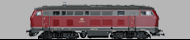
The classes (BR) 215 and 218 diesel locomotives of the Western German Railway (DB) are used in mixed service since 1968.
218 101 to 194, 218 242 to 288 were equipped with a 12 cylinder 4 stroke main Diesel from MAN that was later called MTU 12 V 956 TB10 that generates 2500 HP. The 2800 HP version of this motor is called MTU 12 V 956 TB11.
In the late 1980s the exhaust system of BR 218 with the 12 V motor had been optimized. Since 1995 many of the 218 are equipped with motors called "MTU 12 more…
T18 DB Ep. III H0

The Prussian Railway Administration KPEV had a total of 462 examples of the 1140 hp 2'C2' T18 tank locomotives built between 1912 and 1923. The manufacturer Vulcan delivered twenty machines to Württemberg in 1919. The original task was to transport fast passenger trains on short connections. The two-cylinder locomotives could be used forwards and backwards at 100 km/h and thus did not have to be turned at the end point. In a Prussian way, the locomotives designated as class 78.0-5 from the more…
T18 DB Ep. IV H0
The Prussian Railway Administration KPEV had a total of 462 examples of the 1140 hp 2'C2' T18 tank locomotives built between 1912 and 1923. The manufacturer Vulcan delivered twenty machines to Württemberg in 1919. The original task was to transport fast passenger trains on short connections. The two-cylinder locomotives could be used forwards and backwards at 100 km/h and thus did not have to be turned at the end point. In a Prussian way, the locomotives designated as class 78.0-5 from the more…
T18 KPEV Ep. I H0
The Prussian Railway Administration KPEV had a total of 462 examples of the 1140 hp 2'C2' T18 tank locomotives built between 1912 and 1923. The manufacturer Vulcan delivered twenty machines to Württemberg in 1919. The original task was to transport fast passenger trains on short connections. The two-cylinder locomotives could be used forwards and backwards at 100 km/h and thus did not have to be turned at the end point. In a Prussian way, the locomotives designated as class 78.0-5 from the more…
T18 DRG Ep. II H0
The Prussian Railway Administration KPEV had a total of 462 examples of the 1140 hp 2'C2' T18 tank locomotives built between 1912 and 1923. The manufacturer Vulcan delivered twenty machines to Württemberg in 1919. The original task was to transport fast passenger trains on short connections. The two-cylinder locomotives could be used forwards and backwards at 100 km/h and thus did not have to be turned at the end point. In a Prussian way, the locomotives designated as class 78.0-5 from the more…
KG230 A12L-714 H0

From 1962 Deutz offered the two-axle dieselhydraulic KG 230 B in the power class of a Köf III. KG stands for small locomotive with cardan shaft drive, 230 for the power in PS and B for the wheel arrangement. The in-house air-cooled twelve-cylinder engine A12L714 developed 230 hp at 2000 rpm. The seven KG 230s built for explosion-sensitive plants were not equipped with a water-cooled six-cylinder diesel engine. The gears of most locomotives were set to a maximum speed of between 20 and 30 km / h more…
RhB Ge 6/6 II 701-707 H0

In the late 1950s the narrow gauge Rhetian Railway (RhB) of Switzerland recommended stronger locos for haevy freight and passenger service. After a pre-series of two six axle locos (#701 and #702) the RhB ordered a series of five more locos (#703 - #707) that show differences in front design. Technical equipment of the locos is the same. The end trucks are interchangeable with those of four axle Ge 4/4 I. The locos develop 2398 HP and reach a maximum speed of 80 km/h. Even after around 50 years more…