BR86 DRG/DB/DR LokSound 5 European Sound files  H0
H0

The DRG's standard locomotive program called for the Class 86 for mixed service on branch lines. With an output of 1030 hp and a top speed of 70 km/h with an axle load of only 15.6 t, the 86 replaced many series that dated back to the state railway era. From the factory, 86 293-296 and all other locomotives from locomotive number 86 336 onwards were equipped with Krauss-Helmholtz frames for the leading and trailing axles, which meant that the maximum speed could be increased to 80 km/h. By more…
BR 98.8 Bayr. GtL 4/4 LokSound 5 European Sound files H0

From 1911 onwards, Krauss delivered 117 examples of the GtL 4/4 two-cylinder local railway locomotive in several series to the Bavarian State Railways. The Deutsche Reichsbahn-Gesellschaft DRG received the last 17 in 1927 and grouped them as the 98.8 series. With an output of 450 hp, the four-couplers were the most powerful Bavarian local railway machines. The DRG only considered the top speed of 40 km/h to be in need of improvement and equipped the most recently delivered locomotives with a more…
BR 81 LokSound 5 European Sound files H0

German Deutsche Reichsbahn-Gesellschaft DRG ordered 10 samples of four axle steam locomotive for shunting service in 1928. The two cylinder locos BR 81 developed 860 HP and reached a maximum speed of 45 km/h. In 1963 final loco quitted service at DB.
BR38.10-40 / Pr. P8 LokSound 5 European Sound files H0

The Prussian P8, built from 1906, was perhaps the best-known German steam locomotive series. Its designer Robert Garbe even wanted to see it used in express train service, but approval for 110 km/h failed due to its rough running at high speeds. The 1,180 hp two-cylinder locomotives reached 100 km/h and were considered undemanding and reliable pulling horses for passenger trains. They also proved their worth in front of light and fast freight trains. Of the 3,444 examples that were built for more…
BR18.4 / BR18.5 Bayr. S3/6 LokSound 5 European Sound files H0

In 1908 the locomotive factory J.A. Maffei was commissioned by the Royal Bavarian State Railway to develop a new express locomotive based on the IVf delivered to the Baden State Railway. The series a-c and f-i with 1870 mm high driving wheels were designated as series 18.4 by the Deutsche Reichsbahn-Gesellschaft DRG, as were the series d and e equipped with 2000 mm driving wheels. The four-cylinder compound locomotives produced 1,770 hp and reached 120 km/h with very good driving more…
BR01-DRG-DB-DR LokSound 5 European Sound files H0

The 01 series was the first locomotive in the standard locomotive program of the German Reichsbahn-Gesellschaft DRG. 231 samples were put into service between 1925 and 1937. The 2240 hp two-cylinder locomotive reached 120 km/h with 800 mm wheelsets in the front bogie, and 130 km/h with the 1000 mm wheels installed from locomotive number 01 102. The 01 were indispensable in express train service on both German state railways, which is why the DB 50 and the DR 35 locomotives were modernized and, more…
BR 03 DRG LokSound 5 European Sound files H0

The Deutsche Reichsbahn-Gesellschaft had the class 03 developed to supplement the heavy express train locomotive 01, which was designed for operation on well-developed main lines. Between 1930 and 1937, 298 examples of the 1980 hp two-cylinder locomotive with a top speed of 130 km/h were built. In front of light and medium-heavy passenger trains, the three-couplers impressed with their good driving characteristics, but in many DB departments in the 1950s the travel times of the express trains more…
BR 23 LokSound 5 European Sound files H0

In 1949 the Deutsche Bundesbahn had ordered 105 locos of Class 23 steam locomotives to replace old-fashioned Prussian P8 locos. The 2 cylinder locos developed 1785 HP and reached a maximum speed of 110 km/h. They were used for passenger service, sometimes also for fast trains. Last 23 quitted service in 1975, but eight locos can be found at railroad museums in Germany and the Nederlands.
BR 96 bay. Gt 2x 4/4 LokSound 5 European Sound files H0

From 1913 onwards, the Bavarian State Railway purchased a total of 15 samples of the Gt 2x 4/4 Mallet tank locomotive to push heavy freight trains on the steep routes in the Franconian Forest and Thuringian Forest. Although the 1,470 hp eight-axle locomotives were considered the most powerful tank locomotives in Europe at the time, manufacturer Maffei was able to limit the maximum axle load to 15.5 t, which is why the powerful locomotives could even be used on branch lines. With various more…
BR 50 LokSound 5 European Sound files H0
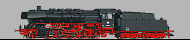
In 1939 German Deutsche Reichsbahn-Gesellschaft DRG received 1st of more than 3100 samples of 2-10-0 two-cylinder steam loco BR 50. The loco developed 1625 HP and reached a maximum speed of 80 km/h. With its axle load of just 15,2 tons the locos were used even on branch lines with light weight rails. Locos of DB quitted service in 1977, the DR locos were used for ten more years.