ICE VT LokSound 5 European Sound files

Diesel elektric version of the ICE (DBAG Baureihe 605)
V36/V36.4 WR 360 C 14 / MWM LokSound 5 European Sound files

In 1938 German „Wehrmacht“ received first samples of three-axle shunting locos for service in military facilities. Most units were powered by six-cylinder diesel MWM RHS235S. The side rod equipped locos reached a maximum speed of 55 km/h at 700 rpm. After WW II both German state railways overtook several units, some were sold at private owners.
V100.20 / BR212 LokSound 5 European Sound files  H0
H0

In 1962 German State Railway DB ordered 380 samples of dieselhydraulic loco V100.20 (later BR 212). The MB 835 Ab diesel develops 1350 HP at 1500 rpm and enables the loco to reach a maximum speed of 100 km/h. 10 more locos were equiped with additional brake for service on steep grades. Those locos were named V100.23 (later BR 213).
For Lokprogrammer from version 5.0.9.
BR 218 / MTU-MA-12V-956-TB11 LokSound 5 European Sound files H0
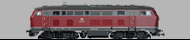
The classes (BR) 215 and 218 diesel locomotives of the Western German Railway (DB) are used in mixed service since 1968.
218 101 to 194, 218 242 to 288 were equipped with a 12 cylinder 4 stroke main Diesel from MAN that was later called MTU 12 V 956 TB10 that generates 2500 HP. The 2800 HP version of this motor is called MTU 12 V 956 TB11.
In the late 1980s the exhaust system of BR 218 with the 12 V motor had been optimized. Since 1995 many of the 218 are equipped with motors called "MTU 12 more…
DR V100 LokSound 5 European Sound files H0

The dieselhydraulic V100 (1968 BR 110 – 115, ab 1992 BR 201 – 204, 293) had been developed by VEB Lokomotivbau „Karl Marx“ for GDR state railway DR for multi purpose service on main and branch lines. The traction motors delivered 1000 HP at 1500 rpm and enabled the loco to reach a maximum speed of 100 km/h. The turbocharged engine 12 KVD 21 SVW is similar to the motor of V180/V100.
.
Different starting processes can be selected with F1:
1x press button = warm start / press button 2x = more…
BR227 / V170 / AA16 NoHAB MY LokSound 5 European Sound files H0

After the Second World War, various European locomotive manufacturers began developing diesel-electric locomotives, which began to displace steam traction in the USA. In Sweden, Nydqvist and Holm AB (NoHAB) acquired the license to manufacture diesel locomotives for the Electro-Motive Division (EMD) in 1949. The Americans owned an export version of the F-series, which had a driver's cab at both ends. For the lighter superstructure in Europe, locos were equipped qith six instead of four axles. more…
VT 11.5 LokSound 5 European Sound files H0
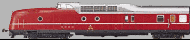
For the international TEE service, launched in 1956, the German Federal Railway (DB) procured a total of 19 power cars starting in 1957. Between each pair of power cars, five intermediate cars were coupled together. In addition to compartment and open-plan seating cars, there was also one car with a kitchen and dining area and one with a dining area and bar. Scharfenberg couplers connected the cars. Each power car was driven by a 12-cylinder, four-stroke diesel engine. As in the technically more…
VT18.16 / BR175 DR LokSound 5 European Sound files H0
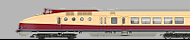
In 1959, the GDR government decided to develop a four-car diesel-hydraulic multiple unit capable of 160 km/h for international express service. A total of twelve diesel multiple units were built at the Görlitz factory, designated VT 18.16 in keeping with their approximately 1,800 hp output and top speed of 160 km/h. The 12-cylinder 12 KVD 18/21 SVW engines, mounted above the power bogies of the motor cars, were rated at 660 kW on trains VT 18.16.01 and 02; the second engine upgrade, available more…
BR130, BR131, BR132DR, BR232 LokSound 5 European Sound files H0
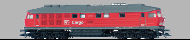
The most famous East German diesel loco is the 132. The six axle diesel electric loco is nicknamed “Ludmilla” by train fans. 709 samples of the 3000 HP locos had been delivered by Lokomotivfabrik Woroschilowgrad in Lugansk (Soviet Union today Ukraine) between 1973 and 1983 to the In the late 1960s the railway of the German Democratic Republic (DR) ordered successors for their V200 class. The new class should have an electric heating to pull also passenger trains. The first two series (class 130 more…
V200.0 LokSound 5 European Sound files H0

In early 1950s young German Federal Railway (DB) introduced four axle two motor dieselhydraulic V200. The loco is powered by two 12 cylinder 1100 HP diesel made by Daimler-Benz, MAN or mostly a MD650 made by Maybach. For use in passenger service all locos received steam heating equipment by Hagenuk. With its maximum speed of 140 km/h the locos were used for multi purpose. After around 30 years DB discharged the locos. 13 locos went to Italian users, seven were sold to swiss SBB for traction of more…