Universal 3 Zylinder LokSound 5 European Sound files  H0
H0

The first German three-cylinder steam locomotive to be built in large numbers was the Prussian S10.2 (BR 17) in 1914. Among the reasons given were its lower weight compared to the four-cylinder S10.1 and its favorable starting characteristics. The latter also played a role in the choice of a three-cylinder drive for the Prussian P10 (BR 39) passenger locomotive and the G12 (BR 58) freight locomotive. A disadvantage compared to the two-cylinder locomotives was the more difficult maintenance due more…
BR38.10-40 / Pr. P8 LokSound 5 European Sound files H0

The Prussian P8, built from 1906, was perhaps the best-known German steam locomotive series. Its designer Robert Garbe even wanted to see it used in express train service, but approval for 110 km/h failed due to its rough running at high speeds. The 1,180 hp two-cylinder locomotives reached 100 km/h and were considered undemanding and reliable pulling horses for passenger trains. They also proved their worth in front of light and fast freight trains. Of the 3,444 examples that were built for more…
BR01-DRG-DB-DR LokSound 5 European Sound files H0

The 01 series was the first locomotive in the standard locomotive program of the German Reichsbahn-Gesellschaft DRG. 231 samples were put into service between 1925 and 1937. The 2240 hp two-cylinder locomotive reached 120 km/h with 800 mm wheelsets in the front bogie, and 130 km/h with the 1000 mm wheels installed from locomotive number 01 102. The 01 were indispensable in express train service on both German state railways, which is why the DB 50 and the DR 35 locomotives were modernized and, more…
BR 23 LokSound 5 European Sound files H0

In 1949 the Deutsche Bundesbahn had ordered 105 locos of Class 23 steam locomotives to replace old-fashioned Prussian P8 locos. The 2 cylinder locos developed 1785 HP and reached a maximum speed of 110 km/h. They were used for passenger service, sometimes also for fast trains. Last 23 quitted service in 1975, but eight locos can be found at railroad museums in Germany and the Nederlands.
BR 50 LokSound 5 European Sound files H0
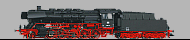
In 1939 German Deutsche Reichsbahn-Gesellschaft DRG received 1st of more than 3100 samples of 2-10-0 two-cylinder steam loco BR 50. The loco developed 1625 HP and reached a maximum speed of 80 km/h. With its axle load of just 15,2 tons the locos were used even on branch lines with light weight rails. Locos of DB quitted service in 1977, the DR locos were used for ten more years.
BR 80 LokSound 5 European Sound files H0

In order to replace uneconomical old worn out locomotives in shunting service, the Deutsche Reichsbahn-Gesellschaft DRG also included a shunting locomotive with an axle load of 18 t in the Einheitslok program. From 1928 the DRG put 39 copies of the 575 hp three-coupler into service. After the Second World War, 21 machines remained with the DR and 17 locomotives with the DB. Despite convincing operating characteristics, the DB stopped its 80 until 1965, as the new V60s were available in more…
BR01.10 Kohle LokSound 5 European Sound files H0

In 1939, Schwartzkopff delivered the model locomotive and the 55 series locomotives for the heavy express train service. The German Reichsbahn-Gesellschaft canceled the further orders because of the start of the war. The 2,120 hp three-cylinder locomotives all had streamlined cladding, which was partially dismantled during the course of the Second World War to simplify maintenance and due to lack of necessity. All 55 locomotives survived the war, but massive damage to the boilers soon became more…
BR 52 Kondenstender DRB LokSound 5 European Sound files H0
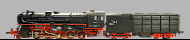
From 1942 the class 52 was derived from the light but powerful class 50 goods train tender locomotive developed from 1937 and mass-produced from 1939. Despite numerous simplifications, the war locomotive with 1640 hp had the same performance as the 50 and also reached 80 km/h when driving forwards. Initially, smoke deflectors were also dispensed with, but after a short time smaller Witte plates were retrofitted compared to the 50. So that the locomotives could withstand the winter in the more…
BR05 Einheitslok DRG DB LokSound 5 European Sound files H0

In 1935, Borsig developed the 2'C2' engines 05 001 and 002, which were equipped with streamlined cladding, for the Deutsche Reichsbahn-Gesellschaft (DRG) to pull light express trains at speeds of over 140 km/h. A third locomotive was given an enclosed driver's cab and was coupled to the tender at the smokebox end. The three-cylinder engine developed 2360 hp and accelerated the racers to 175 km/h. During test runs, 05 002 reached 200.4 km/h with a 197-ton test train, making it the fastest German more…
G8.1_55.25-56_KPEV-DRG-DB-DR LokSound 5 European Sound files H0

In order to be able to transport heavier freight trains, the Prussian state railway KPEV commissioned the development of a four-coupled tender locomotive in 1911. The experience gained with the larger G10 series was incorporated into the development of the locomotive, initially known as the G8 reinforced design, and so the 1260 hp new design proved to be on a par with its larger sister in many respects and even superior in terms of driving characteristics on winding routes. That's why the KPEV more…