BR 80 LokSound 5 European Sound files  H0
H0

In order to replace uneconomical old worn out locomotives in shunting service, the Deutsche Reichsbahn-Gesellschaft DRG also included a shunting locomotive with an axle load of 18 t in the Einheitslok program. From 1928 the DRG put 39 copies of the 575 hp three-coupler into service. After the Second World War, 21 machines remained with the DR and 17 locomotives with the DB. Despite convincing operating characteristics, the DB stopped its 80 until 1965, as the new V60s were available in more…
BR 52.80 DR LokSound 5 European Sound files H0

In the late 1950s German Deutsche Reichsbahn DR decided to modernize war-design freight locomotive BR 52. Around 200 samples received new boilers. The locos developed 1600 hp and reached a maximum speed of 80 km/h. With its axle load of only 16,3 tons the locos were used for freight and passenger trains even on branch lines.
V180 DR / BR118 BR228 DB LokSound 5 European Sound files H0

To replace medium-duty steam locomotive series in passenger and freight train service, the Deutsche Reichsbahn DR developed the twin-engine V180 series with diesel-hydraulic drive in the late 1950s. The four-axle vehicles, initially equipped with two 900 hp twelve-cylinder Type 12 KVD 21 A diesel engines, reached a top speed of 120 km/h. The locomotives delivered from 1965 received the second expansion stage of the diesel engine. This also applied to the six-axle versions, which were heavier more…
BR 180 DBAG LokSound 5 European Sound files

Electric locomotive DBAG BR 180, former DR BR 230
BR 50 LokSound 5 European Sound files H0
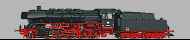
In 1939 German Deutsche Reichsbahn-Gesellschaft DRG received 1st of more than 3100 samples of 2-10-0 two-cylinder steam loco BR 50. The loco developed 1625 HP and reached a maximum speed of 80 km/h. With its axle load of just 15,2 tons the locos were used even on branch lines with light weight rails. Locos of DB quitted service in 1977, the DR locos were used for ten more years.
BR 52 Kondenstender DRB LokSound 5 European Sound files H0
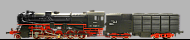
From 1942 the class 52 was derived from the light but powerful class 50 goods train tender locomotive developed from 1937 and mass-produced from 1939. Despite numerous simplifications, the war locomotive with 1640 hp had the same performance as the 50 and also reached 80 km/h when driving forwards. Initially, smoke deflectors were also dispensed with, but after a short time smaller Witte plates were retrofitted compared to the 50. So that the locomotives could withstand the winter in the more…
BR 44 Oel LokSound 5 European Sound files H0
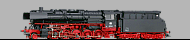
BR 44 had been the most successful steam loco for heavy freight trains at the Deutsche Reichsbahn-Gesellschaft (DRG). Between 1926 an end of WWII 1989 units of the 3 cylindred 2-10 had been built. They developed 1919 HP and reached a maximum speed of 80 km/h. In the 1950s Deutsche Bundesbahn (DB) and Deutsche Reichsbahn (DR) rebuilt 36 (DB) and 95 (DR) with oil firing equipment.
BR86 DRG/DB/DR LokSound 5 European Sound files H0

The DRG's standard locomotive program called for the Class 86 for mixed service on branch lines. With an output of 1030 hp and a top speed of 70 km/h with an axle load of only 15.6 t, the 86 replaced many series that dated back to the state railway era. From the factory, 86 293-296 and all other locomotives from locomotive number 86 336 onwards were equipped with Krauss-Helmholtz frames for the leading and trailing axles, which meant that the maximum speed could be increased to 80 km/h. By more…
BR43 Einheitslok DRG DR LokSound 5 European Sound files H0

In order to determine the suitability of the different drives for heavy freight service, the German Deutsche Reichsbahn-Gesellschaft DRG included five-coupled tender locomotives with two and three cylinders in its standard locomotive program. In 1927, ten of each type were initially built. A further 35 of the 43 with two cylinders followed in 1928. In comparison, the two-cylinder locomotive proved to be equal to the three-cylinder locomotive known as the 44 series up to the medium power range more…
BR 52 LokSound 5 European Sound files H0
In 1939 German Deutsche Reichsbahn-Gesellschaft DRG received 1st of more than 3100 samples of 2-10-0 two-cylinder steam loco BR 50. The loco developed 1625 HP and reached a maximum speed of 80 km/h. With its axle load of just 15,2 tons the locos were used even on branch lines with light weight rails. Locos of DB quitted service in 1977, the DR locos were used for ten more years.