BR71 Einheitslok DRG DB LokSound 5 European Sound files  H0
H0

In the early 1930s, the Deutsche Reichsbahn-Gesellschaft DRG included a light 1’B1’ tender locomotive for branch lines in its standard locomotive program as a replacement for light regional railway tender locomotives that could be used to pull passenger and freight trains. It was intended to be used where modern diesel railcars were too inflexible due to fluctuating passenger numbers or too weak due to the additional freight wagons that had to be carried. In order to reduce personnel costs, the more…
E32 / BR 132 LokSound 5 European Sound files H0

In 1924 German Deutsche Reichsbahn-Gesellschaft DRG received the first sample of side rod equipped electric loco E32. The 29 locos developed 1170 kW and reached a maximum speed of 75 km/h. In the 1930s eight locos were re-geared for a maximum speed of 90 km/h. In 1971 the last remaining locos quitted service at the DB.
Engineer/driver mode:
F4 - Pantograph up / down (only available in Engineer/driver mode). Engineer/driver mode switch on with CV170 = 1, Engineer/driver mode switch off with more…
BR247-Vectron DE LokSound 5 European Sound files

Based on the electric Locos of Vectron locomotive family, Siemens developed a diesel electric version called Vectron DE. The diesel motor MTU 16V 4000 R 84 develops 2400 kW and enables the loco to reach a maximum speed of 160 km/h.
E17 / BR117 LokSound 5 European Sound files

In 1928 German Deutsche Reichsbahn-Gesellschaft (DRG) received 38 samples of electric 2-8-2 loco E17. The eight motor locos reached a maximum speed of 120 km/h and were used by DB untill 1980. DR scrapped the final two locos in 1968.
Standart Class7 Britannia LokSound 5 European Sound files
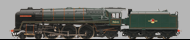
Debuting in 1951 the BR Standard Class 7 had been one of the most famous classes of British steam locomotives. The two cylinder locos reached a maximum speed of 144 km/h and were used till 1966. 70000 “Britannia” and 70013 “Oliver Cromwell” are preserved and power fan trip trains.
BR193 - Vectron Last Mile LokSound 5 European Sound files

In 2010 Siemens presented new Vectron family as successor for successful Taurus locos. The customer has the choice between four electric and one diesel electric versions. The locos develop 5200 kW (DC version) or 6400 kW (single AC, DC+AC version). Depending on gear ratio the locos reach a maximum speed of 160 or 200 km/h. For shunting service on non-electric tracks users can buy a Diesel Power Module with a 180 kW diesel motor.
BR189 / ES64F4 LokSound 5 European Sound files

Siemens/Krauss-Maffei developed a four-system electric loco on their Eurosprinter platform. Between 2003 and 2005 more than 150 samples left Munich factory. The four-axle loco develops 6400 kW and reaches a maximum speed of 140 km/h. German State Railway DB ordered 100 samples, MRCE another 45. Equipment for 1,5 kV and 3 kV DC enables the locos to operate in nearly any European country. Because of their moderate maximum speed the locos are used in heavy freight service mainly, but some can be more…
BR 442 / Talent 2 LokSound 5 European Sound files

In 2008 Talbot started delivery of electric regional railcar Talent 2 (numbered as BR 442). The manufacturer offers the railcars in different length up to a maximum tractive power of 4040 kW of a six-car unit. In any composite configuration each of the 325 railcars is able to reach a maximum speed of 160 km/h.
BR50.35-Reko-DR Kohle LokSound 5 European Sound files H0

In the mid-1950s, the boilers of the BR50 standard locomotives of the Deutsche Reichsbahn DR had reached the end of their service life due to the use in heavy freight traffic. Since the DR was unable to obtain replacements for its 50s, which were universally applicable with an axle load of just 15 t, in the foreseeable future, it was decided to reconstruct many locomotives with a boiler largely equivalent to that of the new BR 23 locomotive. From 1957, the DR reconstructed a total of 208 more…
BR03.10 DR Rekolok LokSound 5 European Sound files H0

In 1959 German DR equipped 16 samples of three-cylinder steam loco 03.10 with new boilers similar to classes 22 and 41. The so-called Reko-03.10 developed 2350 HP and reached a maximum speed of 140 km/h. After receiving oil firing equipment the performance improved again, so the Reko 03.10 stayed in service till 1980. British railfans nick-named museum loco 03 1010 the “roaring monster”.