- Downloads
- Sounds
- projects.esu.eu
- Search results
BR420 / ET420 LokSound 5 European Sound files  H0 N XL L M4
- Article numbers:S0121
- Last change: 3/27/2026
- Manufacturer: ESU

Since the three-car Class 420 S-Bahn multiple units were introduced for the 1972 Munich Olympic Games, they are often referred to as the "Olympic multiple units." With their thyristor-controlled traction control, Deutsche Bahn (DB) was breaking new ground at the time. Because the 2400 kW of power was distributed across all twelve axles, the three-car units, equipped with axle-hung traction motors, exhibited excellent acceleration. The three prototypes were followed by eight production series, incorporating minor modifications. For example, the last two series featured swing-sliding doors, while their predecessors had only sliding doors. Whether the 120 km/h multiple units used in Bavaria earned the nickname "Holy ET" due to their reliability is not recorded. The color scheme, now known as "pop" livery, with pebble gray as the base color and contrasting colors of pure orange, green-blue, or crimson at window level, first appeared on the Class 420 units. In 2006, Deutsche Bahn (DB) extensively modernized two trainsets, visibly featuring LED headlights and air conditioning above the driver's cabs. After more than 50 years of demanding S-Bahn service, DB AG is gradually retiring these reliable three-car units.
Fast Acceleration and Braking Time:
F5 - Reduces the acceleration and braking time, resulting in significantly faster acceleration and braking to a standstill. Pressing this button again resets the acceleration and braking times to their default values.
F8 - Allows for a fast and/or slow acceleration/deceleration time for the running sound. To ensure synchronisation between the running sound and the locomotive, the deceleration time (CV4) should be changed from the default value of 64 to 45 when using this function.
Idle Mode:
F12 - Activates coasting mode. The electric motors become significantly quieter and the sound of rolling becomes audible. This simulates, for example, driving downhill or coasting without a trailer load.
Brake Functions:
F17 - Brake Function 1. The locomotive brakes slowly to a standstill with brake valve sound.
F19 - Brake Function 2 (Emergency Brake). The locomotive brakes rapidly to a standstill.
Passenger Doors:
F27 – Opens and closes the passenger doors. CV168 (value 0 or 1) selects between automatic and manual operation. In automatic mode, the doors close with a warning signal; in manual mode, they close without a warning signal.
Rail Joints:
F28 – Enables the sound of rail joints while driving. CV170 (value 0-3) allows you to select four different joint sounds.
Disable Brake Sound:
F30 – Disables the brake sound. CV169 (value 0-3) allows you to select four different brake sounds. Hide description more…
H0 N XL L M4
- Article numbers
- S0121
- Last change
- 3/27/2026
- Manufacturer
- ESU
BR420 LokSound V4.0 European Soundfiles H0 N XL L M4
- Article numbers:55421, 65421, 55821, 55521, 55321
- Last change: 8/2/2016
- Manufacturer: ESU
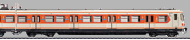
Commuter train BR420
H0 N XL L M4
- Article numbers
- 55421, 65421, 55821, 55521, 55321
- Last change
- 8/2/2016
- Manufacturer
- ESU
ALCO 12cyl 251C C420 (FT) LokSound Select Retail Soundfiles H0 N XL L M4
- Article numbers:75422, 75822, 75322
- Last change: 4/5/2017
- Manufacturer: ESU electronic solutions ulm

Equipped with ESU "FULL THROTTLE" features!
MUST use LokProgrammer Version 4.4.21 or newer
The ALCO 251 prime mover was the most popular and abundant prime mover ever made by the company. While it proved to be quite successful, it sadly outlived its original manufacturer, ALCO who closed their doors in 1969. The 251 prime mover is actually still available to purchase today from Fairbanks Morse for use in Marine, Generator, and locomotive uses.
The 12cyl 251C can be found in the following Locomotives:
RS-32
C420
M420
M420B
M420R
M420TR
HR-412
M424
45 Class
442 Class
600 Class
700 Class
A-321
The 2000 Horsepower 12cyl 251C version was extremely close to 251B in the way that is sounded. The 1800 horsepower 12cyl version of the 251B could be found in the following locomotives:
RS-11
RSD-12
RS-18
RS-36
FPA-4
FPB-4
RSC-14
FD-6
FD-7
FD-9
RSD-16
DL-560
44 Class
930 Class
The 12cyl 251 was also used in many rebuilt locomotives including:
RS-3m
C424m
and others...
As with all SELECT decoders there are up to 16 separate horns, 2 separate brake squeals and 2 bells included on this one sound profile! All changeable using CV48.
Prime Mover:
CV48=0 ALCO 12cyl 251C
Uses our INTERMEDIATE-HORNS-AND-BELLS template...
Horns:
CV48=0 Nathan K5LA
CV48=1 Nathan K3L
CV48=2 Nathan M5
CV48=3 Nathan P3
CV48=4 Nathan Old Cast P5
CV48=5 Nathan K3HA
CV48=6 Leslie S3L #1
CV48=7 Leslie RS5T
CV48=8 Leslie A125
CV48=9 Nathan M3
CV48=10 Leslie RS3K
CV48=11 Nathan K5H
CV48=12 Leslie S2M
CV48=13 Nathan M3H
CV48=14 Nathan M3H (duplicate - space restriction)
CV48=15 Nathan M3H (duplicate - space restriction)
Bells:
CV48=0 Steel Bell
CV48=64 ALCO Bronze Bell
Add values from above for total CV48 value.
Default CV48 Value = 73
0 - ALCO 16cyl 251C
9 - Nathan M3
64 - ALCO Bronze Bell
Total 0+9+64 = 79
New FULL THROTTLE features:
Drive Hold: Sound Slot 2 Mapped to F9
Independent Brake: Sound Slot 11 Mapped to F10
Run 8: Sound Slot 20 (not Mapped)
Coast: Sound Slot 21 (not Mapped)
For more info please see the "Full Throttle" Quick Start Guide in the ESU Instruction Manual Section of our Website.
http://www.esu.eu/en/downloads/instruction-manuals/digital-decoders/ Hide description more…
H0 N XL L M4
- Article numbers
- 75422, 75822, 75322
- Last change
- 4/5/2017
- Manufacturer
- ESU electronic solutions ulm
ALCO 12cyl 251C C420 V2 (FT) LokSound Select Retail Soundfiles H0 N XL L M4
- Article numbers:75445, 75845, 75345
- Last change: 12/13/2017
- Manufacturer: ESU electronic solutions ulm

Equipped with ESU "FULL THROTTLE" features!
MUST use LokProgrammer Version 4.4.21 or newer
This is version 2 of this popular sound file.
The ALCO 251 prime mover was the most popular and abundant prime mover ever made by the company. While it proved to be quite successful, it sadly outlived its original manufacturer, ALCO who closed their doors in 1969. The 251 prime mover is actually still available to purchase today from Fairbanks Morse for use in Marine, Generator, and locomotive uses.
The 12cyl 251C can be found in the following Locomotives:
RS-32
C420
M420
M420B
M420R
M420TR
HR-412
M424
45 Class
442 Class
600 Class
700 Class
A-321
The 2000 Horsepower 12cyl 251C version was extremely close to 251B in the way that is sounded. The 1800 horsepower 12cyl version of the 251B could be found in the following locomotives:
RS-11
RSD-12
RS-18
RS-36
FPA-4
FPB-4
RSC-14
FD-6
FD-7
FD-9
RSD-16
DL-560
44 Class
930 Class
The 12cyl 251 was also used in many rebuilt locomotives including:
RS-3m
C424m
and others...
As with all SELECT decoders there are up to 16 separate horns, 2 separate brake squeals and 2 bells included on this one sound profile! All changeable using CV48.
Prime Mover:
CV48=0 ALCO 12cyl 251C
Uses our INTERMEDIATE-HORNS-AND-BELLS template...
Horns:
CV48=0 Nathan K5LA
CV48=1 Nathan K3L
CV48=2 Nathan M5
CV48=3 Nathan P3
CV48=4 Nathan Old Cast P5
CV48=5 Nathan K3HA
CV48=6 Leslie S3L #1
CV48=7 Leslie S5T
CV48=8 Leslie A125
CV48=9 Nathan M3
CV48=10 Leslie A-200
CV48=11 Nathan K5H
CV48=12 Wabco AABB
CV48=13 Nathan M3H
CV48=14 Nathan M3H (duplicate - space restriction)
CV48=15 Nathan M3H (duplicate - space restriction)
Bells:
CV48=0 Steel Bell
CV48=64 ALCO Bronze Bell
Add values from above for total CV48 value.
Default CV48 Value = 73
0 - ALCO 16cyl 251C
9 - Nathan M3
64 - ALCO Bronze Bell
Total 0+9+64 = 79
New FULL THROTTLE features:
Drive Hold: Sound Slot 2 Mapped to F9
Independent Brake: Sound Slot 11 Mapped to F10
Run 8: Sound Slot 20 (not Mapped)
Coast: Sound Slot 21 (not Mapped)
For more info please see the "Full Throttle" Quick Start Guide in the ESU Instruction Manual Section of our Website.
http://www.esu.eu/en/downloads/instruction-manuals/digital-decoders/ Hide description more…
H0 N XL L M4
- Article numbers
- 75445, 75845, 75345
- Last change
- 12/13/2017
- Manufacturer
- ESU electronic solutions ulm
ALCO 12cyl 251C C420 (FT) LokSound V4.0 American & Australian Sound files H0 N XL L M4
- Article numbers:76422, 76822, 76522, 76322
- Last change: 4/5/2017
- Manufacturer: ESU electronic solutions ulm
Equipped with ESU "FULL THROTTLE" features!
MUST use LokProgrammer Version 4.4.21 or newer
The ALCO 251 prime mover was the most popular and abundant prime mover ever made by the company. While it proved to be quite successful, it sadly outlived its original manufacturer, ALCO who closed their doors in 1969. The 251 prime mover is actually still available to purchase today from Fairbanks Morse for use in Marine, Generator, and locomotive uses.
The 12cyl 251C can be found in the following Locomotives:
RS-32
C420
M420
M420B
M420R
M420TR
HR-412
M424
45 Class
442 Class
600 Class
700 Class
A-321
The 2000 Horsepower 12cyl 251C version was extremely close to 251B in the way that is sounded. The 1800 horsepower 12cyl version of the 251B could be found in the following locomotives:
RS-11
RSD-12
RS-18
RS-36
FPA-4
FPB-4
RSC-14
FD-6
FD-7
FD-9
RSD-16
DL-560
44 Class
930 Class
The 12cyl 251 was also used in many rebuilt locomotives including:
RS-3m
C424m
and others...
New FULL THROTTLE features:
Drive Hold: Sound Slot 2 Mapped to F9
Independent Brake: Sound Slot 11 Mapped to F10
Run 8: Sound Slot 20 (not Mapped)
Coast: Sound Slot 21 (not Mapped)
For more info please see the "Full Throttle" Quick Start Guide in the ESU Instruction Manual Section of our Website.
http://www.esu.eu/en/downloads/instruction-manuals/digital-decoders/ Hide description more…
H0 N XL L M4
- Article numbers
- 76422, 76822, 76522, 76322
- Last change
- 4/5/2017
- Manufacturer
- ESU electronic solutions ulm
ALCO 12cyl 251C C420 V2 (FT) LokSound V4.0 American & Australian Sound files H0 N XL L M4
- Article numbers:76445, 76845, 76545, 76345
- Last change: 12/13/2017
- Manufacturer: ESU electronic solutions ulm
Equipped with ESU "FULL THROTTLE" features!
MUST use LokProgrammer Version 4.4.21 or newer
This is version 2 of this popular sound file.
The ALCO 251 prime mover was the most popular and abundant prime mover ever made by the company. While it proved to be quite successful, it sadly outlived its original manufacturer, ALCO who closed their doors in 1969. The 251 prime mover is actually still available to purchase today from Fairbanks Morse for use in Marine, Generator, and locomotive uses.
The 12cyl 251C can be found in the following Locomotives:
RS-32
C420
M420
M420B
M420R
M420TR
HR-412
M424
45 Class
442 Class
600 Class
700 Class
A-321
The 2000 Horsepower 12cyl 251C version was extremely close to 251B in the way that is sounded. The 1800 horsepower 12cyl version of the 251B could be found in the following locomotives:
RS-11
RSD-12
RS-18
RS-36
FPA-4
FPB-4
RSC-14
FD-6
FD-7
FD-9
RSD-16
DL-560
44 Class
930 Class
The 12cyl 251 was also used in many rebuilt locomotives including:
RS-3m
C424m
and others...
New FULL THROTTLE features:
Drive Hold: Sound Slot 2 Mapped to F9
Independent Brake: Sound Slot 11 Mapped to F10
Run 8: Sound Slot 20 (not Mapped)
Coast: Sound Slot 21 (not Mapped)
For more info please see the "Full Throttle" Quick Start Guide in the ESU Instruction Manual Section of our Website.
http://www.esu.eu/en/downloads/instruction-manuals/digital-decoders/ Hide description more…
H0 N XL L M4
- Article numbers
- 76445, 76845, 76545, 76345
- Last change
- 12/13/2017
- Manufacturer
- ESU electronic solutions ulm
Atlas HO ALCO C420 LokSound 5 North American & Australian factory Equipped Sound files H0 N XL L M4
- Article numbers:99443.1, 99443.2, 99443.3, 99443.4, 99443.5
- Last change: 8/7/2026
- Manufacturer: Atlas
Atlas HO Alco C420 - 58429 LokSound 5 DCC 21-pin
99443.1 - Apache / Nickel Plate Road / Nofolk & Western
99443.2 - Conrail / D&H / Detroit & Mackinac / FUS / Lehigh Valley / NdeM
99443.3 - Erie Mining CO
99443.4 - L&N "Family Lines"
99443.5 - Monon
The ALCO 251 prime mover was the most popular and abundant prime mover ever made by the company. While it proved to be quite successful, it sadly outlived its original manufacturer, ALCO who closed their doors in 1969. The 251 prime mover is actually still available to purchase today from Fairbanks Morse for use in Marine, Generator, and locomotive uses.
The 12cyl 251C can be found in the following Locomotives:
RS-32, C420, M420, M420B, M420R, M420TR, HR-412, M424, 45 Class, 442 Class, 600 Class, 700 Class, A-321
The 2000 Horsepower 12cyl 251C version was extremely close to 251B in the way that is sounded. The 1800 horsepower 12cyl version of the 251B could be found in the following locomotives:
RS-11, RSD-12, RS-18, RS-36, FPA-4, FPB-4, RSC-14, FD-6, FD-7, FD-9, RSD-16, DL-560, 44 Class, 930 Class
The 12cyl 251 was also used in many rebuilt locomotives including:
RS-3m, C424m, and others...
Recorded from a ALCO C-420
This project is a normal idle version. It has a single exhaust stack.
File also contains an "Isolation Switch" Mode on F15 when Standing Still.
Pressing F15 while not moving will lower the prime mover and lock the motor. F15 must be turned off to begin moving.
Another Mode is "Reverser In Center Position". When pressing F24 while stopped, the motor will lock so you can throttle through the notches like the prototype in neutral. F24 must be turned off to begin moving.
This project has "Run 8" mode. When turning on F26 with F28 off, the prime mover goes to run 8. Turning off F26 returns the prime mover sounds back to normal mode.
This project has "Coast" mode. When turning on F27 with F28 off, the prime mover goes to idle for coasting purposes. Turning off F27 returns the prime mover sounds back to normal mode.
You can still use F26 and F27 for manual notching. You have to keep both F26 and F27 off before pressing F28 to turn on manual notching. Once F28 is on, you can use F26 to notch up and F27 to notch down. F26, F27, and F28 must be turned off to return to normal mode.
This project has "Load" mode. When turning on F29 with F15, F24, F26, F27, F28 off, the prime mover goes into load mode. While you are using load mode, the prime mover will notch up 1 or more notches based on primary load settings(CV104). The throttle notches up using speed instead of requested speed while using the load feature. F29 must be turned off to return to normal mode.
Prime mover volume selection mode. By default the prime mover has volume dynamics. Meaning idle is soft while notch 8 is loud. This is very prototypical. The next option is volume maxed out. Meaning idle and notch 8 are the same volume. This is more suitable for people who like it loud.
Change the sound configuration of the prime mover sound slot 1
CV31 = 16, CV32 = 1
----------------------
CV263 = 0 Prime Mover Dynamic Volume Control
CV263 = 1 Prime Mover Max Volume
Atlas ALCO C420 Horn Pack
Horns (SoundCV9):
CV163=0 Leslie A-125
CV163=1 Leslie A-200
CV163=2 Leslie S-2M
CV163=3 Leslie S-3K
CV163=4 Leslie S-3L
CV163=5 Leslie S-5T
CV163=6 Nathan M-3
CV163=7 Nathan M-3H
CV163=8 Nathan M-5
CV163=9 Nathan P-5-OC - Default
CV163=10 Nathan P-5-R24-OC
CV163=11 Nathan P-3-OC
CV163=12 Nathan P-3-R4-OC
CV163=13 Nathan P-5A-OC
CV163=14 Wabco E-2
CV163=15 Wabco A-2
Atlas ALCO Bell Template Pack
Bells (SoundCV10):
CV164=0 ALCO Bronze Bell 003 - Default
CV164=1 ALCO Bronze Bell 005
CV164=2 ALCO Bronze Bell 006
CV164=3 ALCO Bronze Bell 010
Auto Bell:
Many Second and Third Generation locomotives have been fitted with an Automatic Bell that is triggered when the horn is blown. In MANY cases this cannot even be bypassed on modern locos. Before the FRA mandated this feature on new locomotives the bell was of course turned on and off separately. Some locomotives were delivered with a manual bell and have been converted to an automatic bell. This creates a challenge in sound file creation.
We realize that not every loco with a particular prime mover had this feature. As such we have built in an option to turn the feature on and off. We will set the default in the file to be what is most appropriate for the particular file.
To turn the feature OFF - Auto Bell OFF:
1. Remove the Auto bell sound slot from the function mapping chart
CV31 = 16, CV32 = 8
----------------------
CV311 = 4
2. Change the sound configuration of the Auto bell sound slot
CV31 = 16, CV32 = 1
----------------------
CV287 = 0
To turn the feature ON - Auto Bell ON:
1. ADD the Auto bell sound slot from the function mapping chart
CV31 = 16, CV32 = 8
----------------------
CV311 = 12
2. Change the sound configuration of the Auto bell sound slot
CV31 = 16, CV32 = 1
----------------------
CV287 = 1
Auto Bell Timer:
The Bell timer is amount of time the bell will play after the horn if the auto timer is active. The timer is broken down into 1/4 of a second increments.
CV169=4 - 1 Second
CV169=8 - 2 Seconds
CV169=12 - 3 Seconds
CV169=16 - 4 Seconds
CV169=20 - 5 Seconds - Default
Etc...
1st Generation Brake Squeal Template Pack 1
Brake Squeal (SoundCV11)
CV165=0 Composition Shoe #1
CV165=1 Cast Iron Shoe #1
ALCO Air Dryer Template Pack 1
Air Dryer (SoundCV12)
CV166=0 S-1 Air Dryer 1
CV166=1 C-425 Air Dryer 1
CV166=2 RS-18 Air Dryer 1
CV166=3 RS-18 Air Dryer 2
S0722 - Basis File Hide description more…
H0 N XL L M4
- Article numbers
- 99443.1, 99443.2, 99443.3, 99443.4, 99443.5
- Last change
- 8/7/2026
- Manufacturer
- Atlas
ALCO 12-251C C420 LokSound 5 North American and Australian Sound files H0 N XL L M4
- Article numbers:S0722
- Last change: 9/20/2025
- Manufacturer: ESU
The ALCO 251 prime mover was the most popular and abundant prime mover ever made by the company. While it proved to be quite successful, it sadly outlived its original manufacturer, ALCO who closed their doors in 1969. The 251 prime mover is actually still available to purchase today from Fairbanks Morse for use in Marine, Generator, and locomotive uses.
The 12cyl 251C can be found in the following Locomotives:
RS-32, C420, M420, M420B, M420R, M420TR, HR-412, M424, 45 Class, 442 Class, 600 Class, 700 Class, A-321
The 2000 Horsepower 12cyl 251C version was extremely close to 251B in the way that is sounded. The 1800 horsepower 12cyl version of the 251B could be found in the following locomotives:
RS-11, RSD-12, RS-18, RS-36, FPA-4, FPB-4, RSC-14, FD-6, FD-7, FD-9, RSD-16, DL-560, 44 Class, 930 Class
The 12cyl 251 was also used in many rebuilt locomotives including:
RS-3m, C424m, and others...
Recorded from a ALCO C-420
This project is a normal idle version. It has a single exhaust stack.
File also contains an "Isolation Switch" Mode on F15 when Standing Still.
Pressing F15 while not moving will lower the prime mover and lock the motor. F15 must be turned off to begin moving.
Another Mode is "Reverser In Center Position". When pressing F24 while stopped, the motor will lock so you can throttle through the notches like the prototype in neutral. F24 must be turned off to begin moving.
This project has "Run 8" mode. When turning on F26 with F28 off, the prime mover goes to run 8. Turning off F26 returns the prime mover sounds back to normal mode.
This project has "Coast" mode. When turning on F27 with F28 off, the prime mover goes to idle for coasting purposes. Turning off F27 returns the prime mover sounds back to normal mode.
You can still use F26 and F27 for manual notching. You have to keep both F26 and F27 off before pressing F28 to turn on manual notching. Once F28 is on, you can use F26 to notch up and F27 to notch down. F26, F27, and F28 must be turned off to return to normal mode.
This project has "Load" mode. When turning on F29 with F15, F24, F26, F27, F28 off, the prime mover goes into load mode. While you are using load mode, the prime mover will notch up 1 or more notches based on primary load settings(CV104). The throttle notches up using speed instead of requested speed while using the load feature. F29 must be turned off to return to normal mode.
Prime mover volume selection mode. By default the prime mover has volume dynamics. Meaning idle is soft while notch 8 is loud. This is very prototypical. The next option is volume maxed out. Meaning idle and notch 8 are the same volume. This is more suitable for people who like it loud.
Change the sound configuration of the prime mover sound slot 1
CV31 = 16, CV32 = 1
----------------------
CV263 = 0 Prime Mover Dynamic Volume Control
CV263 = 1 Prime Mover Max Volume
1st Generation Horn Pack 2
Horns (SoundCV9):
CV163=0 Leslie S-3J
CV163=1 Leslie S-3K-R
CV163=2 Leslie RS-3L
CV163=3 Leslie S-5T-F
CV163=4 Leslie S-5T-R
CV163=5 Leslie S-5T-RRO
CV163=6 Leslie SL-4T
CV163=7 Nathan K-5LA
CV163=8 Nathan M-3H-R2
CV163=9 Nathan M-3-R1
CV163=10 Nathan M-3-RT1
CV163=11 Nathan M-5-R24
CV163=12 Wabco A-2
ALCO Bell Template Pack 1
Bells (SoundCV10):
CV164=0 ALCO Bronze Bell 003
CV164=1 ALCO Bronze Bell 005
CV164=2 ALCO Bronze Bell 006
CV164=3 ALCO Bronze Bell 010
Auto Bell:
Many Second and Third Generation locomotives have been fitted with an Automatic Bell that is triggered when the horn is blown. In MANY cases this cannot even be bypassed on modern locos. Before the FRA mandated this feature on new locomotives the bell was of course turned on and off separately. Some locomotives were delivered with a manual bell and have been converted to an automatic bell. This creates a challenge in sound file creation.
We realize that not every loco with a particular prime mover had this feature. As such we have built in an option to turn the feature on and off. We will set the default in the file to be what is most appropriate for the particular file.
To turn the feature OFF - Auto Bell OFF:
1. Remove the Auto bell sound slot from the function mapping chart
CV31 = 16, CV32 = 8
----------------------
CV311 = 4
2. Change the sound configuration of the Auto bell sound slot
CV31 = 16, CV32 = 1
----------------------
CV287 = 0
To turn the feature ON - Auto Bell ON:
1. ADD the Auto bell sound slot from the function mapping chart
CV31 = 16, CV32 = 8
----------------------
CV311 = 12
2. Change the sound configuration of the Auto bell sound slot
CV31 = 16, CV32 = 1
----------------------
CV287 = 1
Auto Bell Timer:
The Bell timer is amount of time the bell will play after the horn if the auto timer is active. The timer is broken down into 1/4 of a second increments.
CV169=4 - 1 Second
CV169=8 - 2 Seconds
CV169=12 - 3 Seconds
CV169=16 - 4 Seconds
CV169=20 - 5 Seconds - Default
Etc...
1st Generation Brake Squeal Template Pack 1
Brake Squeal (SoundCV11)
CV165=0 Composition Shoe #1
CV165=1 Cast Iron Shoe #1
ALCO Air Dryer Template Pack 1
Air Dryer (SoundCV12)
CV166=0 S-1 Air Dryer 1
CV166=1 C-425 Air Dryer 1
CV166=2 RS-18 Air Dryer 1
CV166=3 RS-18 Air Dryer 2
S0722 - Release Notes
===================================================
V-3 R-3:
===================================================
- description mispelling fix
- description brake squeal error fix
- soundslot brake squeal spelling mistake
- remastered prime mover
- prime mover volume selection mode
- brake 1 and 2 settings change
- brake set/release change
- traction motor update Hide description more…
H0 N XL L M4
- Article numbers
- S0722
- Last change
- 9/20/2025
- Manufacturer
- ESU
ALCO 12-251C C420 Ed2 LokSound 5 North American and Australian Sound files H0 N XL L M4
- Article numbers:S0745
- Last change: 7/17/2023
- Manufacturer: ESU
The ALCO 251 prime mover was the most popular and abundant prime mover ever made by the company. While it proved to be quite successful, it sadly outlived its original manufacturer, ALCO who closed their doors in 1969. The 251 prime mover is actually still available to purchase today from Fairbanks Morse for use in Marine, Generator, and locomotive uses.
The 12cyl 251C can be found in the following Locomotives:
RS-32, C420, M420, M420B, M420R, M420TR, HR-412, M424, 45 Class, 442 Class, 600 Class, 700 Class, A-321
The 2000 Horsepower 12cyl 251C version was extremely close to 251B in the way that is sounded. The 1800 horsepower 12cyl version of the 251B could be found in the following locomotives:
RS-11, RSD-12, RS-18, RS-36, FPA-4, FPB-4, RSC-14, FD-6, FD-7, FD-9, RSD-16, DL-560, 44 Class, 930 Class
The 12cyl 251 was also used in many rebuilt locomotives including:
RS-3m, C424m, and others...
Recorded from a ALCO C-420
This project is a normal idle version. It has a single exhaust stack.
File also contains an "Isolation Switch" Mode on F15 when Standing Still.
Pressing F15 while not moving will lower the prime mover and lock the motor. F15 must be turned off to begin moving.
Another Mode is "Reverser In Center Position". When pressing F24 while stopped, the motor will lock so you can throttle through the notches like the prototype in neutral. F24 must be turned off to begin moving.
This project has "Run 8" mode. When turning on F26 with F28 off, the prime mover goes to run 8. Turning off F26 returns the prime mover sounds back to normal mode.
This project has "Coast" mode. When turning on F27 with F28 off, the prime mover goes to idle for coasting purposes. Turning off F27 returns the prime mover sounds back to normal mode.
You can still use F26 and F27 for manual notching. You have to keep both F26 and F27 off before pressing F28 to turn on manual notching. Once F28 is on, you can use F26 to notch up and F27 to notch down. F26, F27, and F28 must be turned off to return to normal mode.
This project has "Load" mode. When turning on F29 with F15, F24, F26, F27, F28 off, the prime mover goes into load mode. While you are using load mode, the prime mover will notch up 1 or more notches based on primary load settings(CV104). The throttle notches up using speed instead of requested speed while using the load feature. F29 must be turned off to return to normal mode.
1st Generation Horn Pack 2
Horns (SoundCV9):
CV163=0 Leslie S-3J
CV163=1 Leslie S-3K-R
CV163=2 Leslie RS-3L
CV163=3 Leslie S-5T-F
CV163=4 Leslie S-5T-R
CV163=5 Leslie S-5T-RRO
CV163=6 Leslie SL-4T
CV163=7 Nathan K-5LA
CV163=8 Nathan M-3H-R2
CV163=9 Nathan M-3-R1
CV163=10 Nathan M-3-RT1
CV163=11 Nathan M-5-R24
CV163=12 Wabco A-2
ALCO Bell Template Pack 1
Bells (SoundCV10):
CV164=0 ALCO Bronze Bell 003
CV164=1 ALCO Bronze Bell 005
CV164=2 ALCO Bronze Bell 006
CV164=3 ALCO Bronze Bell 010
Auto Bell:
Many Second and Third Generation locomotives have been fitted with an Automatic Bell that is triggered when the horn is blown. In MANY cases this cannot even be bypassed on modern locos. Before the FRA mandated this feature on new locomotives the bell was of course turned on and off separately. Some locomotives were delivered with a manual bell and have been converted to an automatic bell. This creates a challenge in sound file creation.
We realize that not every loco with a particular prime mover had this feature. As such we have built in an option to turn the feature on and off. We will set the default in the file to be what is most appropriate for the particular file.
To turn the feature OFF - Auto Bell OFF:
1. Remove the Auto bell sound slot from the function mapping chart
CV31 = 16, CV32 = 8
----------------------
CV311 = 4
2. Change the sound configuration of the Auto bell sound slot
CV31 = 16, CV32 = 1
----------------------
CV287 = 0
To turn the feature ON - Auto Bell ON:
1. ADD the Auto bell sound slot from the function mapping chart
CV31 = 16, CV32 = 8
----------------------
CV311 = 12
2. Change the sound configuration of the Auto bell sound slot
CV31 = 16, CV32 = 1
----------------------
CV287 = 1
Auto Bell Timer:
The Bell timer is amount of time the bell will play after the horn if the auto timer is active. The timer is broken down into 1/4 of a second increments.
CV169=4 - 1 Second
CV169=8 - 2 Seconds
CV169=12 - 3 Seconds
CV169=16 - 4 Seconds
CV169=20 - 5 Seconds - Default
Etc...
1st Generation Brake Squeal Template Pack 1
Brake Squeal (SoundCV11)
CV165=0 Composition Shoe #1
CV165=1 Cast Iron Shoe #1
ALCO Air Dryer Template Pack 1
Air Dryer (SoundCV12)
CV166=0 S-1 Air Dryer 1
CV166=1 C-425 Air Dryer 1
CV166=2 RS-18 Air Dryer 1
CV166=3 RS-18 Air Dryer 2
S0745 - Release Notes
===================================================
V-4 R-4:
===================================================
- description mispelling fix
- description brake squeal error fix
- soundslot brake squeal spelling mistake
- remastered prime mover
- updated prime mover comment section Hide description more…
H0 N XL L M4
- Article numbers
- S0745
- Last change
- 7/17/2023
- Manufacturer
- ESU
Cummins 16-QSK95L-4200 HEP LokSound 5 North American and Australian Sound files H0 N XL L M4
- Article numbers:S0837
- Last change: 6/2/2025
- Manufacturer: ESU

The Siemens Charger is a family of diesel-electric passenger locomotives designed and manufactured by Siemens Mobility for the North American market. There are four models of Chargers: the SC-44 for state-supported inter-city services, the SCB-40 for Brightline inter-city service, the SC-42 for VIA corridor service, and the ALC-42 for Amtrak long distance service.
The first production SC-44 was unveiled on March 26, 2016, and entered revenue service on August 24, 2017, followed by the SCB-40, which inaugurated Brightline service on January 13, 2018. The first ALC-42 was delivered to Amtrak on June 17, 2021 and entered revenue service on February 8, 2022 on the Empire Builder.
The Charger is powered by a Cummins 16-cylinder QSK95 4-stroke high speed diesel engine, which meets EPA Tier IV emissions standards that took effect in 2015.[4] Power output varies by model: the SCB-40 produces 4,000 hp (3,000 kW),[5][6] the SC-44 produces 4,400 hp (3,300 kW), and both the SC-42 and ALC-42 produce 4,200 hp (3,100 kW).[7][8] The maximum speed in service is 125 mph (201 km/h).[9]
The locomotive shares much of its overall design with the Siemens Vectron diesel and electric locomotives used in Europe and the Siemens ACS-64 electric locomotive built for Amtrak and SEPTA.
Recorded from a Siemens ALC-42 and SC-42
This project is a normal idle version. It has a single late (silenced) exhaust stack.
File also contains an "Isolation Switch" Mode on F15 when Standing Still.
Pressing F15 while not moving will lower the prime mover and lock the motor. F15 must be turned off to begin moving.
Another Mode is "Reverser In Center Position". When pressing F24 while stopped, the motor will lock so you can throttle through the notches like the prototype in neutral. F24 must be turned off to begin moving.
You can still use F26 and F27 for manual notching. You have to keep both F26 and F27 off before pressing F28 to turn on manual notching. Once F28 is on, you can use F26 to notch up and F27 to notch down. F26, F27, and F28 must be turned off to return to normal mode.
This project has "Load" mode. When turning on F29 with F15, F24, F26, F27, F28 off, the prime mover goes into load mode. While you are using load mode, the prime mover will notch up 1 or more notches based on primary load settings(CV104). The throttle notches up using speed instead of requested speed while using the load feature. F29 must be turned off to return to normal mode.
Prime mover volume selection mode. By default the prime mover has volume dynamics. Meaning idle is soft while notch 8 is loud. This is very prototypical. The next option is volume maxed out. Meaning idle and notch 8 are the same volume. This is more suitable for people who like it loud.
Change the sound configuration of the prime mover sound slot 1
CV31 = 16, CV32 = 1
----------------------
CV263 = 0 Prime Mover Dynamic Volume Control
CV263 = 1 Prime Mover Max Volume
Please note: This file has a few special settings from our default retail file settings
This file has a Special feature providing the sounds and operation of the Head End Power unit. This is used on the prototype loco to provide electricity to the coaches as these locos are almost always used in passenger service.
To engage HEP you must be stopped in Idle. Pressing F7 (Shift 2) will engage the HEP unit.
The lighting has been modified to represent the lighting on the prototype.
This includes LED ditchlights that are timed to the prototype. They also do not fade in and fade out like the prototype.
The function mapping has been set to include the HEP, and special lighting of the models on the market. Including: Strobe Lights, Red Marker Lights, and Carbody Interior Lighting.
The ALC-42 and SC-42 have the ability to play the horn with Full Air, or Half Air. We have included the Full Air Horns on F2, and the Half Air Horn on F3. CV163 will change between them. Only the horns recorded from the ALC-42 have this feature. CV163 at a value of 4 or above will play the ALC-42 Half Air K5LA on F3.
ALC-42 Horn Pack 1
Horns (SoundCV9):
CV163=0 Nathan K-5LA AMTK ALC-42 Full Air and Half Air
CV163=1 Kockum Sonics Tyfon MKTH 75-5 Chime CA VIA SC-42 Full Air and Half air.
CV163=2 Nathan K-5LA AMTK ALC-42 Ed2 Full Air and Half air.
CV163=3 Kockum Sonics Tyfon MKTH 75-5 Chime CA VIA SC-42 Ed2 Full Air and Half air.
CV163=4 Nathan K-5LA
CV163=5 Nathan K-5LA-R24
CV163=6 Nathan K-5L-LA
CV163=7 Nathan K-5LA Amtrak
The Horns below will play on the Sequencer using F23
CV163=0 Nathan K-5LA AMTK ALC-42
CV163=1 Kockum Sonics Tyfon MKTH 75-5 Chime CA VIA SC-42
CV163=2 Nathan K-5LA AMTK ALC-42 Ed2
CV163=3 Kockum Sonics Tyfon MKTH 75-5 Chime CA VIA SC-42 Ed2
CV163=4 Nathan K-5LA
CV163=5 Nathan K-5LA-R24
CV163=6 Nathan K-5L-LA
CV163=7 Nathan K-5LA Amtrak
As a note, VIA RAIL ALC42s do not have a grade crossing sequencer on the floor. There is a button that plays the horn on the floor, but is the same as the horn on the console. While we have included them in the sequencer pack above, we realize this is not prototypical on those locomotives.
ALC-42 Auto Bell On/Off Trigger Template Pack 1
Bells (SoundCV10):
CV164=0 Graham-White E-Bell 010
CV164=1 Graham-White E-Bell 001
CV164=2 Graham-White E-Bell 002
CV164=3 Graham-White E-Bell 003
Auto Bell:
Many Second and Third Generation locomotives have been fitted with an Automatic Bell that is triggered when the horn is blown. In MANY cases this cannot even be bypassed on modern locos. Before the FRA mandated this feature on new locomotives the bell was of course turned on and off separately. Some locomotives were delivered with a manual bell and have been converted to an automatic bell. This creates a challenge in sound file creation.
We realize that not every loco with a particular prime mover had this feature. As such we have built in an option to turn the feature on and off. We will set the default in the file to be what is most appropriate for the particular file.
To turn the feature OFF - Auto Bell OFF:
1. Remove the Auto bell sound slot from the function mapping chart
CV31 = 16, CV32 = 8
----------------------
CV311 = 4
2. Change the sound configuration of the Auto bell sound slot
CV31 = 16, CV32 = 1
----------------------
CV287 = 0
To turn the feature ON - Auto Bell ON:
1. ADD the Auto bell sound slot from the function mapping chart
CV31 = 16, CV32 = 8
----------------------
CV311 = 12
2. Change the sound configuration of the Auto bell sound slot
CV31 = 16, CV32 = 1
----------------------
CV287 = 1
Auto Bell Timer:
The Bell timer is amount of time the bell will play after the horn if the auto timer is active. The timer is broken down into 1/4 of a second increments.
CV169=4 - 1 Second
CV169=8 - 2 Seconds
CV169=12 - 3 Seconds
CV169=16 - 4 Seconds
CV169=20 - 5 Seconds - Default
Etc...
3rd Generation Brake Squeal Template Pack 1
Brake Squeal (SoundCV11)
CV165=0 Composition Shoe #1
CV165=1 Composition Shoe #2
S0837 - Release Notes
===================================================
V-6 R-3:
===================================================
- description mispelling fix
- description brake squeal error fix
- soundslot brake squeal spelling mistake
- remastered prime mover
- prime mover volume selection mode
- brake 1 and 2 settings change
- brake set/release change
- traction motor update
- smart start removed Hide description more…
H0 N XL L M4
- Article numbers
- S0837
- Last change
- 6/2/2025
- Manufacturer
- ESU
License Agreement
1. GRANT OF LICENSE
1.1 ESU grants you a non-transferable, limited, non-exclusive right to use the Content solely for your own personal purposes. You may load the Content into RAM, as well as installation on a hard disk or other storage device on a single computer, hardware product or mobile device owned by you or under your control. The installation process may result in a copy of the Content residing on your computer, in which case, you may retain one (1) copy of the Content on your computer, provided that you retain all copyright and other proprietary notices on the copy and the copy is kept in your possession with the original.1.2 By using the Content, you shall not obtain any ownership, copyright, proprietary or other interest in or to the Content. The Content is licensed, not sold.
1.3 You are licensed to use, modify and combine the Sound Samples with sound samples provided by third parties, to create your own sound compositions which, subject to you complying with the terms of this Agreement, you are free to distribute as you wish provided that: (i) the Sound Samples have been mixed together to create an original work; (ii) individual Sound Samples are not used in isolation and (iii) the Sound Samples or derivatives are not used to create sound libraries for distribution to third parties.
2. PROHIBITED USES
Neither you, nor anyone at your direction, shall:2.1 use the Content, or any part of it, for any public performance, live broadcast or time delayed live broadcast where the Content is used unattended for commercial purposes without ESU' s prior written consent;
2.2 use the Content, or any part of it, in any competitive product;
2.3 sub-license, copy, reproduce, transmit, assign, rent, sell, lease, offer on a pay-per-play basis, distribute for money or any other consideration, or commercially exploit in any other manner or through any medium whatsoever or otherwise transfer in any way the Content or any part thereof;
2.4 manufacture and/or distribute for money or otherwise commercially exploit any product that incorporates any part of the Content. If you wish to use any part of the Content for manufacture, resale, sub-license or further distribution, you must contact ESU (and where relevant, its licensors) to enter into an appropriate agreement with ESU (and, where relevant, its licensors);
2.5 publish the results of any analysis or comparative evaluation of the Content or any part thereof without ESU' s prior written consent;
2.6 reverse engineer, recompile or disassemble any part of the Content except to the extent and in the circumstances expressly permitted by ESU and its licensors in writing or by law;
3. INTELLECTUAL PROPERTY RIGHTS
You acknowledge that all intellectual property rights in the Content are and shall remain vested in ESU and its licensors. You undertake not to interfere with or diminish, whether by act or omission, the rights, title and interest in the Content of ESU and its licensors. You may be held responsible by ESU and/or any of its licensors for any infringement of any intellectual property rights in the Content. For the avoidance of doubt, provided that you comply with the terms of this Agreement, ESU shall not claim ownership of the intellectual property rights in any compositions created by your use of the Content.4. TERM AND TERMINATION
This Agreement is effective from the first date you install the Content. The rights granted to you under this Agreement shall terminate if you fail to abide by its terms. Upon such termination you agree to destroy the Content including any Content stored on the hard disk of any computer under your control. You may terminate this Agreement at any time by destroying or erasing all your copies of the Content. Any termination of this Agreement (howsoever occasioned) shall not affect any accrued rights or liabilities of you or ESU nor shall it affect the coming into force or the continuance in force of the provisions of Clauses 2, 3, 5 and 6 and any provision hereof which is by implication intended to come into or continue in force on or after such termination.5. NO WARRANTIES
TO THE MAXIMUM EXTENT PERMITTED BY APPLICABLE LAW, ESU AND ITS LICENSORS PROVIDE THE CONTENT "AS IS" AND ESU EXCLUDES ON BEHALF OF ITSELF AND ITS LICENSORS, ALL CONDITIONS, TERMS, REPRESENTATIONS (OTHER THAN FRAUDULENT REPRESENTATIONS) AND WARRANTIES RELATING TO THE CONTENT, WHETHER IMPOSED BY STATUTE OR BY OPERATION OF LAW OR OTHERWISE, INCLUDING BUT NOT LIMITED TO, IMPLIED WARRANTIES OF SATISFACTORY QUALITY AND FITNESS FOR A PARTICULAR PURPOSE. NEITHER ESU NOR ITS LICENSORS WARRANT THAT THE OPERATION OF THE CONTENT WILL BE UNINTERRUPTED, ERROR FREE, VIRUS FREE OR MEET YOUR SPECIFIC REQUIREMENTS. YOU MAY HAVE OTHER RIGHTS THAT VARY FROM JURISDICTION TO JURISDICTION.6. ESU's LIABILITY
Neither ESU nor its licensors shall have any liability to you for any loss or damage caused directly or indirectly in connection with the Content, any part thereof or this Agreement, except to the extent that such liability cannot be lawfully excluded. In any case, neither ESU nor its licensors shall be liable for any loss of business, data, profits, savings, or any other special, incidental, consequential, indirect or economic loss whatsoever even if such losses were contemplated at the date of this Agreement.7. GENERAL
7.1 You acknowledge that damages alone might be insufficient remedy for any breach of the terms of this Agreement and that the remedies of injunction, specific performance or other equitable relief would be suitable remedies in the event of any breach or threatened breach of this Agreement.7.2 You may not assign or otherwise transfer all or any part of this Agreement or the rights granted to you hereunder.
7.3 ESU is not obliged to provide any maintenance, technical support or upgrades to you.
7.4 You agree to comply with all applicable import and export regulations and acknowledge that you have the responsibility for obtaining all necessary licenses to export, re-export, transfer or import the Content.
7.5 This Agreement constitutes the entire agreement between you and ESU with respect to the subject matter hereof and supersedes all prior agreements, arrangements and understandings between the parties and constitutes the entire agreement between the parties relating to such subject matter hereof. No addition to or modification of any provision of this Agreement shall be binding upon ESU and you unless made by a written instrument signed by a duly authorized representative of ESU and you.
7.6 No forbearance, delay or indulgence by either party in enforcing the provisions of this Agreement shall prejudice or restrict the rights of that party nor shall any waiver of its rights operate as a waiver of any subsequent breach and no right, power or remedy herein conferred upon or reserved for either party is exclusive of any other right, power or remedy available to that party and each such right, power or remedy shall be cumulative.
7.7 Notwithstanding that the whole or any part of any provision of this Agreement may prove to be illegal or unenforceable the other provisions of this Agreement and the remainder of the provision in question shall remain in full force and effect.
If you download the designated file, you agree to be legally bound by the license given above.