- Downloads
- Sounds
- projects.esu.eu
- Search results
BR 704 LokSound 5 factory equipped sounds  H0 N XL L M4
- Article numbers:17482
- Last change: 10/7/2025
- Manufacturer: Liliput

In 1977, based on the VT 627, the German Deutsche Bundesbahn DB ordered five test vehicles of the four-axle catenary inspection rail car 704. The four-axle vehicles, classed as BR 704, had a diesel-hydraulic power transmission. Propulsion was initially provided by two identical, independent drive systems with Deutz twelve-cylinder diesel engines, one of which was replaced by a more modern and lower-emission Deutz engine from 1986 onwards. The 140 km/h four-axle vehicles were intended to replace the two-axle 701 and 702, some of which were more than 20 years old and which the DB had purchased in large numbers. Despite the need, the five pre-production cars remained, which were retired and scrapped in 2014.
Different starting processes can be selected with F1:
1x press button = warm start / press button 2x = false start / press button 3x = cold start
Heavy load operation:
F5 - Activates heavy load operation. The acceleration now takes noticeably longer and the diesel engine work harder.
Coast/Idle operation:
F24 - Activates Coast/idle operation. The engine speed goes to Coast/idle. This simulates, for example, a downhill ride or rolling without a trailer load.
Braking functions:
F17 - Brake function 1. The locomotive slowly brakes to a standstill with the sound of the brake valve.
Deactivate braking Sound:
F27 - Deactivates brake squeal Sound when the train stops. (4 different brake squeal sounds with CV162 value 0-3 selectable) Hide description more…
H0 N XL L M4
- Article numbers
- 17482
- Last change
- 10/7/2025
- Manufacturer
- Liliput
BR 704 LokSound 5 factory equipped sounds H0 N XL L M4
- Article numbers:17822
- Last change: 10/9/2024
- Manufacturer: Liliput
In 1977, based on the VT 627, the German Deutsche Bundesbahn DB ordered five test vehicles of the four-axle catenary inspection rail car 704. The four-axle vehicles, classed as BR 704, had a diesel-hydraulic power transmission. Propulsion was initially provided by two identical, independent drive systems with Deutz twelve-cylinder diesel engines, one of which was replaced by a more modern and lower-emission Deutz engine from 1986 onwards. The 140 km/h four-axle vehicles were intended to replace the two-axle 701 and 702, some of which were more than 20 years old and which the DB had purchased in large numbers. Despite the need, the five pre-production cars remained, which were retired and scrapped in 2014.
Different starting processes can be selected with F1:
1x press button = warm start / press button 2x = false start / press button 3x = cold start
Heavy load operation:
F5 - Activates heavy load operation. The acceleration now takes noticeably longer and the diesel engine work harder.
Coast/Idle operation:
F24 - Activates Coast/idle operation. The engine speed goes to Coast/idle. This simulates, for example, a downhill ride or rolling without a trailer load.
Braking functions:
F17 - Brake function 1. The locomotive slowly brakes to a standstill with the sound of the brake valve.
Deactivate braking Sound:
F27 - Deactivates brake squeal Sound when the train stops. (4 different brake squeal sounds with CV162 value 0-3 selectable) Hide description more…
H0 N XL L M4
- Article numbers
- 17822
- Last change
- 10/9/2024
- Manufacturer
- Liliput
BR 704 LokSound 5 European Sound files H0 N XL L M4
- Article numbers:S0437
- Last change: 10/21/2025
- Manufacturer: ESU
In 1977, based on the VT 627, the German Deutsche Bundesbahn DB ordered five test vehicles of the four-axle catenary inspection rail car 704. The four-axle vehicles, classed as BR 704, had a diesel-hydraulic power transmission. Propulsion was initially provided by two identical, independent drive systems with Deutz twelve-cylinder diesel engines, one of which was replaced by a more modern and lower-emission Deutz engine from 1986 onwards. The 140 km/h four-axle vehicles were intended to replace the two-axle 701 and 702, some of which were more than 20 years old and which the DB had purchased in large numbers. Despite the need, the five pre-production cars remained, which were retired and scrapped in 2014.
Different starting processes can be selected with F1:
1x press button = warm start / press button 2x = false start / press button 3x = cold start
Heavy load operation:
F5 - Activates heavy load operation. The acceleration now takes noticeably longer and the diesel engine work harder.
Coast/Idle operation:
F12 - Activates Coast/idle operation. The engine speed goes to Coast/idle. This simulates, for example, a downhill ride or rolling without a trailer load.
Braking functions:
F17 - Brake function 1. The locomotive slowly brakes to a standstill with the sound of the brake valve.
Deactivate braking Sound:
F27 - Deactivates brake squeal Sound when the train stops. Hide description more…
H0 N XL L M4
- Article numbers
- S0437
- Last change
- 10/21/2025
- Manufacturer
- ESU
Walthers EMD SD9 LokSound 5 North American & Australian factory Equipped Sound files H0 N XL L M4
- Article numbers:90485.1, 90485.2, 90485.3, 90485.4, 90485.5, 90485.6
- Last change: 4/4/2024
- Manufacturer: Walthers

WalthersProto EMD SD9
90485.1 - CB&Q - Walthers #920-41701, 920-41702
90485.2 - Chicago & Illinois Midland - Walthers #920-41703, 920-41704
90485.3 - Duluth, Missabe & Iron Range - Walthers #920-41705, 920-41706, 920-41707, 920-41708
90485.4 - Great Northern - Walthers #920-41709, 920-41710
90485.5 - Southern Pacific Black Widow - Walthers #920-41711, 920-41712
90485.6 - Southern Pacific Gray - Walthers # 920-41713, 920-41714, 920-41715, 920-41716
The 567 prime mover is a line of medium-speed diesel engines manufactured by GM Electro-Motive Division. They were used in many EMD locomotives from 1938-1966 when it was replaced by the EMD 645. The 567 proved to be exceptionally successful in passenger, switching, freight, marine and stationary services. The 16 cylinder 567C variation could be found in the following locomotives:
FP7, FP9, FL9, FT, F2, F3, F7, F9, GP7, GP8, GP9, GP10, GP11, BL2, GP18, GP28, SD7, SD9, SD18
This project is a normal idle version. It has 2 exhaust stacks.
File also contains an "Isolation Switch" Mode on F15 when Standing Still.
Pressing F15 while not moving will lower the prime mover and lock the motor. F15 must be turned off to begin moving.
Another Mode is "Reverser In Center Position". When pressing F24 while stopped, the motor will lock so you can throttle through the notches like the prototype in neutral. F24 must be turned off to begin moving.
This project has "Run 8" mode. When turning on F26 with F28 off, the prime mover goes to run 8. Turning off F26 returns the prime mover sounds back to normal mode.
This project has "Coast" mode. When turning on F27 with F28 off, the prime mover goes to idle for coasting purposes. Turning off F27 returns the prime mover sounds back to normal mode.
You can still use F26 and F27 for manual notching. You have to keep both F26 and F27 off before pressing F28 to turn on manual notching. Once F28 is on, you can use F26 to notch up and F27 to notch down. F26, F27, and F28 must be turned off to return to normal mode.
This project has "Load" mode. When turning on F29 with F15, F24, F26, F27, F28 off, the prime mover goes into load mode. While you are using load mode, the prime mover will notch up 1 or more notches based on primary load settings(CV104). The throttle notches up using speed instead of requested speed while using the load feature. F29 must be turned off to return to normal mode.
Walthers SD9 Horn Pack:
Horns (SoundCV9):
CV163=0 Wabco AA-2
CV163=1 Wabco A-B
CV163=2 Wabco AA-BB
CV163=3 Wabco AA-BB-Ed2
CV163=4 Leslie S-2M-RB - Leslie S-25 Combo
CV163=5 Leslie S-2M-RB
CV163=6 Leslie S-25
CV163=7 Leslie RS-3L
CV163=8 Leslie RS-3L-R
CV163=9 Leslie RS-3L-R-O
CV163=10 Leslie S-3L
CV163=11 Leslie S-3L-Ed2
CV163=12 Nathan P-3
CV163=13 Nathan P-3-Ed2
CV163=14 Nathan P-3-OC
CV163=15 Nathan P-3-OC-Ed2
CV163=16 Nathan P-5
CV163=17 Nathan P-5-Ed2
CV163=18 Nathan P-5-OC
CV163=19 Nathan P-5-OC-Ed2
Walthers SD9 Bell Pack:
Bells (SoundCV10):
CV164=0 EMD 8004156 Bronze Bell 014
CV164=1 EMD 8475495 Steel Bell 013
CV164=2 EMD 8004156 Bronze Bell 015
CV164=3 EMD 8475495 Steel Bell 024
CV164=4 EMD 8475495 Steel Bell 028
CV164=5 Graham-White E-Bell 005
Auto Bell:
Many Second and Third Generation locomotives have been fitted with an Automatic Bell that is triggered when the horn is blown. In MANY cases this cannot even be bypassed on modern locos. Before the FRA mandated this feature on new locomotives the bell was of course turned on and off separately. Some locomotives were delivered with a manual bell and have been converted to an automatic bell. This creates a challenge in sound file creation.
We realize that not every loco with a particular prime mover had this feature. As such we have built in an option to turn the feature on and off. We will set the default in the file to be what is most appropriate for the particular file.
To turn the feature OFF - Auto Bell OFF:
1. Remove the Auto bell sound slot from the function mapping chart
CV31 = 16, CV32 = 8
----------------------
CV311 = 4
2. Change the sound configuration of the Auto bell sound slot
CV31 = 16, CV32 = 1
----------------------
CV287 = 0
To turn the feature ON - Auto Bell ON:
1. ADD the Auto bell sound slot from the function mapping chart
CV31 = 16, CV32 = 8
----------------------
CV311 = 12
2. Change the sound configuration of the Auto bell sound slot
CV31 = 16, CV32 = 1
----------------------
CV287 = 1
Auto Bell Timer:
The Bell timer is amount of time the bell will play after the horn if the auto timer is active. The timer is broken down into 1/4 of a second increments.
CV169=4 - 1 Second
CV169=8 - 2 Seconds
CV169=12 - 3 Seconds
CV169=16 - 4 Seconds
CV169=20 - 5 Seconds - Default
Etc...
1st Generation Brake Squeal Template Pack 1
Brake Squeal (SoundCV11)
CV165=0 Composition Shoe
CV165=1 Cast Iron Shoe
EMD 1st Generation Air Dryer Template Pack 2
Air Dryer (SoundCV12)
CV166=0 GP9 Air Dryer 1
CV166=1 GP9 Air Dryer 2
CV166=1 GP8 Air Dryer 1
CV166=1 CF7 Air Dryer 1 Hide description more…
H0 N XL L M4
- Article numbers
- 90485.1, 90485.2, 90485.3, 90485.4, 90485.5, 90485.6
- Last change
- 4/4/2024
- Manufacturer
- Walthers
CR QJ 2-10-2 LokSound 5 North American and Australian Sound files H0 N XL L M4
- Article numbers:S0817
- Last change: 4/2/2024
- Manufacturer: ESU
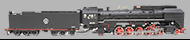
Recorded from Chinese QJ
Whistles from Iowa Interstate #6988
The QJ (Chinese: 前进; pinyin: Qián Jìn; lit. 'To go forward" or "to advance') was a type of heavy freight steam locomotive used by China Railway. The majority were built by Datong locomotive factory. The prototypes and early production of the class were designated HP (Chinese: 和平; pinyin: Hé Píng; lit. 'peace'), being redesignated as FD (Chinese: 反帝; pinyin: Fǎn Dì; lit. 'Anti-Imperialism') class during the Cultural Revolution, before becoming the QJ class in 1971.
The class became the primary mainline freight locomotive on the Chinese rail network by the 1980s, and were then displaced by diesel locomotives in 2005. After the end of steam on the national Chinese railway network many QJ locomotives were used on industrial lines, as well as on the Jitong railway. Several of the class have been preserved.
Two units withdrawn from use in China, numbers 6988 and 7081 (both former Jitong Railway), were originally acquired by the Iowa Interstate Railroad and later donated to Central States Steam Preservation Association.[12][13] A third, number 7040 (re-numbered to 2008), was acquired by the Lexington, Kentucky-based R.J. Corman Railroad Group in 2008, and operated until 2013, when it was placed on display in a specially built glass display building in Lexington.[14] In 2020, Corman donated the engine to the Kentucky Steam Heritage Corporation.[15]
Iowa Interstate 7081 retains its original Chinese appearance with the exception of the Jitong lettering and logo being replaced with the Iowa Interstate's, and the mandatory changes required by U.S. law such as hand rails and a bell. IAIS 6988 was "Americanized" in time for operation at Train Festival 2011 in Rock Island, Illinois. The diesel-style bell originally installed when it arrived in Iowa was replaced with a steam engine type bell, the Chinese headlights were replaced with an American style light with a cast number plate under it, and an American steam whistle was installed. The steel sheet on the front was removed and all red paint was painted over in black, with white trim on the running boards, wheel rims, etc. The R.J. Corman locomotive has been heavily modified. Most notably the smoke deflectors have been removed along with new paint and skirts along the running boards.
This file is set up for the American Iowa Interstate 6988 version with 3 whistles recorded from that loco.
While recorded from a 2-10-2 Chinese QJ this file can be used for large "2-10-2" "Santa Fe" type or other large locomotives in many wheel arrangments.
Whistles:
CV163=0 CR 5-Chime - Original Chinese Whistle
CV163=1 DRG&W 5 Chime
CV163=2 Soo Line 1003
CV163=3 SP 4449 Daylight
CV163=4 Single Chime Hooter
CV163=5 CPR 2317
CV163=6 Western Maryland 6 Chime
CV163=7 CN 4 Chime
CV163=8 PRR Banshee #1
CV163=9 IAIS #6988 Guatemalan
CV163=10 IAIS #6988 Southern 3 Chime
Bells:
CV164=0 #3 HVSR Bell 1
CV164=1 Pnuematic Bell 2
CV164=2 Rope Pull Bell
CV164=3 SOO Line 1003 Bell
CV164=4 DRG&W K27 Bell
Brake Squeal:
CV165=0 Brake Squeal #1 Long
CV165=1 Brake Squeal #1 Short
CV165=2 Brake Squeal #2 Long
CV165=3 Brake Squeal #2 Short
CV165=4 Brake Squeal #3 Long
CV165=5 Brake Squeal #4Short
Dynamos:
CV166=0 Soo Line 1003 Dynamo
CV166=1 K27 463 Dynamo
CV166=2 T16.1 Dynamo
Air Pumps
CV167=0 Cross Compound #1 Soo Line 1003
CV167=1 Cross Compound #2 K27 463
CV167=2 Single Stage #1 Z27
CV167=3 Westinghouse Single Stage 9" Air Pump HVSR #3
Reversers
CV168=0 Johnson Bar
CV168=1 Power Reverse
The ESU Full Throttle Steam files now include a few new logic features for added operational realism while still leaving you in control of HOW YOU wish to run your locomotive.
Heavy Load: F9 by default.
Similar to the “Drive Hold” button on the Full Throttle Diesel files “Heavy Load” allows you to adjust the “Steam Cut Off Valve” at any speed allowing for a fierce full chuff or drifting with snifters and rod clanks. Heavy load can also act as an offset allowing speed adjustments when engaged if desired.
Coast: F4 by default.
Opposite of “Heavy Load” Coast allows for a negative offset allow drifting sounds of Rods and snifter valves at any speed. You again have the option to hold the speed to adjust the speed with this offset active. Even allowing for an increase of speed with no chuffs as if drifting downhill.
Independent brake: F10 by default
Identical to the Full Throttle Diesel files. This allows for the locomotive to stop more quickly than its regular momentum would normally carry it. This one is pretty self-explanatory – just press the brake and come to a stop! For additional options there are 3 Braking rates that can be set up for user preference.
Articulation: Sound Slot 2
By adding Sound Slot 2 to the F8 Function Mapping and enabling the "Secondary Trigger" (CV250) you can add a second set of drivers making any ESU Steam File articulated.
Function Mappable Air Horn: F21 by default
Sound Slot 21.
Many Steam locomotives had a single chime airhorn equipped. Those modelling SP, MILW, and others can now have this feature and put it where they would like in the function mapping in addition to the whistle.
S0817 - Release Notes
===================================================
V-3 R-3:
===================================================
- updated independent brake
- updated boiler hiss
- updated steam chuff sound slot
V-4 R-4:
===================================================
- changed whistle sound slot 3 maximum sound slot speed to 128 Hide description more…
H0 N XL L M4
- Article numbers
- S0817
- Last change
- 4/2/2024
- Manufacturer
- ESU
License Agreement
1. GRANT OF LICENSE
1.1 ESU grants you a non-transferable, limited, non-exclusive right to use the Content solely for your own personal purposes. You may load the Content into RAM, as well as installation on a hard disk or other storage device on a single computer, hardware product or mobile device owned by you or under your control. The installation process may result in a copy of the Content residing on your computer, in which case, you may retain one (1) copy of the Content on your computer, provided that you retain all copyright and other proprietary notices on the copy and the copy is kept in your possession with the original.1.2 By using the Content, you shall not obtain any ownership, copyright, proprietary or other interest in or to the Content. The Content is licensed, not sold.
1.3 You are licensed to use, modify and combine the Sound Samples with sound samples provided by third parties, to create your own sound compositions which, subject to you complying with the terms of this Agreement, you are free to distribute as you wish provided that: (i) the Sound Samples have been mixed together to create an original work; (ii) individual Sound Samples are not used in isolation and (iii) the Sound Samples or derivatives are not used to create sound libraries for distribution to third parties.
2. PROHIBITED USES
Neither you, nor anyone at your direction, shall:2.1 use the Content, or any part of it, for any public performance, live broadcast or time delayed live broadcast where the Content is used unattended for commercial purposes without ESU' s prior written consent;
2.2 use the Content, or any part of it, in any competitive product;
2.3 sub-license, copy, reproduce, transmit, assign, rent, sell, lease, offer on a pay-per-play basis, distribute for money or any other consideration, or commercially exploit in any other manner or through any medium whatsoever or otherwise transfer in any way the Content or any part thereof;
2.4 manufacture and/or distribute for money or otherwise commercially exploit any product that incorporates any part of the Content. If you wish to use any part of the Content for manufacture, resale, sub-license or further distribution, you must contact ESU (and where relevant, its licensors) to enter into an appropriate agreement with ESU (and, where relevant, its licensors);
2.5 publish the results of any analysis or comparative evaluation of the Content or any part thereof without ESU' s prior written consent;
2.6 reverse engineer, recompile or disassemble any part of the Content except to the extent and in the circumstances expressly permitted by ESU and its licensors in writing or by law;
3. INTELLECTUAL PROPERTY RIGHTS
You acknowledge that all intellectual property rights in the Content are and shall remain vested in ESU and its licensors. You undertake not to interfere with or diminish, whether by act or omission, the rights, title and interest in the Content of ESU and its licensors. You may be held responsible by ESU and/or any of its licensors for any infringement of any intellectual property rights in the Content. For the avoidance of doubt, provided that you comply with the terms of this Agreement, ESU shall not claim ownership of the intellectual property rights in any compositions created by your use of the Content.4. TERM AND TERMINATION
This Agreement is effective from the first date you install the Content. The rights granted to you under this Agreement shall terminate if you fail to abide by its terms. Upon such termination you agree to destroy the Content including any Content stored on the hard disk of any computer under your control. You may terminate this Agreement at any time by destroying or erasing all your copies of the Content. Any termination of this Agreement (howsoever occasioned) shall not affect any accrued rights or liabilities of you or ESU nor shall it affect the coming into force or the continuance in force of the provisions of Clauses 2, 3, 5 and 6 and any provision hereof which is by implication intended to come into or continue in force on or after such termination.5. NO WARRANTIES
TO THE MAXIMUM EXTENT PERMITTED BY APPLICABLE LAW, ESU AND ITS LICENSORS PROVIDE THE CONTENT "AS IS" AND ESU EXCLUDES ON BEHALF OF ITSELF AND ITS LICENSORS, ALL CONDITIONS, TERMS, REPRESENTATIONS (OTHER THAN FRAUDULENT REPRESENTATIONS) AND WARRANTIES RELATING TO THE CONTENT, WHETHER IMPOSED BY STATUTE OR BY OPERATION OF LAW OR OTHERWISE, INCLUDING BUT NOT LIMITED TO, IMPLIED WARRANTIES OF SATISFACTORY QUALITY AND FITNESS FOR A PARTICULAR PURPOSE. NEITHER ESU NOR ITS LICENSORS WARRANT THAT THE OPERATION OF THE CONTENT WILL BE UNINTERRUPTED, ERROR FREE, VIRUS FREE OR MEET YOUR SPECIFIC REQUIREMENTS. YOU MAY HAVE OTHER RIGHTS THAT VARY FROM JURISDICTION TO JURISDICTION.6. ESU's LIABILITY
Neither ESU nor its licensors shall have any liability to you for any loss or damage caused directly or indirectly in connection with the Content, any part thereof or this Agreement, except to the extent that such liability cannot be lawfully excluded. In any case, neither ESU nor its licensors shall be liable for any loss of business, data, profits, savings, or any other special, incidental, consequential, indirect or economic loss whatsoever even if such losses were contemplated at the date of this Agreement.7. GENERAL
7.1 You acknowledge that damages alone might be insufficient remedy for any breach of the terms of this Agreement and that the remedies of injunction, specific performance or other equitable relief would be suitable remedies in the event of any breach or threatened breach of this Agreement.7.2 You may not assign or otherwise transfer all or any part of this Agreement or the rights granted to you hereunder.
7.3 ESU is not obliged to provide any maintenance, technical support or upgrades to you.
7.4 You agree to comply with all applicable import and export regulations and acknowledge that you have the responsibility for obtaining all necessary licenses to export, re-export, transfer or import the Content.
7.5 This Agreement constitutes the entire agreement between you and ESU with respect to the subject matter hereof and supersedes all prior agreements, arrangements and understandings between the parties and constitutes the entire agreement between the parties relating to such subject matter hereof. No addition to or modification of any provision of this Agreement shall be binding upon ESU and you unless made by a written instrument signed by a duly authorized representative of ESU and you.
7.6 No forbearance, delay or indulgence by either party in enforcing the provisions of this Agreement shall prejudice or restrict the rights of that party nor shall any waiver of its rights operate as a waiver of any subsequent breach and no right, power or remedy herein conferred upon or reserved for either party is exclusive of any other right, power or remedy available to that party and each such right, power or remedy shall be cumulative.
7.7 Notwithstanding that the whole or any part of any provision of this Agreement may prove to be illegal or unenforceable the other provisions of this Agreement and the remainder of the provision in question shall remain in full force and effect.
If you download the designated file, you agree to be legally bound by the license given above.