VT 98 LokSound V4.0 European Soundfiles
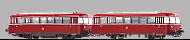
VT 98 of German State Railway DB is a two motor two axle diesel railcar that had been built between 1953 and 1962. Each motor delivers 150 HP. Transmitted by manual 6 speed gearbox the railcars reach a maximum speed of 90 km/h. Some of the railcars are used by railway museums today. epoch selectable via CV48. epoche 3 (CV 48 = 0), Epoche 4 (CV48 = 1).
VT 98 LokSound 5 European Sound files
VT 98 of German State Railway DB is a two motor two axle diesel railcar that had been built between 1953 and 1962. Each motor delivers 150 HP. Transmitted by manual 6 speed gearbox the railcars reach a maximum speed of 90 km/h. Some of the railcars are used by railway museums today. epoch selectable via CV48. epoche 3 (CV 48 = 0), Epoche 4 (CV48 = 1).
VT18.16 / BR175 DR LokSound 5 factory equipped sounds  H0
H0
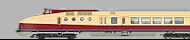
In 1959, the GDR government decided to develop a four-car diesel-hydraulic multiple unit capable of 160 km/h for international express service. A total of twelve diesel multiple units were built at the Görlitz factory, designated VT 18.16 in keeping with their approximately 1,800 hp output and top speed of 160 km/h. The 12-cylinder 12 KVD 18/21 SVW engines, mounted above the power bogies of the motor cars, were rated at 660 kW on trains VT 18.16.01 and 02; the second engine upgrade, available more…
VT18.16 / BR175 DR LokSound 5 factory equipped sounds H0
In 1959, the GDR government decided to develop a four-car diesel-hydraulic multiple unit capable of 160 km/h for international express service. A total of twelve diesel multiple units were built at the Görlitz factory, designated VT 18.16 in keeping with their approximately 1,800 hp output and top speed of 160 km/h. The 12-cylinder 12 KVD 18/21 SVW engines, mounted above the power bogies of the motor cars, were rated at 660 kW on trains VT 18.16.01 and 02; the second engine upgrade, available more…
VT18.16 / BR175 DR LokSound 5 European Sound files H0
In 1959, the GDR government decided to develop a four-car diesel-hydraulic multiple unit capable of 160 km/h for international express service. A total of twelve diesel multiple units were built at the Görlitz factory, designated VT 18.16 in keeping with their approximately 1,800 hp output and top speed of 160 km/h. The 12-cylinder 12 KVD 18/21 SVW engines, mounted above the power bogies of the motor cars, were rated at 660 kW on trains VT 18.16.01 and 02; the second engine upgrade, available more…
VT2.09 / Ferkeltaxe LokSound V4.0 European Soundfiles
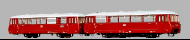
The two axle diesel railcar VT 2.09 (later 771/772) had been developed by Deutsche Reichsbahn (DR) of GDR. The 180 HP diesel motor 6VD 18/15 enabled the railcar to reach a maximum speed of 90 km/h. For transmission the railcar had a 6 speed manual gearing. Last of the cars nicknamed Ferkeltaxi or Blutblase quitted service in 2004. 22 cars had been sold to Rumania and Kuba. epoch selectable via CV48. epoche 3 (CV 48 = 0), Epoche 4 (CV48 = 1).
BR98.10 LokSound V4.0 European Soundfiles

Deutsche Bundesbahn
All 45 98.10 locomotives were recovered after 1945 by the Deutsche Bundesbahn, and continued to be used exclusively in their native Bavaria. Though the locomotives were initially indispensable, they were put out to pasture after the advent of the "Roter Brummer" rail bus, especially those used in passenger train service. Many of the locomotives were still used after this time, in freight service especially. DB did not make any more major changes or improvements; in the late more…
VT 36.5 LokSound V4.0 European Soundfiles
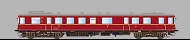
The former Deutsche Reichsbahn-Gesellschaft (DRG) ordered 50 hydraulic foru axle diesel railcars numbered as VT 137 241-270 and VT 137 442-461. The MAN diesel motors delivered 360 HP at 870 rpm and reached a maximum speed of 100 km/h. After WWII 16 railcars went to DB, seven were owned by DR.
VT135 / VT70.9 LokSound V4.0 European Soundfiles
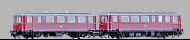
German Deutsche Reichsbahn-Gesellschaft (DRG) received 64 samples of 2-axle diesel railcar VT 135 061-064, 067-076 and 083-132. After WW II DB renumbered them for VT 70.9, DR for BR 186. The 6 cylinder diesel prime mover enabled the railcar to reach a maximum speed of 75 km/h.
BR 98.10 LokSound V4.0 & LokPilot V4.0 for Factory Equipped Locomotives
Deutsche Bundesbahn
All 45 98.10 locomotives were recovered after 1945 by the Deutsche Bundesbahn, and continued to be used exclusively in their native Bavaria. Though the locomotives were initially indispensable, they were put out to pasture after the advent of the "Roter Brummer" rail bus, especially those used in passenger train service. Many of the locomotives were still used after this time, in freight service especially. DB did not make any more major changes or improvements; in the late more…