BR98.10 LokSound V4.0 European Soundfiles

Deutsche Bundesbahn
All 45 98.10 locomotives were recovered after 1945 by the Deutsche Bundesbahn, and continued to be used exclusively in their native Bavaria. Though the locomotives were initially indispensable, they were put out to pasture after the advent of the "Roter Brummer" rail bus, especially those used in passenger train service. Many of the locomotives were still used after this time, in freight service especially. DB did not make any more major changes or improvements; in the late more…
BR 98.10 LokSound V4.0 & LokPilot V4.0 for Factory Equipped Locomotives
Deutsche Bundesbahn
All 45 98.10 locomotives were recovered after 1945 by the Deutsche Bundesbahn, and continued to be used exclusively in their native Bavaria. Though the locomotives were initially indispensable, they were put out to pasture after the advent of the "Roter Brummer" rail bus, especially those used in passenger train service. Many of the locomotives were still used after this time, in freight service especially. DB did not make any more major changes or improvements; in the late more…
BR98.8 LokSound V4.0 & LokPilot V4.0 for Factory Equipped Locomotives
Deutsche Bundesbahn
All 45 98.10 locomotives were recovered after 1945 by the Deutsche Bundesbahn, and continued to be used exclusively in their native Bavaria. Though the locomotives were initially indispensable, they were put out to pasture after the advent of the "Roter Brummer" rail bus, especially those used in passenger train service. Many of the locomotives were still used after this time, in freight service especially. DB did not make any more major changes or improvements; in the late more…
BR 98.8 Bayr. GtL 4/4 LokSound 5 European Sound files  H0
H0

From 1911 onwards, Krauss delivered 117 examples of the GtL 4/4 two-cylinder local railway locomotive in several series to the Bavarian State Railways. The Deutsche Reichsbahn-Gesellschaft DRG received the last 17 in 1927 and grouped them as the 98.8 series. With an output of 450 hp, the four-couplers were the most powerful Bavarian local railway machines. The DRG only considered the top speed of 40 km/h to be in need of improvement and equipped the most recently delivered locomotives with a more…
Lokalbahn BR 98 LokSound V4.0 European Soundfiles

steam locomotive BR98 (Gtl 4/4)
ETAT 231 981-996, SNCF LokSound 5 European Sound files H0
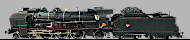
After the First World War, the French ETAT received 16 examples of the Bavarian express train locomotive type S3/6. The four-cylinder locomotives were classified as 3-231 A981-996. The three-coupled locomotives, which had 1770 hp and could reach speeds of 120 km/h, were used in the south-west of France and proved very effective on express and passenger trains. During the Second World War, the German occupying forces drove the locomotives to southern Germany and returned them to scrap after the more…
BR98.10 ex. GtL 4/5 DRG LokSound 5 European Sound files H0

Between 1929 and 1932, Krauss delivered 45 samples of the type 98.10 two-cylinder local railway locomotive to Deutsche Reichsbahn-Gesellschaft DRG on behalf of the Bavarian group administration. The locomotives, which largely corresponded technically to the 98.8 (GtL 4/4) delivered from 1923 onwards, were given a trailing axle to increase the top speed and improve the driving characteristics. With an output of 450 hp, the four-couplers were the most powerful Bavarian local railway machines. more…
#98 WWRR ALCO 4-4-0 LokSound 5 North American and Australian Sound files H0

Recorded from Wilmington Western #98
4-4-0 is a locomotive type with a classification that uses the Whyte notation for the classification of steam locomotives by wheel arrangement and represents the arrangement: four leading wheels on two axles (usually in a leading bogie), four powered and coupled driving wheels on two axles, and a lack of trailing wheels. Due to the large number of the type that were produced and used in the United States, the 4-4-0 is most commonly known as the more…
BR98.3 PtL 2/2 Glaskasten LokSound 5 European Sound files H0

In the early 1900s, the Royal Bavarian State Railways wanted to rationalize operations on its less busy local railway lines by purchasing small locomotives suitable for one-man operation. The most successful was the PtL2/2 design submitted by Krauss, with 29 units built, which was popularly known as the Glaskasterl (Glass Box) due to its large driver's cab. Krauss delivered three locomotives to the Prussian KPEV also. Two further series of 13 units followed with identical boiler and cylinders, more…
BR 44 Öl LokSound V4.0 European Soundfiles
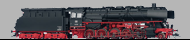
BR 44 had been the most successful steam loco for heavy freight trains at the Deutsche Reichsbahn-Gesellschaft (DRG). Between 1926 an end of WWII 1989 units of the 3 cylindred 2-10 had been built. They developed 1919 HP and reached a maximum speed of 80 km/h. In the 1950s Deutsche Bundesbahn (DB) and Deutsche Reichsbahn (DR) rebuilt 36 (DB) and 95 (DR) with oil firing equipment.