- Downloads
- Sounds
- projects.esu.eu
- Search results
#261 MILW ALCO 4-8-4 LokSound 5 North American and Australian Sound files  H0 N XL L M4
- Article numbers:S0792
- Last change: 4/2/2024
- Manufacturer: ESU
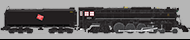
Recorded from MILW #261 S3 Class 4-8-4
We would like to give a special thanks to the "Friends of the 261" for their help in this project. to find out more about their operation or to book a ride please go to: https://261.com/
Milwaukee Road 261 is a class "S3" 4-8-4 "Northern" type steam locomotive built by the American Locomotive Company (ALCO), in Schenectady, New York in July 1944, for the Chicago, Milwaukee, St. Paul and Pacific Railroad, often referred to as the "Milwaukee Road".
It was used for heavy mainline freight work until being retired by the railroad in 1956. Instead of being cut up for scrap, 261 was preserved and donated to the National Railroad Museum in Green Bay, Wisconsin in 1958. Today, the locomotive is owned, operated, and maintained by Minneapolis-based nonprofit organization Friends of the 261, which runs occasional and seasonal excursion trains using the locomotive. The steam engine, restored in 1993,[1] has logged more than 25,000 miles (40,000 km) under its own power since that time.
While recorded from an MILW S3 Class Northern this file can be used for many large locomotives in many wheel arrangments.
Whistles:
CV163=0 MILW 261 Shop Built 3 Chime
CV163=1 ATSF 5 Chime as used on the MILW 261
CV163=2 DL&W 5 Chime as used on the MILW 261 when lettered for Lackawanna
CV163=3 SP 4449 Daylight
CV163=4 B&M 5 Chime
CV163=5 Western Maryland 6 Chime
CV163=6 PRR Banshee #1
CV163=7 DRG&W 484
CV163=8 DRG&W 5 Chime
CV163=9 N&W Hooter
CV163=10 Soo Line 1003
Bells:
CV164=0 MILW #261 Bell
CV164=1 Pnuematic Bell 2
CV164=2 Rope Pull Bell
CV164=3 SOO Line 1003 Bell
CV164=4 DRG&W K27 Bell
Brake Squeal:
CV165=0 Brake Squeal #1 Long
CV165=1 Brake Squeal #1 Short
CV165=2 Brake Squeal #2 Long
CV165=3 Brake Squeal #2 Short
CV165=4 Brake Squeal #3 Long
CV165=5 Brake Squeal #4Short
Dynamos:
CV166=0 Soo Line 1003 Dynamo
CV166=1 K27 463 Dynamo
CV166=2 T16.1 Dynamo
Air Pumps
CV167=0 Cross Compound #1 Soo Line 1003
CV167=1 Cross Compound #2 K27 463
CV167=2 Single Stage #1 Z27
CV167=3 Westinghouse Single Stage 9" Air Pump HVSR #3
Reversers
CV168=0 Johnson Bar
CV168=1 Power Reverse
The ESU Full Throttle Steam files now include a few new logic features for added operational realism while still leaving you in control of HOW YOU wish to run your locomotive.
Heavy Load: F9 by default.
Similar to the “Drive Hold” button on the Full Throttle Diesel files “Heavy Load” allows you to adjust the “Steam Cut Off Valve” at any speed allowing for a fierce full chuff or drifting with snifters and rod clanks. Heavy load can also act as an offset allowing speed adjustments when engaged if desired.
Coast: F4 by default.
Opposite of “Heavy Load” Coast allows for a negative offset allow drifting sounds of Rods and snifter valves at any speed. You again have the option to hold the speed to adjust the speed with this offset active. Even allowing for an increase of speed with no chuffs as if drifting downhill.
Independent brake: F10 by default
Identical to the Full Throttle Diesel files. This allows for the locomotive to stop more quickly than its regular momentum would normally carry it. This one is pretty self-explanatory – just press the brake and come to a stop! For additional options there are 3 Braking rates that can be set up for user preference.
Articulation: Sound Slot 2
By adding Sound Slot 2 to the F8 Function Mapping and enabling the "Secondary Trigger" (CV250) you can add a second set of drivers making any ESU Steam File articulated.
Function Mappable Air Horn: F21 by default
Sound Slot 21.
Many Steam locomotives had a single chime airhorn equipped. Those modelling SP, MILW, and others can now have this feature and put it where they would like in the function mapping in addition to the whistle.
S0792 - Release Notes
===================================================
V-4 R-3:
===================================================
- updated independent brake
- updated boiler hiss
- updated steam chuff sound slot
V-5 R-4:
===================================================
- changed whistle sound slot 3 maximum sound slot speed to 128 Hide description more…
H0 N XL L M4
- Article numbers
- S0792
- Last change
- 4/2/2024
- Manufacturer
- ESU
#11 EV ALCO 2-6-0 LokSound 5 North American and Australian Sound files H0 N XL L M4
- Article numbers:S0815
- Last change: 4/2/2024
- Manufacturer: ESU

Recorded from Everett Railroad 2-6-0 #11.
We would like to give a special thanks to the Everett Railroad for their help in this project. To find out more about their operation or to book a ride please go to: https://everettrailroad.com/
Steam locomotive number 11 was constructed in 1920 by the Cooke Works of the American Locomotive Company (Alco) in Paterson, New Jersey. It is a “2‑6‑0” or “Mogul” type and was one of 54 engines of four different wheel arrangements built between 1920 and 1925 intended for export to Cuba and use in that country’s sugar cane fields.
In fall of 2015, the locomotive returned to service for the first time since the early 1970s and will serve as the Everett railroad’s primary excursion power going forward.
Whistles:
CV163=0 EV #11
CV163=1 DRGW 5-Chime
CV163=2 SOO #1003
CV163=3 SP #4449
CV163=4 Hooter
CV163=5 CPR #2317
CV163=6 WM 6-Chime
CV163=7 CN 4 Chime
CV163=8 PRR Flat Top Single-Chime Banshee
CV163=9 DRGW #484
Bells:
CV164=0 EV #11 Bell
CV164=1 Pnuematic Bell 2
CV164=2 Rope Pull Bell
CV164=3 SOO Line 1003 Bell
CV164=4 DRG&W K27 Bell
Brake Squeal:
CV165=0 Brake Squeal #1 Long
CV165=1 Brake Squeal #1 Short
CV165=2 Brake Squeal #2 Long
CV165=3 Brake Squeal #2 Short
CV165=4 Brake Squeal #3 Long
CV165=5 Brake Squeal #4Short
Dynamos:
CV166=0 Soo Line 1003 Dynamo
CV166=1 K27 463 Dynamo
Air Pumps
CV167=0 Cross Compound #1 Soo Line 1003
CV167=1 Cross Compound #2 K27 463
CV167=2 Single Stage #1 Z27
CV167=3 Air Pump EV #11
Reversers
CV168=0 Johnson Bar
CV168=1 Power Reverse
The ESU Full Throttle Steam files now include a few new logic features for added operational realism while still leaving you in control of HOW YOU wish to run your locomotive.
Heavy Load: F9 by default.
Similar to the “Drive Hold” button on the Full Throttle Diesel files “Heavy Load” allows you to adjust the “Steam Cut Off Valve” at any speed allowing for a fierce full chuff or drifting with snifters and rod clanks. Heavy load can also act as an offset allowing speed adjustments when engaged if desired.
Coast: F4 by default.
Opposite of “Heavy Load” Coast allows for a negative offset allow drifting sounds of Rods and snifter valves at any speed. You again have the option to hold the speed to adjust the speed with this offset active. Even allowing for an increase of speed with no chuffs as if drifting downhill.
Independent brake: F10 by default
Identical to the Full Throttle Diesel files. This allows for the locomotive to stop more quickly than its regular momentum would normally carry it. This one is pretty self-explanatory – just press the brake and come to a stop! For additional options there are 3 Braking rates that can be set up for user preference.
Articulation: Sound Slot 2
By adding Sound Slot 2 to the F8 Function Mapping and enabling the "Secondary Trigger" (CV250) you can add a second set of drivers making any ESU Steam File articulated.
Function Mappable Air Horn: F21 by default
Sound Slot 21.
Many Steam locomotives had a single chime airhorn equipped. Those modelling SP, MILW, and others can now have this feature and put it where they would like in the function mapping in addition to the whistle.
S0815 - Release Notes
===================================================
V-3 R-3:
===================================================
- updated independent brake
- updated boiler hiss
- updated steam chuff sound slot
V-4 R-4:
===================================================
- changed whistle sound slot 3 maximum sound slot speed to 128 Hide description more…
H0 N XL L M4
- Article numbers
- S0815
- Last change
- 4/2/2024
- Manufacturer
- ESU
#98 WWRR ALCO 4-4-0 LokSound 5 North American and Australian Sound files H0 N XL L M4
- Article numbers:S0797
- Last change: 4/2/2024
- Manufacturer: ESU
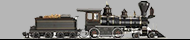
Recorded from Wilmington Western #98
4-4-0 is a locomotive type with a classification that uses the Whyte notation for the classification of steam locomotives by wheel arrangement and represents the arrangement: four leading wheels on two axles (usually in a leading bogie), four powered and coupled driving wheels on two axles, and a lack of trailing wheels. Due to the large number of the type that were produced and used in the United States, the 4-4-0 is most commonly known as the American
While recorded from an early 4-4-0 this file can be used for smaller locomotives in many wheel arrangments.
Whistles:
CV163=0 WWRR #98
CV163=1 N&W #475
CV163=2 WP Hancock Short Bell 3-Chime
CV163=3 Southern Crosby 3-Chime
CV163=4 PRR Flat Top Single-Chime Banshee Ed2
CV163=5 MVRHA 5-Chime
Bells:
CV164=0 WWRR #98 Bell
CV164=1 Pnuematic Bell 2
CV164=2 Rope Pull Bell
CV164=3 SOO Line 1003 Bell
CV164=4 DRG&W K27 Bell
Brake Squeal:
CV165=0 Brake Squeal #1 Long
CV165=1 Brake Squeal #1 Short
CV165=2 Brake Squeal #2 Long
CV165=3 Brake Squeal #2 Short
CV165=4 Brake Squeal #3 Long
CV165=5 Brake Squeal #4Short
Dynamos:
CV166=0 K27 463 Dynamo
CV166=1 T16.1 Dynamo
Air Pumps
CV167=0 Cross Compound #1 Soo Line 1003
CV167=1 Cross Compound #2 K27 463
CV167=2 Single Stage #1 Z27
CV167=3 Westinghouse Single Stage 9" Air Pump HVSR #3
Reversers
CV168=0 Johnson Bar
CV168=1 Power Reverse
The ESU Full Throttle Steam files now include a few new logic features for added operational realism while still leaving you in control of HOW YOU wish to run your locomotive.
Heavy Load: F9 by default.
Similar to the “Drive Hold” button on the Full Throttle Diesel files “Heavy Load” allows you to adjust the “Steam Cut Off Valve” at any speed allowing for a fierce full chuff or drifting with snifters and rod clanks. Heavy load can also act as an offset allowing speed adjustments when engaged if desired.
Coast: F4 by default.
Opposite of “Heavy Load” Coast allows for a negative offset allow drifting sounds of Rods and snifter valves at any speed. You again have the option to hold the speed to adjust the speed with this offset active. Even allowing for an increase of speed with no chuffs as if drifting downhill.
Independent brake: F10 by default
Identical to the Full Throttle Diesel files. This allows for the locomotive to stop more quickly than its regular momentum would normally carry it. This one is pretty self-explanatory – just press the brake and come to a stop! For additional options there are 3 Braking rates that can be set up for user preference.
Articulation: Sound Slot 2
By adding Sound Slot 2 to the F8 Function Mapping and enabling the "Secondary Trigger" (CV250) you can add a second set of drivers making any ESU Steam File articulated.
Function Mappable Air Horn: F21 by default
Sound Slot 21.
Many Steam locomotives had a single chime airhorn equipped. Those modelling SP, MILW, and others can now have this feature and put it where they would like in the function mapping in addition to the whistle.
S0797 - Release Notes
===================================================
V-3 R-3:
===================================================
- updated independent brake
- updated boiler hiss
V-4 R-4:
===================================================
- changed whistle sound slot 3 maximum sound slot speed to 128 Hide description more…
H0 N XL L M4
- Article numbers
- S0797
- Last change
- 4/2/2024
- Manufacturer
- ESU
#165 WP ALCO 0-6-0 LokSound 5 North American and Australian Sound files H0 N XL L M4
- Article numbers:S0841
- Last change: 4/2/2024
- Manufacturer: ESU

Western Pacific 165 is an 0-6-0 switching locomotive built by the Schenectady Works of the American Locomotive Company. This engine was used at many of the WP's rail yards, including Stockton, Sacramento and Portola. It was built in November, 1919, for the United Verde Copper Company of Jerome, Arizona, as their number 87. On September 17, 1927, the 165 and three sister UVCC engines were sold to the WP and become the road's S-34 class, numbered 163-166.
These burly switchers supplemented WP's 12 existing 0-6-0s, and some 2-8-0s in working the various yards. The 165 last operated in March, 1953, as WP was winding down its last steam operations. The engine was retired in October, 1957. Five years later, the engine was donated to the City of San Leandro. The engine was displayed for many years at the San Leandro BART station, before being transferred to the Alameda County Fairgrounds for display there. It was later acquired by the Pacific Locomotive Association and was eventually acquired by the FRRS in a trade with a later owner.
The 0-6-0 configuration was the most widely used wheel arrangement for both tender and tank steam locomotives. The type was also widely used for diesel switchers (shunters). Because they lack leading and trailing wheels, locomotives of this type have all their weight pressing down on their driving wheels and consequently have a high tractive effort and factor of adhesion, making them comparatively strong engines for their size, weight and fuel consumption. On the other hand, the lack of unpowered leading wheels have the result that 0-6-0 locomotives are less stable at speed. They are therefore mostly used on trains where high speed is unnecessary.
Since 0-6-0 tender engines can pull fairly heavy trains, albeit slowly, the type was commonly used to pull short and medium distance freight trains such as pickup goods trains along both main and branch lines. The tank engine versions were widely used as switching (shunting) locomotives since the smaller 0-4-0 types were not large enough to be versatile in this job. 0-8-0 and larger switching locomotives, on the other hand, were too big to be economical or even usable on lightly built railways such as dockyards and goods yards, precisely the sorts of places where switching locomotives were most needed.
While recorded from an early 1919 0-6-0 this file can be used for smaller locomotives in many wheel arrangments.
We would like to give a special thanks to the Western Pacific Railroad Museum for their help in this project. To find out more about their operation or to book a ride please go to: https://www.wplives.org/index.html
Whistles:
CV163=0 WP 165
CV163=1 DRGW 5-Chime
CV163=2 SOO #1003
CV163=3 SP #4449
CV163=4 Hooter
CV163=5 EV #11
CV163=6 WM 6-Chime
CV163=7 CN 4 Chime
CV163=8 PRR Flat Top Single-Chime Banshee
CV163=9 DRGW #484
Bells:
CV164=0 EV #11 Bell
CV164=1 Pnuematic Bell 2
CV164=2 Rope Pull Bell
CV164=3 SOO Line 1003 Bell
CV164=4 DRG&W K27 Bell
Brake Squeal:
CV165=0 Brake Squeal #1 Long
CV165=1 Brake Squeal #1 Short
CV165=2 Brake Squeal #2 Long
CV165=3 Brake Squeal #2 Short
CV165=4 Brake Squeal #3 Long
CV165=5 Brake Squeal #4Short
Dynamos:
CV166=0 Soo Line 1003 Dynamo
CV166=1 K27 463 Dynamo
CV166=2 T16.1 Dynamo
Air Pumps
CV167=0 Cross Compound #1 Soo Line 1003
CV167=1 Cross Compound #2 K27 463
CV167=2 Single Stage #1 Z27
CV167=3 Air Pump EV #11
Reversers
CV168=0 Johnson Bar
CV168=1 Power Reverse
The ESU Full Throttle Steam files now include a few new logic features for added operational realism while still leaving you in control of HOW YOU wish to run your locomotive.
Heavy Load: F9 by default.
Similar to the “Drive Hold” button on the Full Throttle Diesel files “Heavy Load” allows you to adjust the “Steam Cut Off Valve” at any speed allowing for a fierce full chuff or drifting with snifters and rod clanks. Heavy load can also act as an offset allowing speed adjustments when engaged if desired.
Coast: F4 by default.
Opposite of “Heavy Load” Coast allows for a negative offset allow drifting sounds of Rods and snifter valves at any speed. You again have the option to hold the speed to adjust the speed with this offset active. Even allowing for an increase of speed with no chuffs as if drifting downhill.
Independent brake: F10 by default
Identical to the Full Throttle Diesel files. This allows for the locomotive to stop more quickly than its regular momentum would normally carry it. This one is pretty self-explanatory – just press the brake and come to a stop! For additional options there are 3 Braking rates that can be set up for user preference.
Articulation: Sound Slot 2
By adding Sound Slot 2 to the F8 Function Mapping and enabling the "Secondary Trigger" (CV250) you can add a second set of drivers making any ESU Steam File articulated.
Function Mappable Air Horn: F21 by default
Sound Slot 21.
Many Steam locomotives had a single chime airhorn equipped. Those modelling SP, MILW, and others can now have this feature and put it where they would like in the function mapping in addition to the whistle.
S0841 - Release Notes
===================================================
V-3 R-3:
===================================================
- updated independent brake
- updated boiler hiss
- updated steam chuff sound slot
V-4 R-4:
===================================================
- changed whistle sound slot 3 maximum sound slot speed to 128 Hide description more…
H0 N XL L M4
- Article numbers
- S0841
- Last change
- 4/2/2024
- Manufacturer
- ESU
4-12-2 Three Cylinder LokSound 5 North American and Australian Sound files H0 N XL L M4
- Article numbers:S0785
- Last change: 4/2/2024
- Manufacturer: ESU
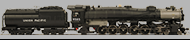
The 4-12-2 represents the wheel arrangement of four leading wheels, twelve coupled driving wheels, and two trailing wheels. This arrangement was named the Union Pacific type, after the only railroad to use it, the Union Pacific Railroad.
Only one type of locomotive with a 4-12-2 wheel arrangement was built: the Union Pacific Railroad's 9000-series locomotives, 88 of which were built by ALCO between 1926 and 1930. These locomotives were used to increase the speed of freight trains in flat country, and were fairly successful, but were maintenance nightmares, largely because of their use of an inside third cylinder driving the cranked second driving axle between the frames. There was no inside valve gear to worry about, however. ALCO had obtained permission to use the conjugated valve gear invented by Sir Nigel Gresley. This system used two hinged levers connected to the outer cylinder's valves to operate the inner cylinder's valve. The 9000 class locomotives were the largest to use Gresley gear.
In this front view of the same locomotive the third cylinder and the mechanism that controlled it can be seen below the smokebox.
Between 1934 and 1940 eight of the first fifteen locos had their Gresley gear removed and were converted to a "double Walschaerts" valve gear which utilized a double eccentric (return) crank and second link on the right side (similar to the gear Baldwin used on its 3-cylinder experimental compound 4-10-2 #60000), which operated the valve for the inside cylinder. Union Pacific referred to this system as the "third link." The 4-12-2's constructed from 1928 utilized roller bearings in the Gresley lever bearings, thus none of these engines were converted. The pre-1928 engines not converted received the roller bearing levers in 1940, and no further conversions were made.
During design the third and fourth driving axles were planned to be "blind" (flangeless) in order to improve curve handling, but ALCO's lateral motion devices on the first and sixth axles (which allowed the axles to slide up to two inches to the side) made this unnecessary. They had the longest rigid wheelbase in North America, and the longest in the world until the Soviet Union built their 4-14-4 locomotive in 1934. The trailing truck carried the same axle load as the drivers, which was unusual.
There has been debate as to whether the first driving axle of the 4-12-2 was cranked to provide clearance for the main rod connected to the second axle. Union Pacific drawings show no such crank on the first axle, and the Railway Age article says "The 67 in (170 cm) drivers permit the use of a straight axle on the front drivers..." The spacing between the first and second axles was increased by 18 in (46 cm) to provide clearance. Based on the published dimensions, this means at its closest the centerline of the inside rod was 11.645 in (29.58 cm) from the centerline of the first axle. (UP drawings reproduced in Kratville and Bush's "Union Pacific Type" books show the inside rod 113 in (290 cm) long and the first and second driver axles 88 in (220 cm) apart. The inside cylinder axis was inclined 9.5 degrees and was 32 in (81 cm) above the plane of the driving axles at a point 181 in (460 cm) ahead of the second driving axle, so the cylinder axis missed the centerline of the second axle by 1-11/16 inches. The rod centerline is closest to the axle when the crank is 54.49 degrees below horizontal.)
There is one surviving UP 4-12-2 "Union Pacific" type locomotive. It is number 9000 displayed at the Los Angeles County Fairplex in Pomona, CA
Whistles:
CV163=0 UP 844 "Steamboat" - Default
CV163=1 Union Pacific 3-chime steamboat
CV163=2 Steam Whistle 1
CV163=3 SP 4449 Daylight
CV163=4 DRG&W 5 Chime
CV163=5 SOO Line 1003
CV163=6 DL&W 5 Chime
CV163=7 WM 6 Chime
Bells:
CV164=0 Pnuematic Bell 1
CV164=1 Pnuematic Bell 2
CV164=2 Steam Loco Rope Pull Bell
CV164=3 SOO Line 1003 Bell
CV164=4 UP 844 Air Ringer Bell - Default
CV164=5 SP 4449 Bell
CV164=6 DRG&W K27 Bell
Dynamos:
CV165=0 Soo Line 1003 Dynamo
CV165=1 K27 463 Dynamo
CV165=2 SPTriple Dynamo
CV165=3 UP Dual Dynamo
CV165=4 Z27 Dynamo
CV165=5 T16.1 Dynamo
Air Pumps
CV166=0 Cross Compound #1 Soo Line 1003
CV166=1 Cross Compound #2 K27 463
CV166=2 Cross Compound #3 SP 4449
CV166=3 Cross Compound #4UP 844
CV166=4 Single Stage #1 Z27
CV166=5 Single Stage #2 T16.1
The ESU Full Throttle Steam files now include a few new logic features for added operational realism while still leaving you in control of HOW YOU wish to run your locomotive.
Heavy Load: F9 by default.
Similar to the “Drive Hold” button on the Full Throttle Diesel files “Heavy Load” allows you to adjust the “Steam Cut Off Valve” at any speed allowing for a fierce full chuff or drifting with snifters and rod clanks. Heavy load can also act as an offset allowing speed adjustments when engaged if desired.
Coast: F4 by default.
Opposite of “Heavy Load” Coast allows for a negative offset allow drifting sounds of Rods and snifter valves at any speed. You again have the option to hold the speed to adjust the speed with this offset active. Even allowing for an increase of speed with no chuffs as if drifting downhill.
Independent brake: F10 by default
Identical to the Full Throttle Diesel files. This allows for the locomotive to stop more quickly than its regular momentum would normally carry it. This one is pretty self-explanatory – just press the brake and come to a stop! For additional options there are 3 Braking rates that can be set up for user preference.
Articulation: Sound Slot 2
By adding Sound Slot 2 to the F8 Function Mapping and enabling the "Secondary Trigger" (CV250) you can add a second set of drivers making any ESU Steam File articulated.
Function Mappable Air Horn: F21 by default
Sound Slot 21.
Many Steam locomotives had a single chime airhorn equipped. Those modelling SP, MILW, and others can now have this feature and put it where they would like in the function mapping in addition to the whistle.
S0785 - Release Notes
===================================================
V-2 R-2:
===================================================
- updated independent brake
- updated boiler hiss
V-3 R-3:
===================================================
- updated steam chuffs sound slot
V-4 R-4:
===================================================
- changed whistle sound slot 3 maximum sound slot speed to 128 Hide description more…
H0 N XL L M4
- Article numbers
- S0785
- Last change
- 4/2/2024
- Manufacturer
- ESU
#1702 GSMR BLW 2-8-0 LokSound 5 North American and Australian Sound files H0 N XL L M4
- Article numbers:S0814
- Last change: 4/2/2024
- Manufacturer: ESU

Recorded from Great Smoky Mountains Railroad #1702.
We would like to give a special thanks to the GSMR for their help in this project. To find out more about their operation or to book a ride please go to: https://www.gsmr.com/steam/
The Great Smoky Mountains Railroad #1702 is a 2-8-0 steam locomotive, built in September 1942 by the Baldwin Locomotive Works in Eddystone, PA. Originally destined to be US Army Transportation Corp #1702, part of their S160 class of 2-8-0 Consolidations, which were also built by Lima & ALCO between 1942 and 1945.
Whistles:
CV163=0 GSMR #1702
CV163=1 DRGW 5-Chime
CV163=2 SOO #1003
CV163=3 SP #4449
CV163=4 Hooter
CV163=5 CPR #2317
CV163=6 WM 6-Chime
CV163=7 CN 4 Chime
CV163=8 PRR Flat Top Single-Chime Banshee
CV163=9 DRGW #484
Bells:
CV164=0 GSMR #1702
CV164=1 Pnuematic Bell 2
CV164=2 Rope Pull Bell
CV164=3 SOO Line 1003 Bell
CV164=4 DRG&W K27 Bell
Brake Squeal:
CV165=0 Brake Squeal #1 Long
CV165=1 Brake Squeal #1 Short
CV165=2 Brake Squeal #2 Long
CV165=3 Brake Squeal #2 Short
CV165=4 Brake Squeal #3 Long
CV165=5 Brake Squeal #4Short
Dynamos:
CV166=0 Soo Line 1003 Dynamo
CV166=1 K27 463 Dynamo
CV166=2 T16.1 Dynamo
Air Pumps
CV167=0 Cross Compound #1 Soo Line 1003
CV167=1 Cross Compound #2 K27 463
CV167=2 Single Stage #1 Z27
CV167=3 Air Pump GSMR #1702
Reversers
CV168=0 Johnson Bar
CV168=1 Power Reverse
The ESU Full Throttle Steam files now include a few new logic features for added operational realism while still leaving you in control of HOW YOU wish to run your locomotive.
Heavy Load: F9 by default.
Similar to the “Drive Hold” button on the Full Throttle Diesel files “Heavy Load” allows you to adjust the “Steam Cut Off Valve” at any speed allowing for a fierce full chuff or drifting with snifters and rod clanks. Heavy load can also act as an offset allowing speed adjustments when engaged if desired.
Coast: F4 by default.
Opposite of “Heavy Load” Coast allows for a negative offset allow drifting sounds of Rods and snifter valves at any speed. You again have the option to hold the speed to adjust the speed with this offset active. Even allowing for an increase of speed with no chuffs as if drifting downhill.
Independent brake: F10 by default
Identical to the Full Throttle Diesel files. This allows for the locomotive to stop more quickly than its regular momentum would normally carry it. This one is pretty self-explanatory – just press the brake and come to a stop! For additional options there are 3 Braking rates that can be set up for user preference.
Articulation: Sound Slot 2
By adding Sound Slot 2 to the F8 Function Mapping and enabling the "Secondary Trigger" (CV250) you can add a second set of drivers making any ESU Steam File articulated.
Function Mappable Air Horn: F21 by default
Sound Slot 21.
Many Steam locomotives had a single chime airhorn equipped. Those modelling SP, MILW, and others can now have this feature and put it where they would like in the function mapping in addition to the whistle.
S0814 - Release Notes
===================================================
V-3 R-3:
===================================================
- updated independent brake
- updated boiler hiss
- updated steam chuff sound slot
V-4 R-4:
===================================================
- changed whistle sound slot 3 maximum sound slot speed to 128 Hide description more…
H0 N XL L M4
- Article numbers
- S0814
- Last change
- 4/2/2024
- Manufacturer
- ESU
Southern #630 Ks-1 2-8-0 LokSound 5 North American and Australian Sound files H0 N XL L M4
- Article numbers:S0858
- Last change: 12/19/2025
- Manufacturer: ESU
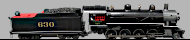
Southern Railway #630 was crafted by ALCO in 1904 under the Class K designation 2-8-0 consolidation. In 1917 it was significantly overhauled to include superheaters, piston valves, and Southern Valve Gear. It served the Southern Railway for the next 48 years primarily on the Asheville Division until retirement in June 1952.
#630 was then moved to Johnson City, TN where it found new life with the East Tennessee & Western North Carolina Railroad. It was numbered 207 and ran between Johnson City and Elizabethton. In 1967, the Southern Railway reacquired #630 in a trade to operate the locomotive as part of their steam program. It ran on the mainline once again until 1978.
The Tennessee Valley Railroad Museum (TVRM) then took #630 in under lease and it remained operational until 1989 and was retired. The locomotive was officially donated to the TVRM in 1999, restoration began in 2001 and completed in 2011. It continues to operate today at TVRM delighting passengers and railfans from all over the world.
We would like to send a Special Thanks to the TVRM for the opportunity to record the #630.
Whistles:
CV163 = 0 Southern Ks 1 Class #630
CV163 = 1 NKP #765
CV163 = 2 DRGW 5-Chime
CV163 = 3 SOO #1003
CV163 = 4 SP #4449
CV163 = 5 Hooter
CV163 = 6 CPR #2317
Bells:
CV164 = 0 Southern Ks 1 Class #630
CV164 = 1 #765 NKP Bell
CV164 = 2 Pneumatic Bell 2
CV164 = 3 Steam Loco Rope Bell
Brake Squeal:
CV165=0 Brake Squeal #1 Long
CV165=1 Brake Squeal #1 Short
CV165=2 Brake Squeal #2 Long
CV165=3 Brake Squeal #2 Short
CV165=4 Brake Squeal #3 Long
CV165=5 Brake Squeal #4Short
The ESU Full Throttle Steam files now include a few new logic features for added operational realism while still leaving you in control of HOW YOU wish to run your locomotive.
Heavy Load: F9 by default.
Similar to the “Drive Hold” button on the Full Throttle Diesel files “Heavy Load” allows you to adjust the “Steam Cut Off Valve” at any speed allowing for a fierce full chuff or drifting with snifters and rod clanks. Heavy load can also act as an offset allowing speed adjustments when engaged if desired.
Coast: F4 by default.
Opposite of “Heavy Load” Coast allows for a negative offset allow drifting sounds of Rods and snifter valves at any speed. You again have the option to hold the speed to adjust the speed with this offset active. Even allowing for an increase of speed with no chuffs as if drifting downhill.
Independent brake: F10 by default
Identical to the Full Throttle Diesel files. This allows for the locomotive to stop more quickly than its regular momentum would normally carry it. This one is pretty self-explanatory – just press the brake and come to a stop! For additional options there are 3 Braking rates that can be set up for user preference.
Articulation: Sound Slot 2
By adding Sound Slot 2 to the F8 Function Mapping and enabling the "Secondary Trigger" (CV250) you can add a second set of drivers making any ESU Steam File articulated.
S0858 - Release Notes
===============
V1-R1:
===============
- New Project Hide description more…
H0 N XL L M4
- Article numbers
- S0858
- Last change
- 12/19/2025
- Manufacturer
- ESU
Big Boy LokSound V4.0 European Soundfiles H0 N XL L M4
- Article numbers:54411, 64411, 54811, 54511, 54311
- Last change: 8/2/2016
- Manufacturer: ESU
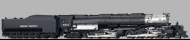
With a total weight of 548,3t and a power of 6.290 HP (@48 km/h) the Union Pacific Railroad (UP) class 4000 locomotives (well know as "Big Boy") is one of the most powerful steam locomotives on the world. The American Locomotive Company (ALCO) built a total of 25 units between 1941 and 1944. At a maximum speed of 112 km/h (70mph) the Big boy is also the fastest articulated steam engine at all.
H0 N XL L M4
- Article numbers
- 54411, 64411, 54811, 54511, 54311
- Last change
- 8/2/2016
- Manufacturer
- ESU
License Agreement
1. GRANT OF LICENSE
1.1 ESU grants you a non-transferable, limited, non-exclusive right to use the Content solely for your own personal purposes. You may load the Content into RAM, as well as installation on a hard disk or other storage device on a single computer, hardware product or mobile device owned by you or under your control. The installation process may result in a copy of the Content residing on your computer, in which case, you may retain one (1) copy of the Content on your computer, provided that you retain all copyright and other proprietary notices on the copy and the copy is kept in your possession with the original.1.2 By using the Content, you shall not obtain any ownership, copyright, proprietary or other interest in or to the Content. The Content is licensed, not sold.
1.3 You are licensed to use, modify and combine the Sound Samples with sound samples provided by third parties, to create your own sound compositions which, subject to you complying with the terms of this Agreement, you are free to distribute as you wish provided that: (i) the Sound Samples have been mixed together to create an original work; (ii) individual Sound Samples are not used in isolation and (iii) the Sound Samples or derivatives are not used to create sound libraries for distribution to third parties.
2. PROHIBITED USES
Neither you, nor anyone at your direction, shall:2.1 use the Content, or any part of it, for any public performance, live broadcast or time delayed live broadcast where the Content is used unattended for commercial purposes without ESU' s prior written consent;
2.2 use the Content, or any part of it, in any competitive product;
2.3 sub-license, copy, reproduce, transmit, assign, rent, sell, lease, offer on a pay-per-play basis, distribute for money or any other consideration, or commercially exploit in any other manner or through any medium whatsoever or otherwise transfer in any way the Content or any part thereof;
2.4 manufacture and/or distribute for money or otherwise commercially exploit any product that incorporates any part of the Content. If you wish to use any part of the Content for manufacture, resale, sub-license or further distribution, you must contact ESU (and where relevant, its licensors) to enter into an appropriate agreement with ESU (and, where relevant, its licensors);
2.5 publish the results of any analysis or comparative evaluation of the Content or any part thereof without ESU' s prior written consent;
2.6 reverse engineer, recompile or disassemble any part of the Content except to the extent and in the circumstances expressly permitted by ESU and its licensors in writing or by law;
3. INTELLECTUAL PROPERTY RIGHTS
You acknowledge that all intellectual property rights in the Content are and shall remain vested in ESU and its licensors. You undertake not to interfere with or diminish, whether by act or omission, the rights, title and interest in the Content of ESU and its licensors. You may be held responsible by ESU and/or any of its licensors for any infringement of any intellectual property rights in the Content. For the avoidance of doubt, provided that you comply with the terms of this Agreement, ESU shall not claim ownership of the intellectual property rights in any compositions created by your use of the Content.4. TERM AND TERMINATION
This Agreement is effective from the first date you install the Content. The rights granted to you under this Agreement shall terminate if you fail to abide by its terms. Upon such termination you agree to destroy the Content including any Content stored on the hard disk of any computer under your control. You may terminate this Agreement at any time by destroying or erasing all your copies of the Content. Any termination of this Agreement (howsoever occasioned) shall not affect any accrued rights or liabilities of you or ESU nor shall it affect the coming into force or the continuance in force of the provisions of Clauses 2, 3, 5 and 6 and any provision hereof which is by implication intended to come into or continue in force on or after such termination.5. NO WARRANTIES
TO THE MAXIMUM EXTENT PERMITTED BY APPLICABLE LAW, ESU AND ITS LICENSORS PROVIDE THE CONTENT "AS IS" AND ESU EXCLUDES ON BEHALF OF ITSELF AND ITS LICENSORS, ALL CONDITIONS, TERMS, REPRESENTATIONS (OTHER THAN FRAUDULENT REPRESENTATIONS) AND WARRANTIES RELATING TO THE CONTENT, WHETHER IMPOSED BY STATUTE OR BY OPERATION OF LAW OR OTHERWISE, INCLUDING BUT NOT LIMITED TO, IMPLIED WARRANTIES OF SATISFACTORY QUALITY AND FITNESS FOR A PARTICULAR PURPOSE. NEITHER ESU NOR ITS LICENSORS WARRANT THAT THE OPERATION OF THE CONTENT WILL BE UNINTERRUPTED, ERROR FREE, VIRUS FREE OR MEET YOUR SPECIFIC REQUIREMENTS. YOU MAY HAVE OTHER RIGHTS THAT VARY FROM JURISDICTION TO JURISDICTION.6. ESU's LIABILITY
Neither ESU nor its licensors shall have any liability to you for any loss or damage caused directly or indirectly in connection with the Content, any part thereof or this Agreement, except to the extent that such liability cannot be lawfully excluded. In any case, neither ESU nor its licensors shall be liable for any loss of business, data, profits, savings, or any other special, incidental, consequential, indirect or economic loss whatsoever even if such losses were contemplated at the date of this Agreement.7. GENERAL
7.1 You acknowledge that damages alone might be insufficient remedy for any breach of the terms of this Agreement and that the remedies of injunction, specific performance or other equitable relief would be suitable remedies in the event of any breach or threatened breach of this Agreement.7.2 You may not assign or otherwise transfer all or any part of this Agreement or the rights granted to you hereunder.
7.3 ESU is not obliged to provide any maintenance, technical support or upgrades to you.
7.4 You agree to comply with all applicable import and export regulations and acknowledge that you have the responsibility for obtaining all necessary licenses to export, re-export, transfer or import the Content.
7.5 This Agreement constitutes the entire agreement between you and ESU with respect to the subject matter hereof and supersedes all prior agreements, arrangements and understandings between the parties and constitutes the entire agreement between the parties relating to such subject matter hereof. No addition to or modification of any provision of this Agreement shall be binding upon ESU and you unless made by a written instrument signed by a duly authorized representative of ESU and you.
7.6 No forbearance, delay or indulgence by either party in enforcing the provisions of this Agreement shall prejudice or restrict the rights of that party nor shall any waiver of its rights operate as a waiver of any subsequent breach and no right, power or remedy herein conferred upon or reserved for either party is exclusive of any other right, power or remedy available to that party and each such right, power or remedy shall be cumulative.
7.7 Notwithstanding that the whole or any part of any provision of this Agreement may prove to be illegal or unenforceable the other provisions of this Agreement and the remainder of the provision in question shall remain in full force and effect.
If you download the designated file, you agree to be legally bound by the license given above.