SP Cab Forward LokSound Select Retail Soundfiles
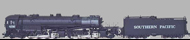
Cab Forwards were designed to keep the crews from getting asfixiated from smoke while long tunnels. While a few other railroads considered purchasing the design, only the Southern Pacific Railroad ever bought any. Many wheel arrangements were used but most of them were of the 4-8-8-2 design.
Many Cab Forwards also contained a Seperate Air Horn. This Sound Profile also contains the ability to play this horn sound using Function 12. (remappable if desired)
AC-6 through AC-12 Cab Forwards Used more…
SP Cab Forward 4-8-8-2 LokSound 5 North American and Australian Sound files  H0
H0
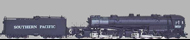
Cab Forwards were designed to keep the crews from getting asfixiated from smoke while long tunnels. While a few other railroads considered purchasing the design, only the Southern Pacific Railroad ever bought any. Many wheel arrangements were used but most of them were of the 4-8-8-2 design.
AC-6 through AC-12 Cab Forwards Used a Saturated airpump mounted on the front of the boiler. These had a very distinct sound which we have gone through great lengths to duplicate.
Whistles:
CV163=0 UP more…
BR05 001 /BR05 002 /BR05 003 LokSound V4.0 European Soundfiles
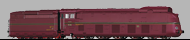
In 1935 German manufacturer Borsig had delivered 4-6-4 steam locos 05 001 and 002 for Deutsche Reichsbahn Gesellschaft DRG for fast passenger service. 05 003 had been delivered in 1937 with cab forward design. After WW II DB rebuilt the locos without streamline body and used them till 1958.
BR 05 003 LokSound V4.0 & LokPilot V4.0 for Factory Equipped Locomotives
In 1935 German manufacturer Borsig had delivered 4-6-4 steam locos 05 001 and 002 for Deutsche Reichsbahn Gesellschaft DRG for fast passenger service. 05 003 had been delivered in 1937 with cab forward design. After WW II DB rebuilt the locos without streamline body and used them till 1958.
BR 52 Kondenstender DRB LokSound 5 European Sound files H0
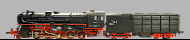
From 1942 the class 52 was derived from the light but powerful class 50 goods train tender locomotive developed from 1937 and mass-produced from 1939. Despite numerous simplifications, the war locomotive with 1640 hp had the same performance as the 50 and also reached 80 km/h when driving forwards. Initially, smoke deflectors were also dispensed with, but after a short time smaller Witte plates were retrofitted compared to the 50. So that the locomotives could withstand the winter in the more…
Kittel Dampftriebwagen LokSound 5 European Sound files H0

In the early 1900s, several state and private railways attempted to reduce operating costs by using steam railcars on lightly used routes. The design of one of the most successful types was penned by Eugen Kittel. At one end of the vehicle was the standing boiler integrated into the driver's cab, the equipment required to operate it, the coal box and a seat for the conductor. A stoker with control authorization was allowed to drive the steam railcar. At this time, the conductor was in the more…
BR 64 - Piko LokSound V4.0 European Soundfiles

The Class 64 steam locomotive entered service at former Deutsche Reichsbahn-Gesellschaft in 1928. The multipurpose loco had been used for light passenger and freight service on main and branch lines. A maximum speed of 90 km/h made her a popular runner until scrap in the early 1970s. Today some locos belong to railroad museums that are used in service on fan trip trains.
This file had been designed exclusively for use in 2013 edition of Piko G scale model of BR 64.
Engine illumination – more…
G 4/5 LokSound V4.0 & LokPilot V4.0 for Factory Equipped Locomotives

steam loco G 4/5 H of the Royal Bavarian State Railroad, aka DRG BR 56.8; type 2-8-0, 4 cylinders
It was the largest, most powerful and most modern German locomotive with this wheel arrangement. The last ones were taken our of service in 1947. Now the G 4/5 H is making its comeback as a Brawa H0 gauge model in two versions with fascinating details. High quality: chassis, wheels and rigging in die-cast zinc. Affectionate: details such as a fully functioning drive train, true-to-original back more…
BR05 Einheitslok DRG DB LokSound 5 European Sound files H0

In 1935, Borsig developed the 2'C2' engines 05 001 and 002, which were equipped with streamlined cladding, for the Deutsche Reichsbahn-Gesellschaft (DRG) to pull light express trains at speeds of over 140 km/h. A third locomotive was given an enclosed driver's cab and was coupled to the tender at the smokebox end. The three-cylinder engine developed 2360 hp and accelerated the racers to 175 km/h. During test runs, 05 002 reached 200.4 km/h with a 197-ton test train, making it the fastest German more…
BR05 003 DRG LokSound 5 European Sound files H0

In contrast to the 05 001 and 002, which were equipped with hard coal firing, the third locomotive of the series was ordered from Borsig in 1937 with a front driver's cab for a better view of the track. This involved coupling the locomotive with the smokebox end to the tender and equipping it with a coal dust firing system of the AEG type. The tests with the locomotive were less than satisfactory and so the DRG converted the machine into a conventional steam locomotive with hard coal firing and more…