ET 426 LokSound V4.0 & LokPilot V4.0 for Factory Equipped Locomotives
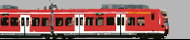
The regional railcars in the 426 series are used throughout the DB AG network. The 426 railcar has two units and achieves a maximum speed of 160 km/h. The two final bogies are driven, and the central Jacobs-type bogie is not driven. The total installed power is 1,175 kW. When the railcar is braked, electrical energy can be fed into the mains and the released heat can be used for heating purposes.
SNCF BB 26000 LokSound 5 European Sound files  H0
H0
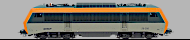
Between 1988 and 1998, the French national railway company SNCF purchased 234 BB26000 electric locomotives. Designed for operation with 1.5 kV direct current and 25 kV/50 Hz alternating current, these four-axle locomotives produce 5600 kW. Their two traction motors accelerate the locomotives, known as Sybics, to 200 km/h. After the SNCF was divided into business units, 139 locomotives, the majority of which went to the Fret freight division, and 20 to long-distance services. 14 were allocated more…
FS E626 LokSound 5 factory equipped sounds

Elektrolokomotive FS E 626 Ep.IV-V
Nach fünf Vorserienloks bestellten die Italienischen Staatsbahnen FS zwischen 1933 und 1935 insgesamt 268 Exemplare der sechsachsigen Ellok E626 in mehreren Serien. Jeweils zwei Achsen waren in einem Gestell zusammen gefasst. Die beiden Endgestelle waren drehbar, das mittlere starr gelagert. Die sechs Fahrmotoren des FS-Typs 32.200 leisteten zusammen 2100 kW, die Höchstgeschwindigkeit der Lok betrug 95 km/h.
Auscision 85 Class LokSound 5 North American & Australian factory Equipped Sound files

Equipped with ESU "FULL THROTTLE" features!
MUST use LokProgrammer Version 5.0.0 or newer
Auscision Models NSW 85 Class Electric Locomotive
There are up to 16 separate horns included on this one sound profile! All changeable using seperate CVs. However only the Nathan Airchime P5 is applicable for this locomotive.
Horn: (SoundCV9)
CV163=0 Nathan Airchime P5
Brake Squeal (SoundCV11)
CV165=0 Composition Shoe
CV166=1 Cast Iron Shoe
FULL THROTTLE features:
Drive Hold: Logic Function, Mapped more…
Auscision 86 Class LokSound 5 North American & Australian factory Equipped Sound files

Equipped with ESU "FULL THROTTLE" features!
MUST use LokProgrammer Version 5.0.0 or newer
Auscision Models NSW 86 Class / 8650 Electric Locomotive
There are up to 16 separate horns included on this one sound profile! All changeable using seperate CVs. However only the Nathan Airchime P5 is applicable for this locomotive.
Horn: (SoundCV9)
CV163=0 Nathan Airchime P5
Brake Squeal (SoundCV11)
CV165=0 Composition Shoe
CV166=1 Cast Iron Shoe
FULL THROTTLE features:
Drive Hold: Logic Function, more…
EMD/ASEA AEM-7/ALP-44(FT) LokSound Select Retail Soundfiles

Equipped with ESU "FULL THROTTLE" features!
MUST use LokProgrammer Version 4.4.21 or newer
AEM-7/ALP-44
The AEM-7 is a twin-cab four-axle 7,000 hp (5.2 MW) B-B electric locomotive built by Electro-Motive Division (EMD) and ASEA between 1978–1988. The locomotive was a derivative of the Swedish SJ Rc4 designed for passenger service in the United States. The primary customer was Amtrak, which bought 54 for use on the Northeast Corridor and Keystone Corridor. Two commuter operators, MARC and more…
EMD/ASEA AEM-7/ALP-44(FT) LokSound V4.0 American & Australian Sound files
Equipped with ESU "FULL THROTTLE" features!
MUST use LokProgrammer Version 4.4.21 or newer
AEM-7/ALP-44
The AEM-7 is a twin-cab four-axle 7,000 hp (5.2 MW) B-B electric locomotive built by Electro-Motive Division (EMD) and ASEA between 1978–1988. The locomotive was a derivative of the Swedish SJ Rc4 designed for passenger service in the United States. The primary customer was Amtrak, which bought 54 for use on the Northeast Corridor and Keystone Corridor. Two commuter operators, MARC and more…
E32 / BR 132 LokSound 5 factory equipped sounds H0

In 1924 German Deutsche Reichsbahn-Gesellschaft DRG received the first sample of side rod equipped electric loco E32. The 29 locos developed 1170 kW and reached a maximum speed of 75 km/h. In the 1930s eight locos were re-geared for a maximum speed of 90 km/h. In 1971 the last remaining locos quitted service at the DB.
*** This project file is made to be used with the PIKO model of E32, released in 2021. Please use a 58412 LokSound 5 with PluX22 interface. ***
Engineer/driver mode:
F18 - more…
BR 151 LokSound 5 factory equipped sounds H0
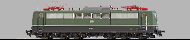
*** This project file is adjusted for the use in Piko's BR 151 model. Please download this file to a LokSound 5 58412 with PluX22 interface.****
BR151 For around 40 years the Class BR 151 represented the most important type for traction of fast and heavy freight trains for the State Railway of Federal Republic of Germany (DB). At the time of origin in more…
ET403 DB LokSound 5 European Sound files H0
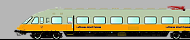
In 1973, the Deutsche Bundesbahn DB received three electric multiple units for inter-city express transport. All 16 axles of the four-part vehicle were powered. As was usual at the time, the trains only had first class places. Due to the small number of units, various assemblies from the already proven ET 420 S-Bahn multiple unit were installed, which enabled a reasonably secure stock of spare parts for wearing parts. The output was 3840 kW, the maximum speed in passenger operation was 200 more…