BR 96 bay. Gt 2x 4/4 LokSound 5 European Sound files  H0
H0
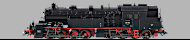
From 1913 onwards, the Bavarian State Railway purchased a total of 15 samples of the Gt 2x 4/4 Mallet tank locomotive to push heavy freight trains on the steep routes in the Franconian Forest and Thuringian Forest. Although the 1,470 hp eight-axle locomotives were considered the most powerful tank locomotives in Europe at the time, manufacturer Maffei was able to limit the maximum axle load to 15.5 t, which is why the powerful locomotives could even be used on branch lines. With various more…
BR 98.8 Bayr. GtL 4/4 LokSound 5 European Sound files H0

From 1911 onwards, Krauss delivered 117 examples of the GtL 4/4 two-cylinder local railway locomotive in several series to the Bavarian State Railways. The Deutsche Reichsbahn-Gesellschaft DRG received the last 17 in 1927 and grouped them as the 98.8 series. With an output of 450 hp, the four-couplers were the most powerful Bavarian local railway machines. The DRG only considered the top speed of 40 km/h to be in need of improvement and equipped the most recently delivered locomotives with a more…
Kittel Dampftriebwagen LokSound V4.0 European Soundfiles

Steam rail car, type "Kittel", manufactured by Maschinenfabrik Esslingen, Germany
T18 DB Ep. III LokSound 5 factory equipped sounds H0

The Prussian Railway Administration KPEV had a total of 462 examples of the 1140 hp 2'C2' T18 tank locomotives built between 1912 and 1923. The manufacturer Vulcan delivered twenty machines to Württemberg in 1919. The original task was to transport fast passenger trains on short connections. The two-cylinder locomotives could be used forwards and backwards at 100 km/h and thus did not have to be turned at the end point. In a Prussian way, the locomotives designated as class 78.0-5 from the more…
T18 DRG Ep. II LokSound 5 factory equipped sounds H0
The Prussian Railway Administration KPEV had a total of 462 examples of the 1140 hp 2'C2' T18 tank locomotives built between 1912 and 1923. The manufacturer Vulcan delivered twenty machines to Württemberg in 1919. The original task was to transport fast passenger trains on short connections. The two-cylinder locomotives could be used forwards and backwards at 100 km/h and thus did not have to be turned at the end point. In a Prussian way, the locomotives designated as class 78.0-5 from the more…
T18 SNCF Ep.III LokSound 5 factory equipped sounds H0
Between 1915 and 1918, the Reichseisenbahnen Elsass-Lothringen (EL) procured a total of 27 examples of the 1140 hp Prussian tank locomotive T18. After the First World War, 26 of these were transferred to the now French successor railway Chemins de Fer d'Alsace et de Lorraine (A.L.) while retaining the original numbers. Only rarely did the reliable locomotives leave Alsatian territory. Like the German railways, the A.L. changed the brake system on their T18 and allowed the machines to run at 100 more…
BR 80 DB Ep-III LokSound 5 factory equipped sounds H0

In order to replace uneconomical old worn out locomotives in shunting service, the Deutsche Reichsbahn-Gesellschaft DRG also included a shunting locomotive with an axle load of 18 t in the Einheitslok program. From 1928 the DRG put 39 copies of the 575 hp three-coupler into service. After the Second World War, 21 machines remained with the DR and 17 locomotives with the DB. Despite convincing operating characteristics, the DB stopped its 80 until 1965, as the new V60s were available in more…
BR 80 DRG Ep-II LokSound 5 factory equipped sounds H0
In order to replace uneconomical old worn out locomotives in shunting service, the Deutsche Reichsbahn-Gesellschaft DRG also included a shunting locomotive with an axle load of 18 t in the Einheitslok program. From 1928 the DRG put 39 copies of the 575 hp three-coupler into service. After the Second World War, 21 machines remained with the DR and 17 locomotives with the DB. Despite convincing operating characteristics, the DB stopped its 80 until 1965, as the new V60s were available in more…
UP Challenger 4-6-6-4 (FT) LokSound Select Retail Soundfiles
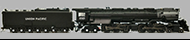
Equipped with ESU "FULL THROTTLE STEAM" features!
MUST use LokProgrammer Version 4.5.1 or newer.
The name Challenger was given to steam locomotives with a 4-6-6-4 wheel arrangement. This means that they have four wheels in the leading "pilot" truck, which helps guide the locomotive into curves; two sets of six "driving" wheels, and finally, four "trailing" wheels, which support the rear of the engine and its massive firebox. Each set of driving wheels has its own steam cylinder. In essence, more…
UP Challenger 4-6-6-4 (FT) LokSound V4.0 American & Australian Sound files
Equipped with ESU "FULL THROTTLE STEAM" features!
MUST use LokProgrammer Version 4.5.1 or newer.
The name Challenger was given to steam locomotives with a 4-6-6-4 wheel arrangement. This means that they have four wheels in the leading "pilot" truck, which helps guide the locomotive into curves; two sets of six "driving" wheels, and finally, four "trailing" wheels, which support the rear of the engine and its massive firebox. Each set of driving wheels has its own steam cylinder. In essence, more…