
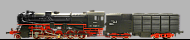
 From 1942 the class 52 was derived from the light but powerful class 50 goods train tender locomotive developed from 1937 and mass-produced from 1939. Despite numerous simplifications, the war locomotive with 1640 hp had the same performance as the 50 and also reached 80 km/h when driving forwards. Initially, smoke deflectors were also dispensed with, but after a short time smaller Witte plates were retrofitted compared to the 50. So that the locomotives could withstand the winter in the invading areas in the east, the driver's cab was closed all around and the frost protection of various assemblies was increased. Despite the simplifications, the problem of supplying feed water with as little lime as possible remained in the eastern war zones. The Wehrmacht commissioned Henschel to develop the 52 with a condensation device, since the company had already supplied such locomotives to the USSR and Argentina in the early 1930s. Compared to a normal 52, the exhaust steam does not escape through the chimney to the outside, but drives the turbine of the induced draft fan located at the front of the smoke chamber. In the tender there is another turbine driven by the steam and three fan wheels that cool the hot steam and allow it to condense. The water collected in this way is then available again as high-quality boiler feed water. Due to this complex technology, the condensation locomotive lacks the exhaust hammer typical of normal steam locomotives. The whine of the turbines and fan wheels, on the other hand, is acoustically distinctive. The locomotives delivered 1520 hp and reached a top speed of 80 km/h. In the Soviet Union it was customary to turn locomotives across triangles, which is why the large total wheelbase of the condensate locomotives equipped with a five-axle tender was not relevant there. In areas with turntables, however, the locomotives and tenders could only be turned separately with great effort, which is why the locomotives were coupled to a four-axle type 2'2T13.5 Kon tender from 1987 onwards, with which the overall wheelbase fell to a turntable-compatible 21755 mm. Although the condensed locomotives had proven themselves excellently, both German state railways quickly retired their machines after the war due to a lack of demand, or coupled them with a standard tub-type tender.
| Key | Functions | Sound slots | Volume CVs | Volume values |
|---|
| F0 | front light | 16 | 379 | 13 |
| F1 | sound on/off | 1, 2, 9, 28, 29, 30, 31, 32 | 259, 267, 323, 475, 483, 491, 499, 507 | 52, 48, 75, 60, 7, 95, 255, 3 |
| F2 | whistle #1 | 3 | 275 | 180 |
| F3 | whistle #2 | 4 | 283 | 128 |
| F4 | coal shoveling | 5 | 291 | 65 |
| F5 | heavy load | | | |
| F6 | acceleration/brake time, shunting mode/shunting speed | | | |
| F7 | curve squeal | 15 | 371 | 88 |
| F8 | AUX#1 | | | |
| F9 | suction turbine radiator fan (while standing and slow driving) | 9 | 323 | 75 |
| F10 | conductor's signal | 10 | 331 | 48 |
| F11 | coupler clank | 8 | 315 | 70 |
| F12 | emergency braking | 23 | 435 | 105 |
| F13 | Set brake/Brake release (automaticly) | 13 | 355 | 55 |
| F14 | station announcement | 7 | 307 | 90 |
| F15 | ESU smoke generator | | | |
| F16 | safety valve | 12 | 347 | 128 |
| F17 | brake function 1 | 25 | 451 | 55 |
| F18 | water refill | 18 | 395 | 70 |
| F19 | water pump (slow) | 21 | 419 | 45 |
| F20 | injector #1 | 20 | 411 | 47 |
| F21 | injector #2 | 22 | 427 | 47 |
| F22 | dumping | 19 | 403 | 85 |
| F23 | turbo generator off/on | | | |
| F24 | air pump (slow) | 6 | 299 | 50 |
| F25 | sanding valve | 11 | 339 | 40 |
| F26 | sound fader | | | |
| F27 | disable brake squeal sound | | | |
| F28 | train driver's dialog | 14 | 363 | 90 |
| F29 | air pump (fast) | 27 | 467 | 50 |
| F30 | water pump fast | 26 | 459 | 45 |
| F31 | rail clank | 17 | 387 | 60 |
Make sure that index CV31 is set to 16 and index CV32 is set to 1 before changing a volume CV.