
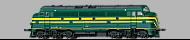
 After the Second World War, various European locomotive manufacturers began developing diesel-electric locomotives, which began to displace steam traction in the USA. In Sweden, Nydqvist and Holm AB (NoHAB) acquired the license to manufacture diesel locomotives for the Electro-Motive Division (EMD) in 1949. The Americans owned an export version of the F-series with 2-stroke-diesel, which had a driver's cab at both ends. For the lighter superstructure in Europe, locos were equipped with six instead of four axles. Customer could choose between six (Co'Co wheel alignment) or four (A1A) (A1A) driven axles. The Belgian State Railways SNCB/NMBS ordered a total of 40 of the all-axle-driven licensed Nose locomotives delivered between 1955 and 57 from the local manufacturer AFB. 17 locomotives were run with 1720 hp (at 900 rpm) engines 16-567 C, a top speed of 120 km/h and steam boilers as class 202 (later 52). During production, four of the locomotives were branched off and delivered as 1601-1604 to the Luxembourg State Railways CFL. The 203 series (later 53 series) had to run without a boiler with the same key data as the 202. With an output of 1900 hp (at 900 rpm) and a steam boiler, the four 204 (later series 54) were specially geared to 140 km/h for cross-border TEE traffic to Germany and France.
 Different starting processes can be selected with F1: 1x press button = warm start / press button 2x = false start / press button 3x = cold start
F5 enables the heavy load mode: The diesel notch is always one up compared with normal operation. If you want to jump two notches, simply set CV 104 to 170 (instead of 150).
F27 turns on the manual ntoching. Once F28 is on, you can use F28 to notch up and F29 to notch down. F27, F28, and F29 must be turned off to return to normal mode. If F27 is off and you press F28, the prime mover will run to full speed.
F17 will bring the locomotive to full stop.