
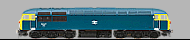
 Between 1976 and 1984, British Rail had 135 examples of the six-axle class 56 freight locomotive built. The final production of the first 30 of the series created according to BR plans was carried out with sub-assemblies in Romania at Electroputere. The following locomotives were assembled in England. The 16-cylinder Ruston-Paxman 16RK3CT diesel engine produced 2625 kW and generated the power for the six traction motors. In favor of reliability, the power was reduced to 2420 kW at 900 rpm. The Class 56 did not have a train heating equipment, which is why the gear ratio for the maximum speed of 129 km/h suitable for passenger trains is somewhat surprising. For particularly heavy trains, the six-axle vehicles received multiple traction control. The first shutdowns took place after only 20 years of operation. In the 2010s, for example, the railway companies GB Railfreight and Colas Rail still used Class 56s for medium-heavy freight duty. GB Railfreight plans to repower some of their 16 Class 56s with EMD 12-710 12-cylinder engines and re-run as Class 69s.
 Different starting processes can be selected with F1: 1x press button = warm start / press button 2x = false start / press button 3x = cold start
F2 slows down the locomotive slowly.
F5 enables the heavy load mode: The diesel notch is always one up compared with normal operation. If you want to jump two notches, simply set CV 104 to 150 (instead of 130).
F8 turns on the manual ntoching. Once F8 is on, you can use F7 to notch up and F6 to notch down. F8, F6, and F7 must be turned off to return to normal mode. If F8 is off and you press F7, the prime mover will run to full speed.
F14, F18 and CV 170 value 0 or 1, can switch between a "normal announcement" or an announcement "with gong".
F9 can increase the speed of the spirax valve by double-clicking it. The speed levels are slow, medium and fast.
17 will bring the locomotive to full stop.
F21 and CV 168 = value 0 or 1, can switch between a "normal" or a "squeaking" wiper.
F28 and CV 164 = Value 0, 1, 2 or 3, can switch between different rail joints (three coupler can be activated with CV 165 = value 1).
F29 and CV 169 = value 0 or 1, can switch between the "Automatic Warning System (AWS)" or the "Train Protection and Warning System (TPWS)".