
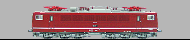
 To haul fast and heavy passenger and freight trains on electrified main lines, the Deutsche Reichsbahn (DR) developed the Class 250 electric locomotives in the early 1970s. With a power output of 5400 kW, the 273 six-axle locomotives built between 1974 and 1984 were the most powerful electric locomotives in the DR's fleet. Reaching speeds of up to 125 km/h, the Class 250 could even haul express trains, as the maximum permissible line speed in East Germany was 120 km/h. Classified as Class 155 by DB AG, these locomotives were originally slated to cease major overhauls in 1995, a decision that was reversed because DB still required these reliable locomotives. More than 30 examples are currently (as of 2025) still operational with private railway companies.
Engineer/driver mode:
F4 - Pantograph up / down (only available in Engineer/driver mode). Engineer/driver mode switch on with CV170 = 1, Engineer/driver mode switch off with CV170 = 0)
The Engineer/driver mode serves as a prototypical control of the train. The realistic start up process and the current-dependent processes are activated.
***Please note! In Engineer/driver mode, the train only reacts when the pantograph is up***
Heavy load operation:
F5 - Activates heavy load operation. The acceleration now takes noticeably longer and the electric motors work harder.
Braking functions:
F12 - Brake function 1 with brake fan sound. Downhill simulation (speed reduction with CV179 and CV182 adjustable). Train significantly reduces the speed.
F17 - Brake function 2 with brake valve sound. Trains brakes to a standstill.
Radiator fan automatic:
F15 - When stationary and fan button off:
Press once = fan on
Press twice briefly = fan stops running after driving when stationary.
If fan button is permanently active = fan remains on until button is switched off.
Deactivate braking Sound:
F27 - Deactivates brake squeal Sound when the train stops. (4 different brake squeal sounds with CV165 value 0-3 selectable)
F14 - Station Announcement #1: Announcements selectable via CV169: (0=randomized Announcement, 1=Ulm, 2=Cologne, 3=Mainz, 4=Munich, 5=Mannheim, 6=Salzburg, 7=Stuttgart, 8=Dortmund, 9=Duisburg, 10=Augsburg)
CV168 allows you to choose between announcements in Standard German (value = 0) and Saxon German (value = 1) as well as shunting radio.