
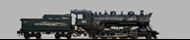
 Strasburg Rail Road (Great Western) No. 90 is a 2-10-0 "Decapod" type steam locomotive owned and operated by the Strasburg Rail Road outside of Strasburg, Pennsylvania. Built by the Baldwin Locomotive Works in 1924, No. 90 originally pulled sugar beet trains for the Great Western Railway of Colorado. In 1967, No. 90 was sold to the Strasburg Rail Road where it now resides and operates today for use on excursion trains. As of today, No. 90 is one of only two operational Decapod type steam locomotives in America, the other being Frisco No. 1630 at the Illinois Railway Museum in Union, Illinois.
 The locomotive was built by the Baldwin Locomotive Works in June 1924, in Philadelphia. it originally pulled sugar beet trains of about 40 to 50 cars length for the Great Western Railway of Colorado to the company's towering mill in Loveland, Colorado. It was the Great Western's largest and most powerful road locomotive, and saw extensive use on trains too large for the company's fleet of 2-8-0s. On November 7, 1944, the engine was hit by a truck at a grade crossing east of Loveland and knocked onto its fireman's side, killing both the fireman and the truck driver. The Great Western sent 90 to the Chicago, Burlington and Quincy Railroad's shops in Denver for repairs. Following WWII, the locomotive was used primarily in the Autumn during the harvest season.
By the late 1950s, the engine was occasionally used in excursion service on the Great Western. In 1963, No. 90 pulled a few special excursions for that year's National Railway Historical Society Convention, were it was held in Denver at the time. On one such excursion, Strasburg Rail Road's Chief Mechanical Officer, Huber Leath, met the Great Western's superintendent, a man who grew up in the vicinity of the Strasburg Rail Road and struck a deal in which the Great Western would contact the Strasburg Rail Road as soon as the engine was available for purchase. The Strasburg Rail Road purchased No. 90 on April 5, 1967, for a price of $23,000.00(~$175,000 in 2019) and the locomotive arrived on Strasburg's property a month later on May 5, 1967.
In the winter of 1968, Ross Rowland's High Iron Company planned to operate a series of mainline steam excursions between Jersey City, New Jersey and Wilkes-Barre, Pennsylvania on the Central Railroad of New Jersey. Rowland had originally planned to lease two ex Canadian Pacific G5-class 4-6-2s, numbers 1238 and 1286, both owned by George M. Hart. However, those two locomotives were on emergency leases to the city of Reading, Pennsylvania to provide steam for the city after the boiler at the Reading Steam Heat and Power Co. became disabled. Since tickets for the excursion had already been sold, and Rowland was unwilling to pull the trip with a diesel, he leased Steamtown's ex Canadian Pacific 127 (formerly 1278), a sister to the two locomotives he intended to use to pull the train. However, the 127 did not have enough power to pull the train over the grades on the CNJ near Jim Thorpe, Pennsylvania on her own and Rowland leased the 90 to act as a helper engine for the trips, double-heading with the 127 between Bethlehem and Jim Thorpe, Pennsylvania. After the trips concluded, No. 90 was returned to Strasburg.
As it was on the Great Western, the engine is also the most powerful of the four steam locomotives in operation at the Strasburg Rail Road in Lancaster County, Pennsylvania, rated for 1,211 tons on the line. It is currently one of the only two 2-10-0 Decapods operating in the United States, the other one is former Frisco No. 1630, which operates at the Illinois Railway Museum.
No. 90 has had numerous modifications during its time at Strasburg, the most recent being in 2013, in which it was repainted in a new paint scheme similar to what it originally wore back in the 1990s. Differences include the yellow pin striping and lettering, which is currently painted / stenciled in white. Its smokebox was painted silver, and its number plate was black. In 2015, No. 90 went through another modification, where its smokebox color changed from silver to brown. After this modification, 90 was to return to service in February 2016. As of January 2023, No. 90 is still operational, but in early 2024, it is currently undergo its Federal Railroad Administration (FRA) federally mandated 1,472-day boiler inspection and overhaul.
Whistles:
CV163=0 SCR #90
CV163=1 SP&S 3-Chime
CV163=2 PRR 3-Chime
CV163=3 NKP #765
CV163=4 MILW #261
CV163=5 Hooter
CV163=6 Hancock Long Bell 3-Chime
CV163=7 DRGW #346
Bells:
CV164=0 #90 SCR Bell 1
CV164=1 Pnuematic Bell 2
CV164=2 Rope Pull Bell
CV164=3 SOO Line 1003 Bell
Brake Squeal:
CV165=0 Brake Squeal #1 Long
CV165=1 Brake Squeal #1 Short
CV165=2 Brake Squeal #2 Long
CV165=3 Brake Squeal #2 Short
CV165=4 Brake Squeal #3 Long
CV165=5 Brake Squeal #4Short
Dynamos:
CV166=0 SCR #90 Dynamo
CV166=1 K27 463 Dynamo
Air Pumps
CV167=0 Cross Compound #1 Soo Line 1003
CV167=1 Cross Compound #2 K27 463
CV167=2 Single Stage #1 Z27
CV167=3 SCR #90
Reversers
CV168=0 Johnson Bar
CV168=1 Power Reverse
The ESU Full Throttle Steam files now include a few new logic features for added operational realism while still leaving you in control of HOW YOU wish to run your locomotive.
Heavy Load: F9 by default.
Similar to the “Drive Hold” button on the Full Throttle Diesel files “Heavy Load” allows you to adjust the “Steam Cut Off Valve” at any speed allowing for a fierce full chuff or drifting with snifters and rod clanks. Heavy load can also act as an offset allowing speed adjustments when engaged if desired.
Coast: F4 by default.
Opposite of “Heavy Load” Coast allows for a negative offset allow drifting sounds of Rods and snifter valves at any speed. You again have the option to hold the speed to adjust the speed with this offset active. Even allowing for an increase of speed with no chuffs as if drifting downhill.
Independent brake: F10 by default
Identical to the Full Throttle Diesel files. This allows for the locomotive to stop more quickly than its regular momentum would normally carry it. This one is pretty self-explanatory – just press the brake and come to a stop! For additional options there are 3 Braking rates that can be set up for user preference.
Articulation: Sound Slot 2
By adding Sound Slot 2 to the F8 Function Mapping and enabling the "Secondary Trigger" (CV250) you can add a second set of drivers making any ESU Steam File articulated.
Function Mappable Air Horn: F21 by default
Sound Slot 21.
Many Steam locomotives had a single chime airhorn equipped. Those modelling SP, MILW, and others can now have this feature and put it where they would like in the function mapping in addition to the whistle.
S0799 - Release Notes
===================================================
V-1 R-1:
===================================================
- new project